










We have all attempted to work from a dining table or an improvised corner, only to realize that environment dictates performance. The distinction between a makeshift setup and a professional-grade workspace lies entirely in the curation of your office space furniture. As a designer, I tell my clients that this isn't just about buying a desk; it is about architectural planning for your productivity. The goal is to balance ergonomic necessity with a visual narrative that makes you actually want to sit down and work.
Quick Decision Guide: What Matters Most
If you are rushing to furnish your workspace, prioritize these four pillars to ensure long-term satisfaction and functionality:
- Ergonomics & Adjustability: Look for chairs with lumbar support and synchro-tilt mechanisms. Your body should be supported dynamically, not statically.
- Scale & Proportion: Measure your footprint. A massive executive desk in a 10x10 room creates claustrophobia, while petite furniture in a loft feels temporary.
- Material Durability: High-pressure laminate (HPL) offers scratch resistance for heavy use, while solid wood provides warmth and character but requires coasters.
- Wire Management: Ensure desks have integrated grommets or channels. Visual clutter leads to mental clutter.
The Foundation: Prioritizing Ergonomics Over Aesthetics
While I love a sculptural chair as much as the next designer, your primary work chair is a machine for living, not just an accent piece. When selecting seating, focus on the "engine" under the seat. A high-quality task chair must offer seat depth adjustment (seat pan slide) to accommodate your leg length. If the edge of the chair hits the back of your knees, you are cutting off circulation, which leads to fatigue by 2:00 PM.
The Desk Silhouette
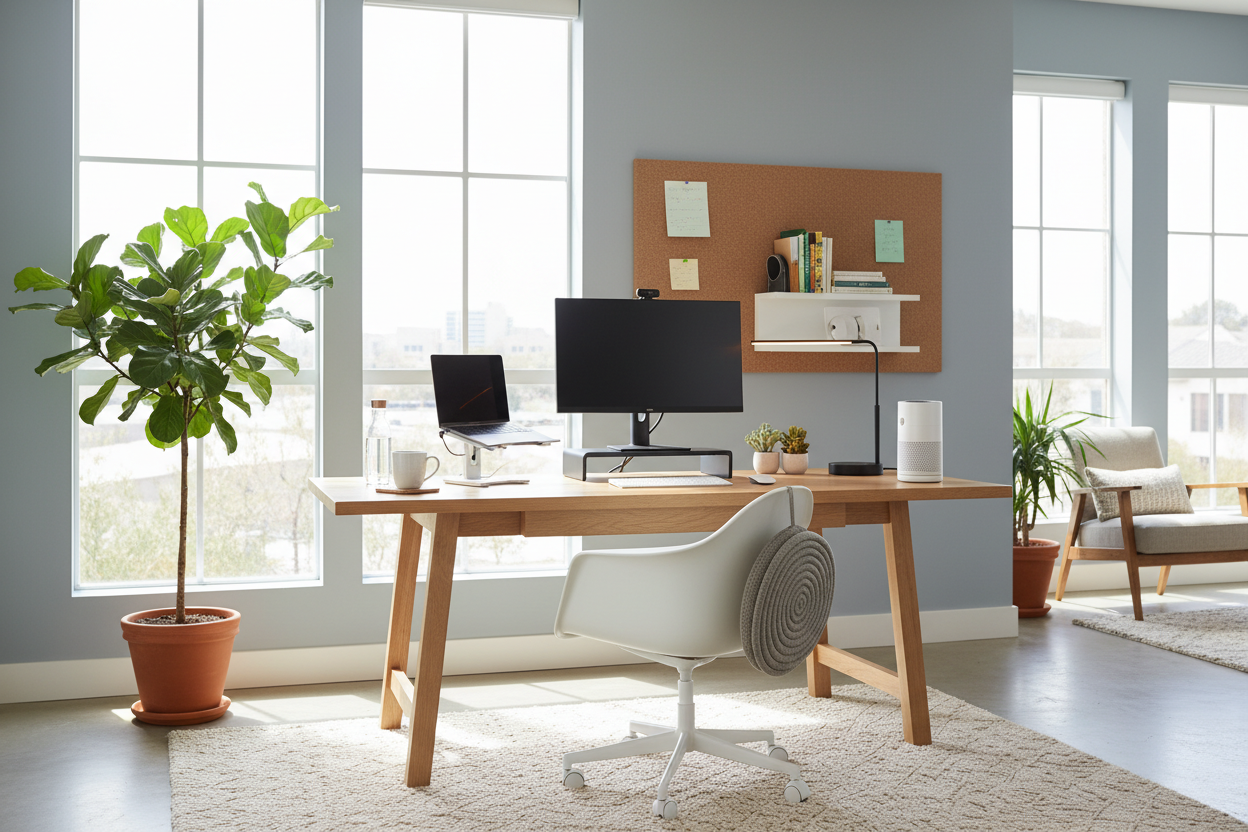
For the desk, consider the workflow. The trend has shifted away from bulky pedestal desks toward lighter, architectural silhouettes with open legs. This increases the perceived space in the room. However, if you opt for a sit-stand mechanism, ensure the base is weighted heavily enough to prevent wobble at the maximum height setting—a common failure point in budget options.
Materiality: Choosing Furniture for Office Space
The tactile experience of your workspace influences your mood. When sourcing furniture for office space, the surface material is critical. Glass desks, while visually lightweight and modern, are cold to the touch and create harsh acoustic reflections. They also demand constant cleaning.
I often steer clients toward wood veneers or linoleum tops. Furniture linoleum specifically is a fantastic, underutilized material; it is matte, soft to the touch, resists fingerprints, and provides a perfect writing surface. If you prefer the grandeur of wood, ensure it is a commercial-grade veneer or a kiln-dried solid wood to prevent warping from the heat generated by laptops and monitors.
Spatial Planning and Light
Where you place the furniture is as important as the piece itself. Avoid the instinct to push your desk flush against a wall. Instead, try the "command position"—facing the door but not directly in line with it. This allows you to anchor the room with the desk, creating a focal point.
Pay attention to glare. Your monitor should be perpendicular to windows, not facing them or backing them. If space allows, incorporate a secondary seating area, like a lounge chair or a small meeting table. This change in posture allows for different types of thinking; creative work often flows better away from the screen.
My Personal Take on Office Space Furniture
I learned a hard lesson early in my career regarding "minimalist" design in a working office. I once specified a stunning, high-gloss white lacquer desk for my own studio. It looked incredible in photos—sleek, modern, pristine.
However, within a week, I realized the mistake. The high-gloss finish acted like a mirror, reflecting the overhead track lighting directly into my eyes, causing massive strain. Furthermore, the lack of a "modesty panel" or cable tray meant that every single power cord was visible, ruining the clean lines I had paid for. I spent the next weekend drilling into that beautiful lacquer to mount an ugly aftermarket wire basket underneath. Now, I always check the underside of a desk first. If the manufacturer hasn't thought about where the wires go, they haven't designed a desk; they've designed a table.
Conclusion
Investing in the right pieces is an investment in your own efficiency. By merging ergonomic science with sophisticated textures and thoughtful layout, you transform a room into a sanctuary for focus. Don't settle for utility alone; curate a space that respects your work.
Frequently Asked Questions
How much space do I need behind my desk for the chair?
You should allow at least 36 to 42 inches (approx. 90-105 cm) of clearance behind your desk. This allows you to slide the chair back comfortably to stand up and provides enough visual breathing room so the space doesn't feel cramped.
Is solid wood better than veneer for an office desk?
Not necessarily. While solid wood is durable and can be refinished, high-quality wood veneer over a stable core (like MDF) is often more stable in fluctuating temperatures and humidity, preventing cracking. Veneer also allows for more consistent grain matching across large surfaces.
How do I mix wood tones in a home office?
To avoid a chaotic look, identify the dominant wood tone (usually the desk or floor) and choose secondary pieces that share the same undertone (warm, cool, or neutral). Don't try to match them perfectly; instead, aim for deliberate contrast, such as pairing a dark walnut desk with lighter oak shelving.


Dejar un comentario
Este sitio está protegido por hCaptcha y se aplican la Política de privacidad de hCaptcha y los Términos del servicio.