










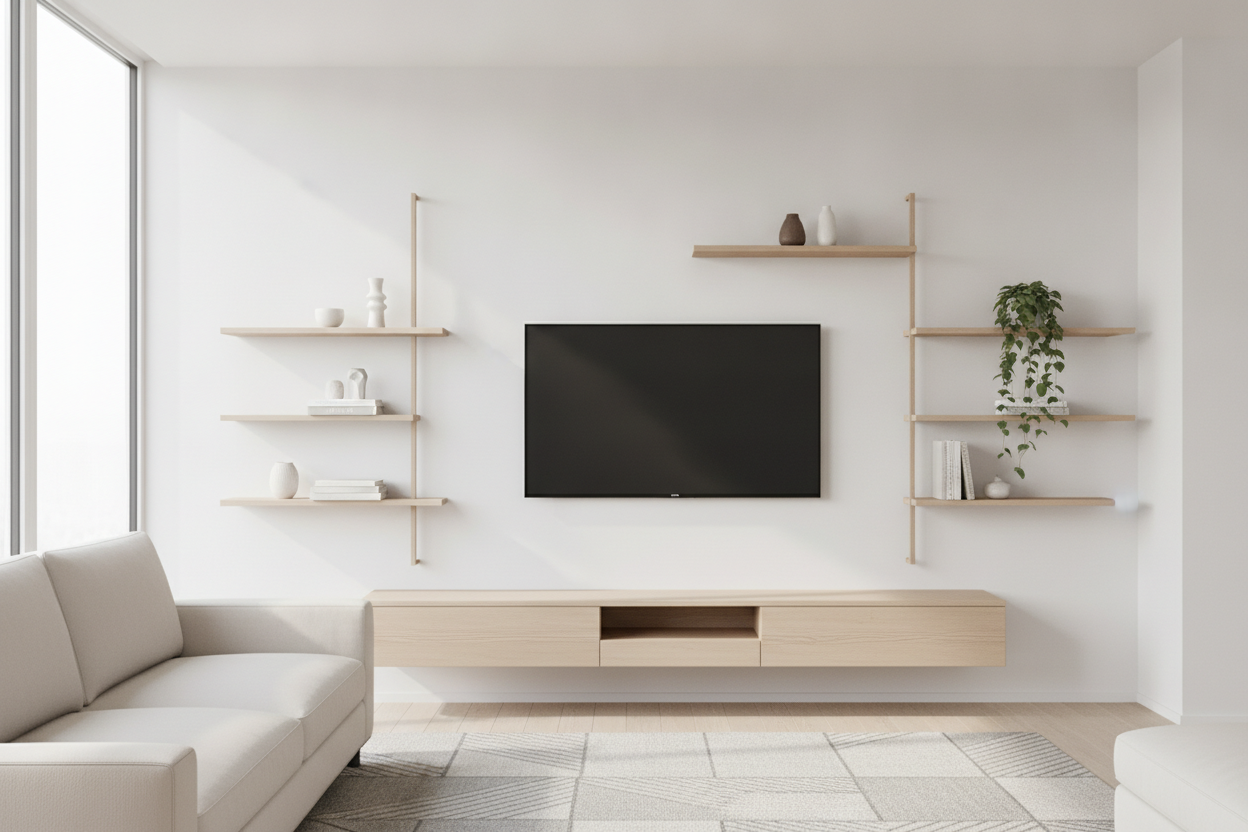
I spent four hours last Saturday measuring, leveling, and sweating over a stud finder, only to realize that once my 65-inch screen was finally up, the room looked... wrong. It had that 'waiting room' vibe—a big black rectangle floating on a vast, empty sea of drywall. The immediate impulse is to grab an on wall tv shelf to ground the space, but before you drill more holes, let’s talk about whether you actually need more furniture on your wall or if you’re just trying to fill a void.
Quick Takeaways
- Shelves are essential for housing soundbars and gaming consoles that shouldn't live on the floor.
- A floating shelf creates an airy look but offers zero hidden storage for ugly cables.
- Dust is the enemy; open shelving requires weekly maintenance.
- Sometimes a low-profile floor console is actually the more 'minimalist' choice.
The Minimalist Dilemma: To Shelf or Not to Shelf?
The dream of a mounted TV is a clean, wire-free aesthetic that makes your living room feel like a high-end gallery. But in practice, a lone screen often looks unfinished. Adding shelves for tv mounted to wall setups can provide a much-needed visual anchor. It bridges the gap between the floor and the screen, making the TV look like a deliberate part of the design rather than a tech-heavy afterthought.
However, there is a fine line between 'curated' and 'cluttered.' When you add a ledge, you’re inviting the eye to stop there. If that ledge is just holding a dusty remote and a tangled HDMI cable, you’ve ruined the very minimalism you were chasing. I’ve seen beautiful rooms killed by a cheap-looking shelf that didn't have the visual weight to support a massive screen.
When You Absolutely Need Shelves for TV Mounted to Wall Setups
Let’s get practical. Sometimes a shelf isn't about 'vibes'—it's about survival. If you have a PS5, a cable box, or a high-end soundbar, those things need a flat, stable surface. I learned this the hard way when my toddler decided the hanging power cord was a fun rope to pull. Moving the tech up high is the only real way of keeping grabby hands away from your expensive gear.
A soundbar, specifically, needs to be at ear level and unobstructed. If you don't have a piece of furniture underneath, a dedicated wall shelf is the only way to get that crisp audio without mounting the speaker directly to the TV (which can sometimes look bulky). It also gives you a place to tuck those IR blasters and small streaming sticks that always seem to dangle awkwardly from the side ports.
The Clutter Trap: Is It Just Another Dust Collector?
Here is the cold, hard truth: a modern tv floating shelf is a magnet for junk. Within a week of installing mine, it became a graveyard for dead AA batteries, a half-eaten bag of pretzels, and three different remotes I don't even know how to use. You have to ask yourself whether it actually saves space or just moves the mess into your direct line of sight.
If you aren't a disciplined minimalist, that sleek ledge will become a 48-inch dust bunny habitat. Unlike a traditional cabinet, there are no doors to hide the chaos. Every wire, every speck of lint, and every stray piece of mail is on full display. If you’re the type of person who drops their keys on the first available surface, a floating shelf is a dangerous temptation.
How to Style Wall Shelves for Mounted TV Screens (Without the Mess)
If you decide to go for it, styling is everything. The goal is to make the shelf look intentional. I always suggest the 'Rule of Three.' Group a small stack of books, a single decorative object, and perhaps a small trailing plant like a Pothos. The plant is a secret weapon—the vines can actually grow down and mask the plastic cord covers running to your outlets.
For the tech side, look into adjustable storage solutions that allow you to customize the height for different gadgets. Don't center everything perfectly; an asymmetrical layout feels more modern and less like a retail display. Use cord clips on the underside of the shelf to keep any necessary wires tucked tightly against the bottom so they don't loop down and ruin the silhouette.
Plot Twist: Maybe You Just Need a Low-Profile Console
Sometimes, we try too hard to force the 'floating' look when the room actually needs a solid base. Dealing with heavy-duty wall anchors and fishing wires through drywall is a massive chore. If you have a lot of peripherals—think 4K players, physical media, or bulky receivers—a sleek, floor-standing unit might be the smarter play.
A low console gives you the best of both worlds: you still get that modern, low-slung look, but you gain actual drawers to hide the mess. I’ve swapped out floating shelves for floor units in two different apartments because I got tired of seeing my router blink all night. Sometimes, the cleanest visual choice is the one that hides the most stuff.
FAQ
How high should I mount the shelf?
Usually, 4 to 6 inches below the bottom of the TV is the sweet spot. Any higher and it looks cramped; any lower and it feels like it's falling off the wall.
Can an on wall tv shelf hold a heavy gaming console?
Only if you hit at least one wall stud. Drywall anchors are fine for a picture frame, but a PS5 or a heavy receiver will eventually rip them out of the wall. Always aim for the studs.
How do I hide the wires if I can't go through the wall?
Use a D-Line cord cover. It’s a plastic track that sticks to the wall. Paint it the exact same color as your wall, and it virtually disappears.


Dejar un comentario
Este sitio está protegido por hCaptcha y se aplican la Política de privacidad de hCaptcha y los Términos del servicio.