










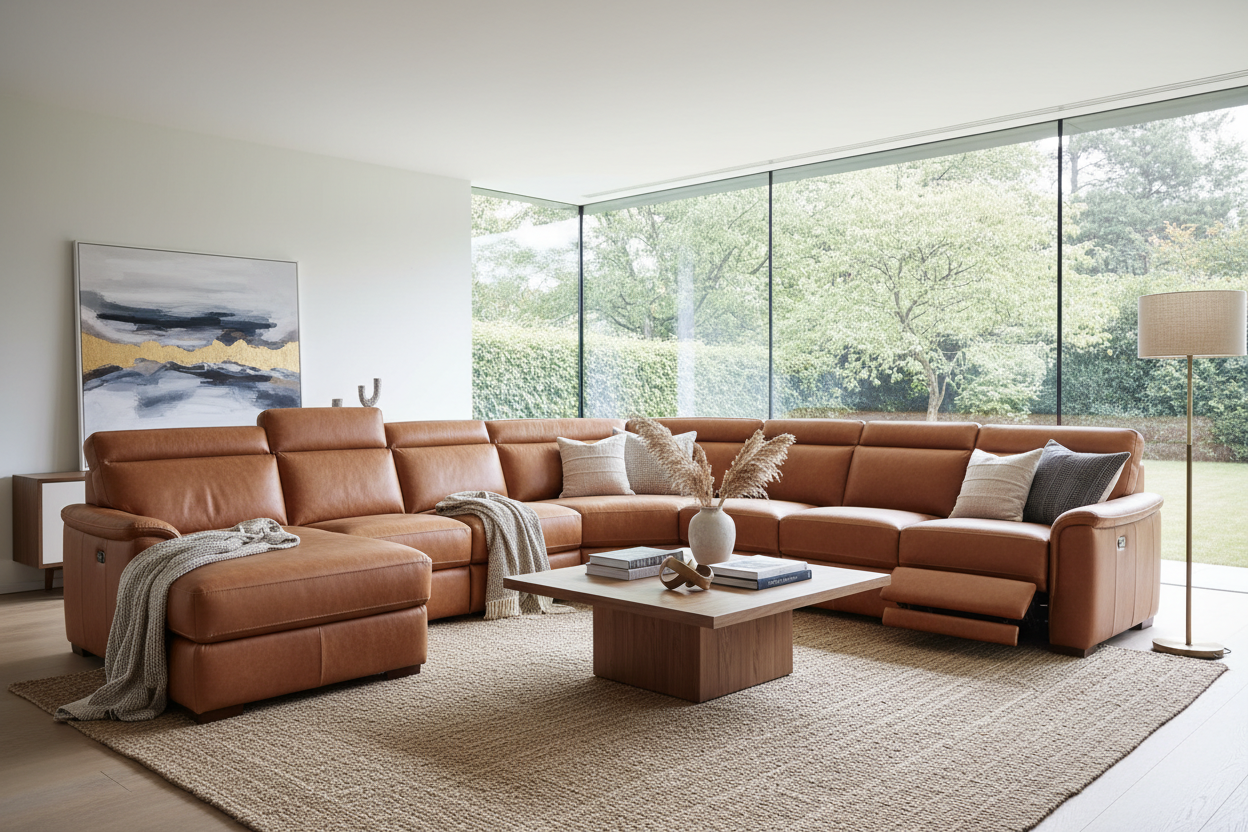
There is a specific tension I see in almost every client consultation: the battle between high-end aesthetics and Sunday afternoon comfort. You want the sleek, architectural lines of modern Italian design, but you also want to kick your feet up. For years, these two desires were mutually exclusive. However, the modern reclining leather sectional with chaise has evolved to bridge that gap, provided you know exactly what to look for.
Key Features to Look For
- Leather Grade: Prioritize Top-Grain or Full-Grain leather for longevity; avoid bonded leather which peels over time.
- Mechanism Type: Look for "wall-hugger" designs if placing the sofa near a perimeter, or battery-pack options for floating layouts.
- Suspension System: heavy-gauge sinuous springs or kiln-dried hardwood frames ensure the piece holds its shape.
- Chaise Configuration: Determine if you need a Left-Arm Facing (LAF) or Right-Arm Facing (RAF) chaise based on your room's traffic flow.
- Cushion Density: High-resiliency foam wrapped in down provides the best balance of structure and softness.
Decoding Material Quality: Beyond the Label
When shopping for a real leather sectional with recliners, the terminology can be intentionally confusing. In my showroom experience, "Genuine Leather" is often a red flag—it is technically leather, but usually the lowest split layer, stamped with a texture.
For a piece of furniture that will see daily friction, you need Top-Grain or Full-Grain leather. These grades develop a rich patina over time rather than wearing out. If you have pets or children, I often recommend a semi-aniline finish. It retains the natural look but includes a light protective coating that resists scratching and staining better than pure aniline.
Managing Visual Weight in Your Layout
A large leather sectional couch with recliners introduces a significant amount of "visual weight" into a room. Because leather is a heavy, opaque material, a massive sectional can easily swallow a room if not balanced correctly.
The Silhouette Strategy
To counteract the bulk, look for models with a "leggy" silhouette. A sectional that sits flush on the floor feels heavier. One raised on metal or wooden legs allows light to pass underneath, increasing the perception of floor space. Additionally, avoid over-stuffed headrests. Low-profile headrests that articulate up only when needed help maintain open sightlines across the living area.
Functionality: The Power Dilemma
Integrating a leather reclining sectional with chaise lounge requires electrical planning. Standard recliners need to be plugged in. If you plan to float your sectional in the center of the room, you do not want an unsightly black cord snaking across your rug.
If you are in the renovation phase, install floor outlets. If you are working with an existing space, insist on purchasing rechargeable battery packs for the reclining motors. They usually hide neatly under the frame and last for weeks on a single charge.
Lessons from My Own Projects
I learned a hard lesson about reclining sectionals during a project in a downtown loft last year. We ordered a stunning, cloud-grey reclining sectional. It looked perfect on the floor plan. However, I hadn't accounted for the "pitch" of the recline in relation to the coffee table.
When the footrest was fully extended, it hit the edge of their marble coffee table. We had to push the table so far out that it was unreachable when the clients were sitting upright. It ruined the ergonomics of the conversation area. Now, I always tape out the fully extended footprint on the floor before purchasing. Also, a specific detail about leather: on that same project, we realized that the motion mechanism caused leather-on-leather friction noise. We solved it by applying a tiny amount of leather conditioner where the seat meets the arm, but it's a quirk most people don't expect until they hear it.
Conclusion
Selecting the right sectional is about balancing engineering with artistry. It shouldn't just be a place to sit; it should anchor your room without weighing it down. Focus on the leather grade, plan your electrical layout, and measure your clearance carefully. When chosen correctly, this piece will serve as the durable, comfortable heart of your home for decades.
Frequently Asked Questions
How much space do I need behind a reclining sectional?
It depends on the mechanism. Standard recliners need 8-12 inches of clearance. However, "zero-wall" or "wall-hugger" mechanisms track forward as they recline, requiring as little as 2-4 inches behind the frame.
Can I replace the battery packs on power recliners?
Yes, most battery packs are universal or brand-specific accessories that detach easily for charging. They typically last 150-300 cycles (open/close) before needing a recharge.
Is a leather chaise better than a standard recliner seat?
The chaise offers static comfort and is better for reading or napping without mechanical adjustment. However, it is fixed in place. If you want flexibility to sit upright with feet on the floor, a standard recliner seat is more versatile.



Dejar un comentario
Este sitio está protegido por hCaptcha y se aplican la Política de privacidad de hCaptcha y los Términos del servicio.