










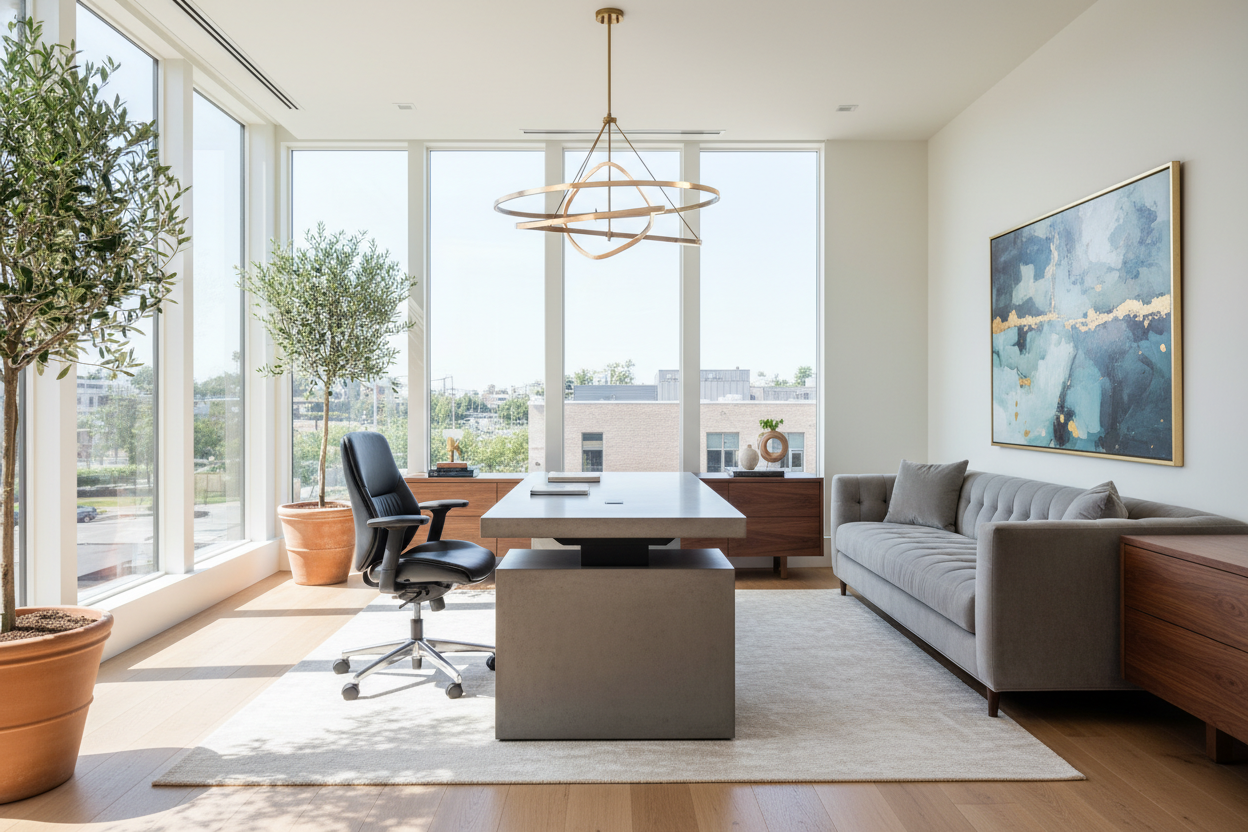
For years, workspace lighting has been an afterthought—often relegated to utilitarian flush mounts or harsh fluorescent strips that do nothing for creativity. As we spend more time in our dedicated workspaces, the desire to merge professional functionality with residential comfort has never been higher. Installing a chandelier in office settings is no longer just a bold design statement; it is a strategic move to define the room's hierarchy and elevate your daily experience.
Quick Decision Guide: Selecting the Perfect Fixture
- Scale & Diameter: A fixture should generally be 1/2 to 2/3 the width of your desk if hung directly above it, ensuring it doesn't overwhelm the visual plane.
- Drop Height: Maintain at least 7 feet of clearance from the floor in walkways, or 30-36 inches above the desk surface for a focused look.
- Light Layering: Never rely on a chandelier alone. Combine it with task lamps and recessed lighting to prevent eye strain.
- Glare Control: Opt for frosted glass or shaded bulbs to diffuse light, preventing harsh reflections on computer monitors.
- Dimmability: Essential for transitioning from high-focus work modes to ambient evening settings.
Mastering Scale and Placement
The most common error I see in home office chandelier ideas is incorrect scaling. A fixture that is too small looks apologetic, while one that is too massive can make a small office chandelier feel claustrophobic. If you are centering the fixture in the room, calculate the diameter by adding the length and width of the room in feet and converting that number to inches. However, if you are anchoring the light over a desk, focus on the furniture's footprint rather than the room's perimeter.
Balancing Aesthetics with Ergonomics
When curating office chandelier ideas, functionality must dictate the form. A modern chandelier for office environments often features integrated LED technology, which allows for slimmer profiles and better energy efficiency. However, be wary of exposed bulbs in a modern office chandelier. While the industrial aesthetic is popular, the direct filament exposure can cause retinal fatigue after hours of work. Look for fixtures with diffusers, linen shades, or alabaster details that soften the output while maintaining a high lumen count.
Materiality and Mood
The finish of your chandelier light for office sets the tone for the entire room. For a masculine, grounded aesthetic, matte black or oil-rubbed bronze adds visual weight and seriousness. Conversely, a modern chandelier for home office spaces featuring brushed brass or polished nickel can bounce light around the room, making the space feel airier and more energetic. If your desk is heavy timber, contrast it with glass or metal; if your desk is glass or lacquer, introduce texture through a wood-beaded or fabric-shaded fixture.
Defining the Style: Modern vs. Traditional
Office chandelier modern designs tend to favor geometric shapes and asymmetry, which can stimulate creative thinking. These works of art often act as the focal point in a minimalist room. On the other hand, home office chandelier lighting that leans traditional—think tiered crystals or candelabra styles—can add a sense of permanence and authority, perfect for executive suites or law libraries. The key is to ensure the office chandelier lighting complements your architectural details rather than competing with them.
My Personal Take on Chandelier in Office
I learned a hard lesson about home office chandelier placement during a project in a high-rise downtown. We installed a stunning, multi-tiered crystal fixture directly above a client's mahogany desk. It looked magazine-worthy. However, within a week, the client called me. The issue wasn't the look—it was the heat and the hum.
The fixture used older halogen bulbs that actually raised the temperature around his head, and the cheap dimmer switch caused a low-frequency buzz that was maddening during quiet reading time. I had to swap the entire electrical load to high-quality LEDs and install a heavy-duty Lutron dimmer. Now, I always check the thermal output and driver quality of a fixture before specifying it for a quiet, stationary zone like a desk. It’s those invisible details—sound and heat—that define luxury just as much as the silhouette.
Conclusion
Integrating a statement fixture into your workspace is about reclaiming the room from purely utilitarian roots. Whether you choose a sleek linear suspension or a dramatic organic form, the right lighting shifts your mindset the moment you step into the room. Don't be afraid to go bold; your best work deserves the best light.
Frequently Asked Questions
How low should a chandelier hang in a home office?
If the chandelier is centered in the room where people walk, keep the bottom at least 7 feet from the floor. If it is hung directly over a desk, you can lower it to approximately 30 to 36 inches above the desktop, provided it doesn't obstruct your line of sight to the door or a guest.
Is a chandelier enough light for an office?
Rarely. A chandelier provides ambient light, which sets the general mood. For paperwork or computer work, you absolutely need task lighting (like a desk lamp) to reduce shadows and eye strain. Think of the chandelier as the "jewelry" and the task light as the "tool."
Can I put a chandelier in a small office?
Absolutely. In a compact room, look for a semi-flush mount chandelier or a fixture with a transparent quality (like glass or acrylic). This provides the elegance of a chandelier without occupying too much visual space or making the ceiling feel lower.

Dejar un comentario
Este sitio está protegido por hCaptcha y se aplican la Política de privacidad de hCaptcha y los Términos del servicio.