










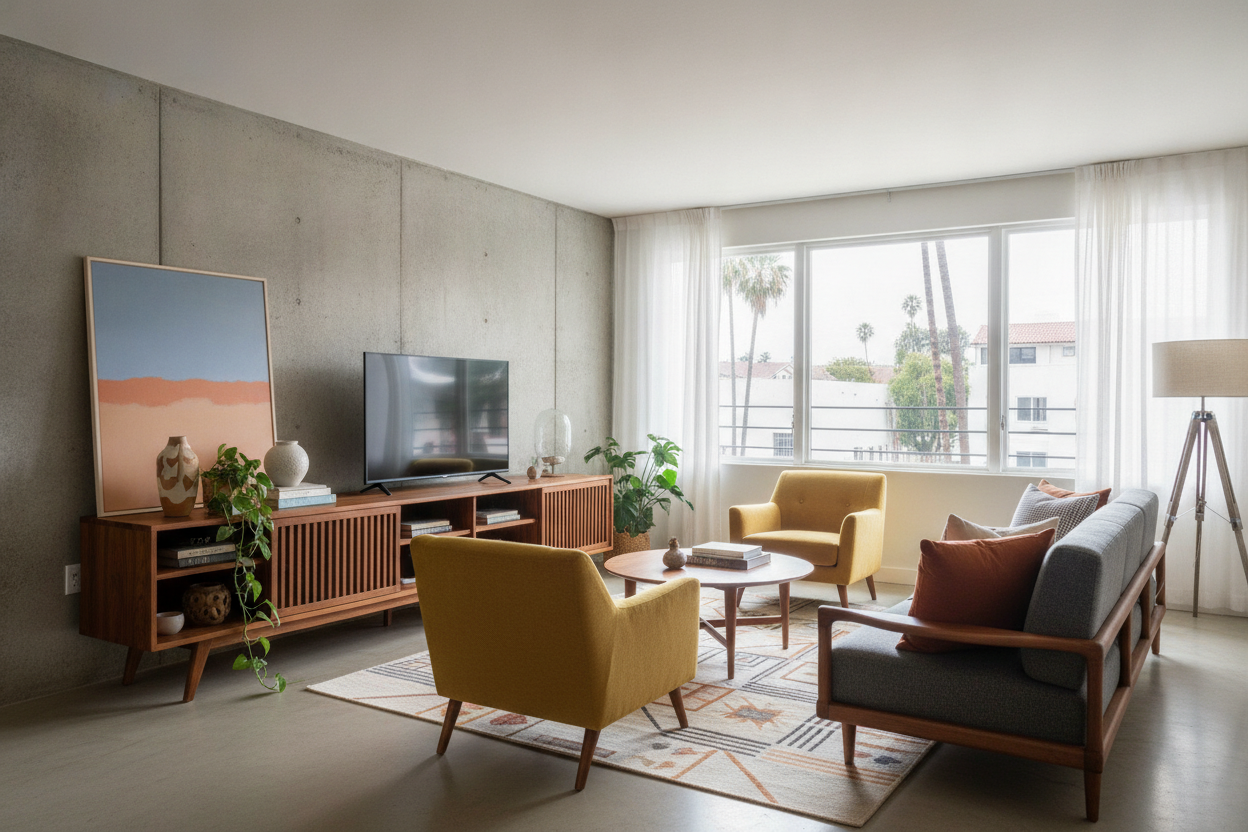
I spent my first six months in a Koreatown walk-up with my 55-inch OLED sitting on a stack of moving blankets. I’d spent every weekend scouting for a tv stand los angeles shops weren't overcharging for, but the reality of the local market is brutal. You either find a gorgeous vintage piece that costs more than your car, or you end up with a wobbly particle-board unit from a big-box store that starts sagging under the weight of a soundbar within three weeks.
- Avoid the Melrose design district unless you have a corporate expense account.
- Measure your depth twice—most LA apartments are too narrow for deep, bulky consoles.
- Slatted doors are the only way to hide a router without killing your Wi-Fi signal.
- Online ordering with home delivery is almost always better than fighting the 405 with a U-Haul.
The Melrose Markup Is Real (And Totally Avoidable)
If you have spent any time walking the showrooms near Melrose and La Cienega, you know the feeling of falling in love with a media console only to see a price tag that looks like a mortgage payment. I once found a 'minimalist' oak stand that was basically three planks of wood and a prayer, priced at $2,400. In these neighborhoods, you aren't paying for the quality of the kiln-dried hardwood or the precision of the dovetail joints; you are paying for the gallery lighting and the high-rent zip code. It is an honest-to-god racket.
I’ve seen 'curated' pieces in West Hollywood that are the exact same units you can find online, just with a different knob and a 400% markup. The local furniture scene can feel like an exclusive club where the entry fee is your entire savings account. If you want a piece that feels unique but doesn't require a loan, you have to look past the staged windows. Don’t get me wrong, those showrooms are great for inspiration, but they are the worst place to actually swipe your card. I’ve learned to take photos of the styles I like and then source the materials or the specific design elsewhere. Real furniture value is found when you stop paying for the 'experience' of a boutique and start looking at the specs of the build itself.
Skip the Big Box Showrooms on the Westside
The alternative to the high-end showrooms is usually the trek to the Westside for the massive big-box retailers. We’ve all done it: the soul-crushing drive on the 10, the parking lot wars, and the labyrinthine walk through a warehouse only to find that the floor model is held together by scotch tape. These places are great for cheap kitchen utensils, but for a media unit that needs to support a heavy TV and hide a mess of cables, they usually fall short. Most of their stuff is made of 1.5 lb/ft³ density fiberboard that won't survive a single move across town.
When I was hunting for my own place, I realized that Choosing The Perfect Tv Stand For Style And Function is about more than just finding something that fits the wall. You need something that won't off-gas chemicals in your small apartment and won't buckle under the weight of a modern television. The generic flat-pack options you find on the Westside are designed for temporary living, not for a home you actually care about. I’ve assembled enough of those 'disposable' units to know that the cam-locks always strip and the back panels are basically cardboard. Instead of settling for whatever is in stock locally because you're tired of looking, it's worth the extra time to find something that actually uses real wood veneers and solid legs. Your living room is the focal point of your life; don't anchor it with a piece of furniture that feels like an afterthought.
Why I Eventually Gave Up and Went the Mid-Century Route
LA architecture practically demands a specific aesthetic. Whether you are in a 1920s Spanish Revival with arched doorways or a 1950s Dingbat apartment with floor-to-ceiling windows, the 'bulky' look just doesn't work. I tried a heavy, industrial-style metal cabinet first, and it made my living room feel like a garage. I finally realized that the reason everyone in this city obsessed over tapered legs and warm wood tones is because they actually work for the space. A Mid Century Modern Tv Stand With Slatted Doors Open Shelves And Cable Management is the ultimate cheat code for a cramped LA apartment.
The 'visual floor space' created by furniture on legs is a real thing. When you can see the floor underneath your TV stand, the room feels three feet wider. I opted for a walnut finish because it hides the inevitable dust that blows in through old window frames, and the warm tone balances out the cold, white walls that every landlord in Southern California seems to love. I also learned that 'mid-century' doesn't have to mean 'fragile.' You want something with a solid wood base. I’ve had the cheap versions where the legs are just screwed into thin MDF, and one accidental bump while vacuuming sent the whole thing leaning like the Tower of Pisa. Look for units that have a reinforced mounting plate for the legs. It’s the difference between a piece of furniture that lasts through your next three moves and one that ends up on the curb with a 'FREE' sign on it by next summer.
The Slatted Door Hack for Cramped Living Rooms
If your couch is only four feet away from your TV, you do not want swinging doors. I learned this the hard way when I realized I had to move my coffee table every time I wanted to get to my PlayStation. Slatted doors or sliding panels are the only logical choice for urban living. Not only do they save space, but they also solve the 'black box' problem where your electronics look like a cluttered mess. The slats allow your remote's IR signal to pass through, so you can keep the doors closed while you’re actually using your tech. It keeps the aesthetic clean without sacrificing the functionality of your gear.
The Hidden Cost of Transporting Furniture in LA
Let's talk about the logistics. I once tried to fit a 70-inch solid wood console into the back of my friend’s Prius. We spent forty minutes in a parking lot in Burbank trying every possible angle before realizing it just wasn't happening. Then comes the cost of a U-Haul, the insurance, the gas, and the three hours of your life you’ll never get back fighting traffic on the 101. By the time you’ve paid for the rental and the 'thank you' pizza for your friends, you’ve spent an extra $150 and a whole lot of sanity.
This is why I eventually stopped the 'thrift hunt' and started looking at curated Tv Stands online that offer direct shipping. There is a specific kind of peace that comes with knowing a box will show up at your door and you don't have to navigate a 26-foot truck through a narrow alleyway in Silver Lake. When you factor in the value of your time—and in LA, your time is expensive—free or flat-rate shipping is a massive win. I’ve done the 'FB Marketplace' shuffle where you drive to Glendale only to find out the 'mint condition' stand has a giant water stain on top. Save yourself the heartbreak and the gas money. Ordering a high-quality, ready-to-assemble piece is the most adult decision I’ve made for my living room.
FAQ
How wide should my TV stand be compared to the TV?
Don't let the screen overhang the edges. You want at least 3 to 6 inches of breathing room on either side so the setup looks balanced and won't tip over if someone bumps into it.
Does walnut or oak look better in LA apartments?
Walnut is the classic choice for MCM vibes and hides dust better. Oak is great if you have a lot of natural light and want a 'Scandi' or airy feel, but it can sometimes look a bit too 'beachy' if you aren't careful.
How do I hide all the messy power strips?
Look for a unit with a recessed back panel or built-in cable management holes. If it doesn't have them, you can use adhesive cable clips along the back of the legs to keep everything tucked away.

Dejar un comentario
Este sitio está protegido por hCaptcha y se aplican la Política de privacidad de hCaptcha y los Términos del servicio.