










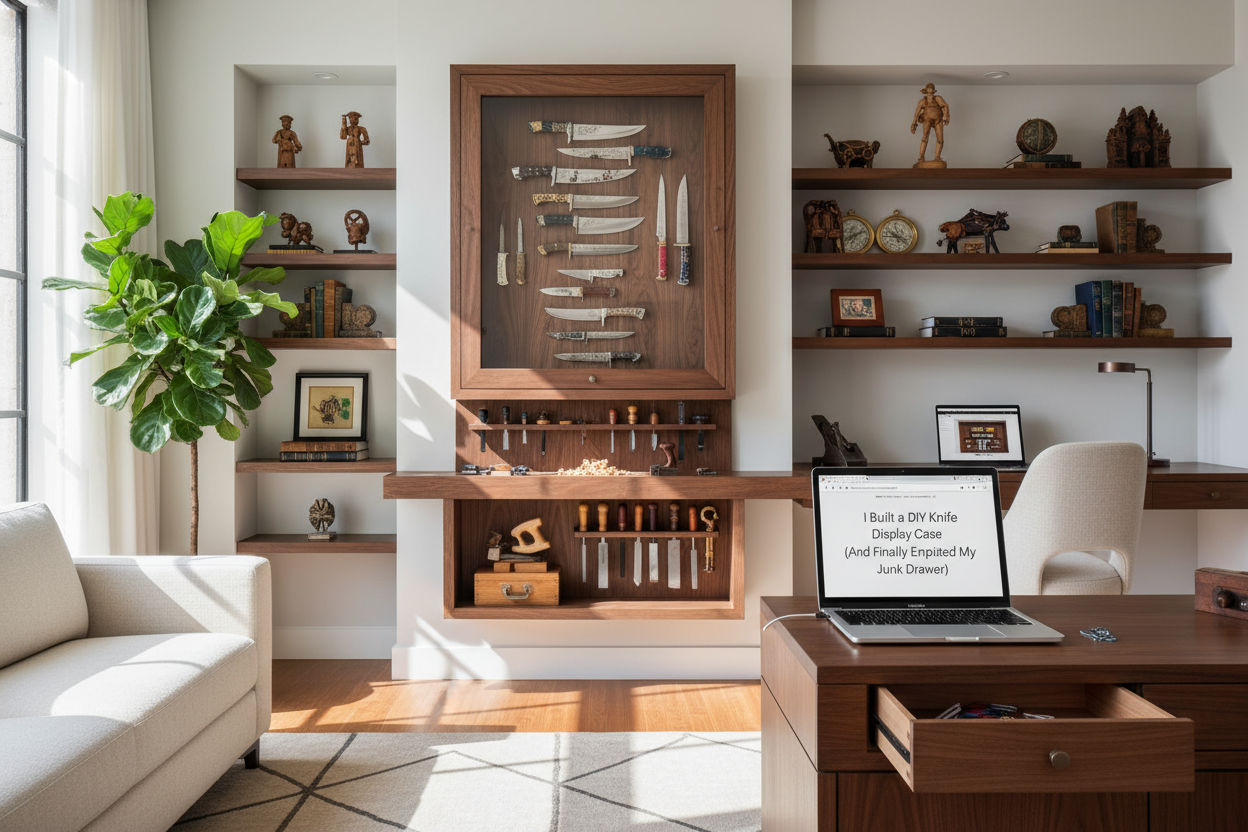
I was digging for a Philips head screwdriver the other day and nearly sliced my finger on a Benchmade Bugout that had escaped its sheath in the dark. That was the breaking point. My collection—mostly hard-earned pocket knives and a few vintage buck knives—was living in a literal junk drawer. It felt disrespectful to the craftsmanship. I decided right then that I needed a diy knife display case that didn't look like a high school shop project gone wrong.
After the success of my DIY action figure display case last winter, I knew I had the basic skills to pull this off. The goal was simple: get the knives out of the drawer and onto the wall where they belong. Learning how to display knife collection on wall spaces isn't just about showing off; it's about organization and actually being able to find the tool you need for the day without needing a tetanus shot.
- Budget: Under $50 if you have basic scrap wood.
- Time: One full Saturday, plus drying time for finish.
- Difficulty: Intermediate (requires a steady hand for the slots).
- Tools: Miter saw, drill, and a table saw or router.
Picking Your Design: Wall Cabinet vs. Tabletop Stand
Before you start sawdusting your way through the garage, you have to decide where these things are going. I spent hours looking at different knife display diy ideas. Some people prefer a flat, horizontal tray that sits on a dresser. It’s easy to build, but it eats up your surface area like crazy. If you have a massive collection and zero wall space, you might be better off looking into corner display cases to house the overflow.
For me, a wall-mounted unit was the only way to go. It keeps the knives at eye level and turns them into actual decor. I briefly considered a diy pocket knife display that used magnets, but I didn't want the metal-on-metal contact scratching my blades. A vertical cabinet with slotted shelves is the gold standard. It’s secure, looks professional, and keeps the dust off. Finding the right knife display stand plans is half the battle, but most of them are over-engineered. You don't need dovetail joints to hold a three-ounce folder.
The Tools and Woodworking Plans You Actually Need
If you search for knife display case woodworking plans online, you’ll find guys with $10,000 workshops talking about biscuit joinery and exotic hardwoods. Ignore them. You can make a gorgeous case with a single 8-foot stick of 1x4 pine or walnut and some basic plywood for the back. My simplified knife display case plans focus on three things: a solid outer frame, a groove for the glass, and the internal shelving.
You’ll need a miter saw for clean 45-degree corners—don't try to eye-ball these or your frame will look like a trapezoid. A table saw is essential for cutting the 'rabbet' (the little ledge where the glass sits) and for making the slots in the shelves. If you don't own a table saw, a router table works too. You also need wood glue, a brad nailer (or small finish nails), and some sandpaper. For the finish, I’m a sucker for Danish oil. It’s hard to mess up and gives the wood a deep, hand-rubbed look without the plastic-y feel of poly.
Step-by-Step: How to Make a Knife Display Case Without Losing Your Mind
Building this thing is a lesson in patience. Start by measuring your largest knife. There is nothing worse than finishing a build and realizing your favorite hunting knife is half an inch too long for the frame. When I figured out how to build a knife display case, I settled on an internal width of 12 inches. It’s wide enough for two pocket knives side-by-side or one large fixed blade.
Prepping the Frame and Glass Door
Cut your 1x4s to length with mitered corners. Before you glue anything, use your table saw to cut a 1/4-inch deep groove along the inner edge of the frame pieces. This is where your 'glass' will slide in. I actually recommend using 1/8-inch acrylic (Plexiglass) for a diy knife display. It’s lighter, won't shatter if the case falls, and you can cut it at home with a utility knife and a straight edge. Glue the bottom and sides of the frame together, slide the acrylic into the grooves, and then cap it with the top piece. It’s a 'floating' glass design that looks incredibly clean.
Creating the Slotted Shelves (The Secret to a Perfect Fit)
This is the part that makes or breaks the project. To make a diy pocket knife display case work, the knives need to sit at an angle so you can see the scales and the blade profile. I took a thin piece of wood—about 1.5 inches wide—and ran it across my table saw at a 45-degree angle, cutting only halfway through the wood. These 'kerf' cuts become the slots that the knife blades sit in. Space them about 2 inches apart. Once the shelves are cut, glue them into the frame. Ensure they are perfectly level, or your knives will look like they’re sliding off a sinking ship.
A Few Mistakes I Made (So You Don't Have To)
My first attempt at this knife display case diy was a disaster because I forgot about depth. I built the case too shallow, and my thicker tactical knives hit the glass door, preventing it from closing. Make sure your frame is at least 3 inches deep to accommodate those beefy folders. Also, don't skimp on the backing. A piece of felt-covered plywood makes the knives pop; bare wood can make the whole thing look a bit washed out.
If you get halfway through this and realize your woodworking skills are more 'toddler with a hammer' than 'master craftsman,' don't sweat it. You can always pivot and buy a pre-made glass door display case. There's no shame in it—sometimes the time saved is worth the extra cash. But if you stick with the DIY route, the feeling of hanging that finished case on the wall and seeing your collection finally organized is unbeatable. No more junk drawers, no more sliced fingers—just a clean, sharp display.
FAQ
What is the best wood for a knife display?
Walnut is the classic choice because the dark wood makes the steel blades stand out. However, if you're on a budget, pine stained with a 'Dark Walnut' finish looks 90% as good for a fraction of the price.
How do I mount the case to the wall securely?
Don't just use a single nail. Use heavy-duty sawtooth hangers on both upper corners, or better yet, a French cleat. Knives are heavy, and you don't want the whole thing crashing down at 3 AM.
Should I use glass or acrylic?
Acrylic is easier for DIYers because you can cut it yourself. Glass looks slightly clearer over time and doesn't scratch as easily, but you'll need to have it custom-cut at a hardware store.



Dejar un comentario
Este sitio está protegido por hCaptcha y se aplican la Política de privacidad de hCaptcha y los Términos del servicio.