










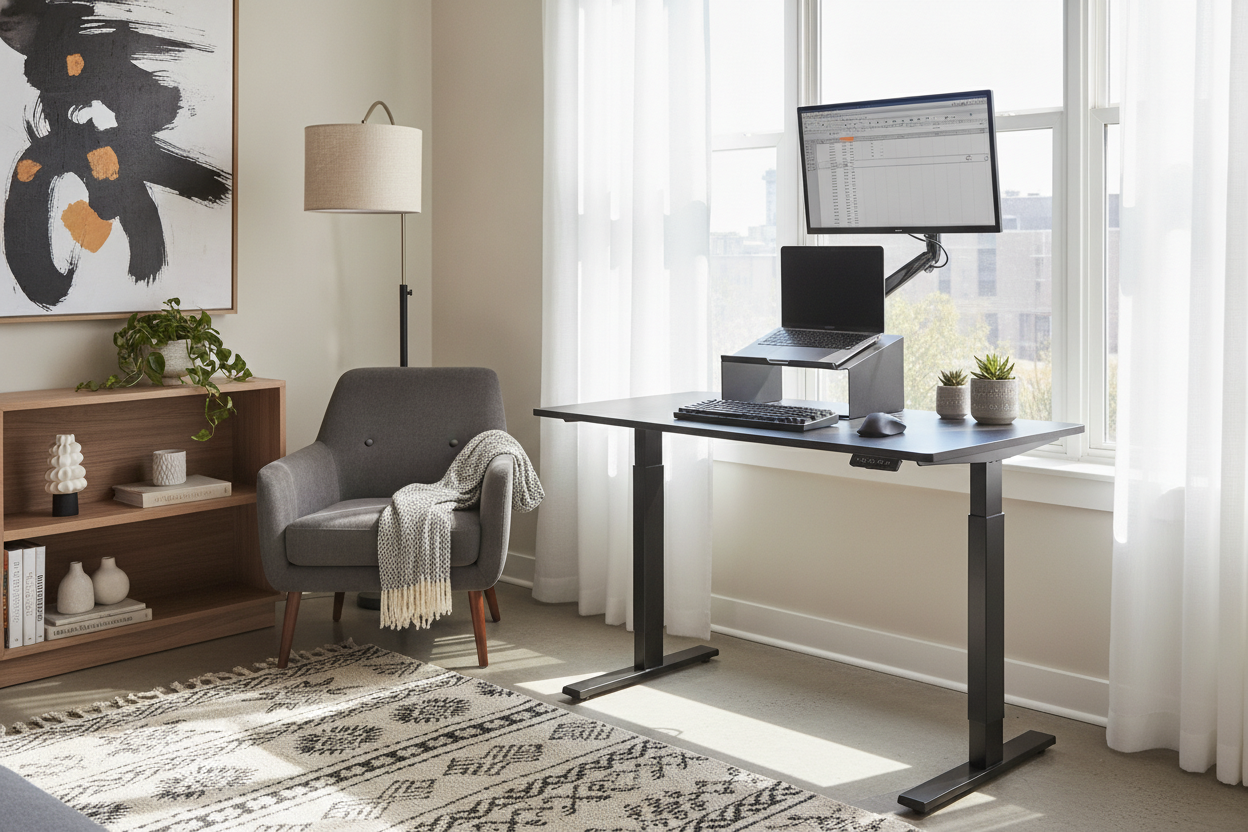
My living room used to look like a corporate cubicle farm. I bought into the hype that a bigger desk meant better productivity, but after six months, my 60-inch motorized beast was just a glorified mail collector that blocked the only good light in my apartment. I missed my furniture—specifically, a mid-century teak writing desk I’d inherited that had zero ergonomic value but 100% of the soul. That is when I decided to swap the tech-heavy monster for a black adjustable standing tabletop desk.
Quick Takeaways
- Save your existing furniture: You don't have to trash a beautiful desk just to save your spine.
- Small footprint, big impact: A 32-inch model holds a monitor and laptop without hogging the whole surface.
- Manual is often faster: No hunting for a power outlet or waiting on a slow motor.
- Visual stealth: Black finishes blend into tech setups better than bulky white plastic.
The Great Downgrade: Why I Ditched My Giant Motorized Desk
There is a specific kind of regret that hits when you realize your furniture is wearing you. I had one of those massive motorized setups with memory presets, and while the tech was cool, the sheer physical presence of it was exhausting. It felt like an appliance, not a piece of home decor. In a small apartment, every square inch has to justify its existence, and that desk was failing the test.
When you consider the weight of a solid wood standing desk, you realize you are essentially anchoring yourself to one corner of the room forever. If I wanted to rearrange my layout, I needed a literal moving crew. The realization hit me during a Sunday reset: I didn't need more desk; I needed more flexibility. I wanted my floor space back, and I wanted to see my vintage teak desk again.
How I Kept My Favorite Vintage Desk (And Saved My Back)
The beauty of a tabletop converter is that it acts as a bridge between your aesthetic taste and your physical needs. I placed the black adjustable standing tabletop desk right on top of my old writing desk, and it felt like a revelation. I didn't have to choose between a sore lower back and a room that looked like a startup office. The black finish provides a sleek, modern contrast to the warm wood tones of the vintage base, making the whole setup look intentional rather than cluttered.
I chose black because it makes the tech disappear. When my monitor and keyboard sit on a dark surface, the borders seem to melt away, which is a neat trick for keeping a small room from feeling overwhelmed by hardware. It’s a stealthy compromise. Most days, I leave it in the lowered position, and it just looks like a slightly raised monitor riser. When the 2 PM slump hits, I pop it up, and I’m standing in three seconds flat.
Finding the Sweet Spot: Why I Didn't Go Too Wide
I learned the hard way that more surface area isn't always better. I briefly looked at giant 71-inch ergonomic workstations, but they would have completely eclipsed my base desk. Instead, I opted for a black adjustable standing tabletop desk 32 inches wide. This is the 'Goldilocks' zone for apartment dwellers.
At 32 inches, I have exactly enough room for my 27-inch monitor and my 13-inch MacBook Pro on a stand. There’s a tiny bit of room left for a coffee mug, but not enough room for clutter to accumulate. It forces a certain level of desk discipline that I desperately needed. It sits centered on my 48-inch vintage desk, leaving plenty of room on the sides for a lamp or a notebook. It’s functional without being greedy.
The Daily Reality of a Manual Lift Converter
Let’s talk about the 'lifting' part. People worry that a manual gas-spring lift will be a workout, but it’s actually smoother than most electric motors I’ve used. You just squeeze a handle and the gas struts do 90% of the work. The biggest hurdle is actually cable management. Since the converter moves independently of the base desk, you have to make sure your monitor cables have enough slack to reach full height without yanking your laptop off the edge.
There is a slight wobble if you’re an aggressive typer, but it’s nothing a set of dampened keycaps can't fix. The portability is the real winner here. If I get tired of my office corner, I’ve even tried using a tabletop converter on a kitchen counter for a few hours. You can't do that with a 150-pound electric frame. It’s the ultimate setup for someone who likes to change their mind about their layout every two weeks.
Is Downsizing Your Desk Right for You?
Before you pull the trigger, take a look at your current surface. Is it sturdy? A tabletop converter adds about 25-40 pounds to your desk before you even add your computer. If you’re working on a flimsy folding table, this isn't for you. But if you have a solid piece of furniture you love, a converter is the best way to modernize your health without ruining your interior design. It’s about keeping the soul of your home while giving your spine a break.
FAQ
Is a 32-inch desk wide enough for two monitors?
It’s tight. You can fit two 24-inch monitors if they have slim bezels and you don't mind them overhanging the edges slightly. For a dual-monitor setup, I'd usually recommend a dedicated monitor arm attached to the converter.
Will the converter scratch my wood desk?
Most come with rubber feet, but I always add extra adhesive felt pads to the bottom just to be safe. It’s a $2 insurance policy for your furniture.
How much weight can these manual converters actually lift?
Most are rated for 30-35 pounds. That covers a large monitor, a laptop, and your peripherals easily. Just don't try to lean your full body weight on it while you're typing.

Dejar un comentario
Este sitio está protegido por hCaptcha y se aplican la Política de privacidad de hCaptcha y los Términos del servicio.