










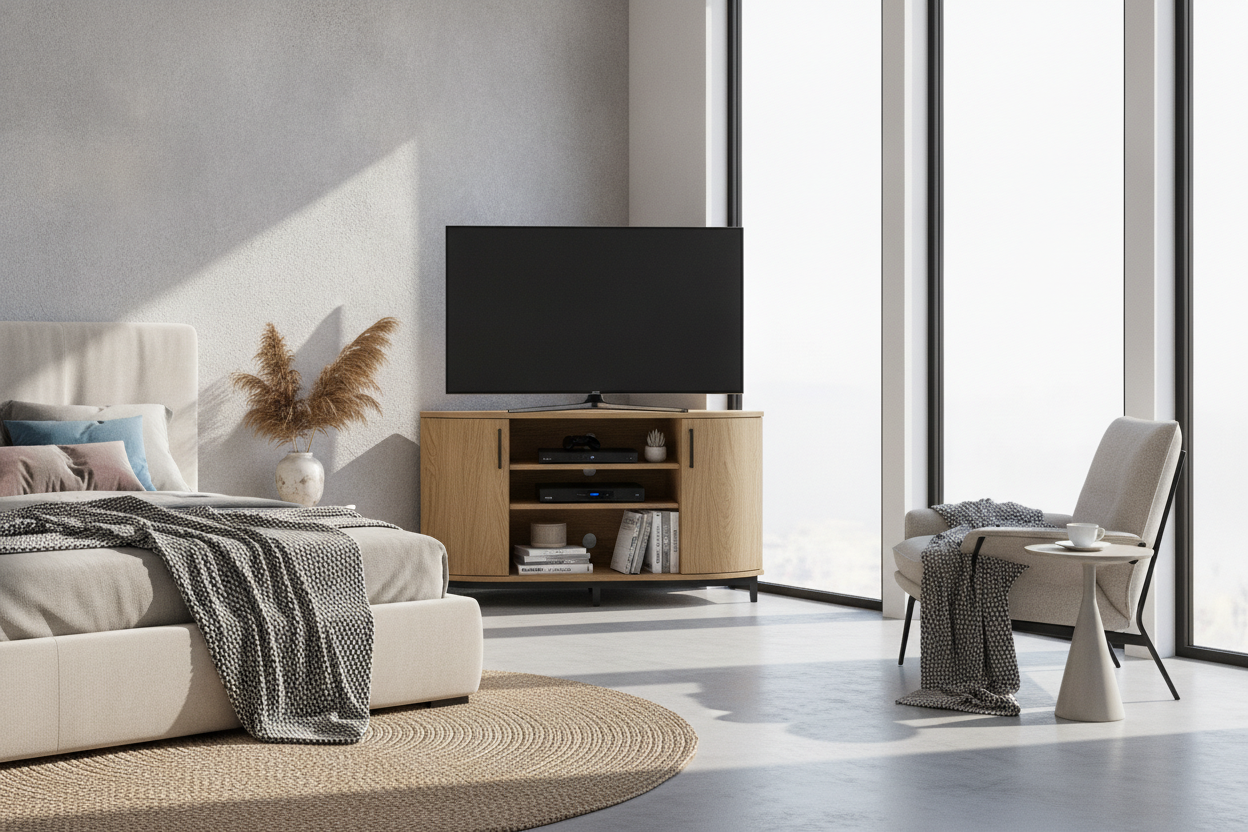
I spent three years squinting at a TV perched on a six-drawer dresser that took up half my bedroom walkway. It was a classic small-apartment mistake: choosing horizontal storage when I had zero floor to spare. My shins were bruised from bumping into the corner of that dresser every time I went to the bathroom at 2 AM, and my neck was permanently stiff from the awkward viewing angle.
The fix wasn't a smaller TV or a wall mount (my landlord would have a heart attack over the anchors). It was a corner tall tv stand. By moving the entire setup into a piece of 'dead' space, I reclaimed enough floor area to actually open my closet doors all the way for the first time since I moved in. Here is how I made the switch and why I'm never going back to low-profile consoles in the bedroom.
Quick Takeaways
- Verticality is your best friend in a bedroom under 120 square feet.
- Eye level in bed is much higher than eye level on a sofa; height is an ergonomic necessity.
- Corner units reclaim square footage that usually just collects dust.
- Enclosed storage is mandatory to keep tech clutter from ruining your 'sanctuary' vibes.
The Ergonomic Nightmare of Low Bedroom TVs
Most media consoles are designed for living rooms, meaning they sit about 18 to 24 inches high. That is great for a standard sofa, but in bed? You are basically doing a mini-crunch just to see the subtitles. It is a literal pain in the neck. I found myself stacking old coffee table books under my TV just to get a decent viewing angle, which looked exactly as cheap as it sounds.
Beyond the physical strain, a wide, low dresser is a massive waste of horizontal space. In a cramped bedroom, every inch of the 'walkway'—the path between your bed and the wall—is precious. When you use a standard console, you are forcing the room to center around a bulky piece of furniture that does not even put the screen at the right height. It is a lose-lose situation for your floor plan and your vertebrae.
Why a Corner Tall TV Stand Actually Makes Sense Here
I finally realized that the corner of my room was doing absolutely nothing. It was a graveyard for a discarded yoga mat and a pile of 'maybe' laundry. By switching to a corner tall tv stand, I moved the focal point of the room away from the center of the wall. This instantly opened up the walking path and made the room feel four feet wider.
I have used this trick before with a tall narrow accent cabinet in my entryway, and the logic holds: height beats width every time in a tight layout. These extra tall corner tv stands are specifically designed to put the screen at the 40-to-50-inch mark. This aligns perfectly with your natural line of sight when you are propped up against a headboard. No more chin-to-chest straining just to watch a movie before sleep.
The Magic of a Tall Corner TV Cabinet With Doors
A bedroom should be a place to decompress, not a place to stare at a tangled mess of HDMI cables, a blinking router, and a dusty PlayStation. This is why I am a stickler for a tall corner tv cabinet with doors. Open shelving is a trap; it looks great in a catalog with three perfectly placed ceramic vases, but in real life, it just showcases your cable management failures.
If you want to keep the room feeling light but still hide the junk, a black cabinet with glass doors is a sophisticated compromise. I prefer fluted or frosted glass because it obscures the plastic look of gaming consoles while still allowing your remote signals to pass through. It turns a utility item into a piece of actual furniture that complements your bedding rather than competing with it.
Styling Vertical Furniture Without the 'Monolith' Vibe
The fear with any tall corner media cabinet is that it will look like a giant wooden monolith looming over you while you sleep. To avoid the 'heavy' look, I stay away from chunky, dark oak pieces that go all the way to the floor. Look for a tall corner media console with tapered legs or a recessed base. Seeing a sliver of the floor underneath makes the piece feel like it is floating rather than anchored like a safe.
I also suggest 'capping' the height. If your stand is 50 inches tall, don't hang a massive piece of art right above it. Let the top of the tall corner unit for tv be the highest point in that corner. Add a single trailing plant like a Pothos on top to break up the hard lines of the wood. It softens the silhouette and helps the furniture blend into the walls.
High-Tech Alternatives for the Anti-Cabinet Crowd
I know some people hate having a TV visible in the bedroom at all. If you have a bigger budget and zero interest in a corner setup, you might look into a hidden tv mechanism. These are great because they sit at the foot of the bed and disappear when not in use. They are the ultimate luxury for a minimalist aesthetic.
However, for those of us living in rentals or working with a standard budget, the tall corner entertainment cabinet is the most practical win. It solves the storage problem, fixes the ergonomic issues, and uses the one part of the room that was previously doing nothing for you. It is the smartest $300 I have spent on my bedroom in years.
FAQ
How high should a bedroom TV stand be?
For the best viewing experience from bed, the center of your TV screen should be roughly 42 to 50 inches from the floor. This prevents neck strain when you are leaning back against pillows.
Will a corner unit fit a 55-inch TV?
Many do, but you have to check the actual width of the stand versus the width of your TV, not the diagonal screen size. Some tall corner entertainment center designs are narrower to fit tighter corners, so always measure your TV's footprint first.
Does a tall cabinet make the room look smaller?
Actually, no. Because it occupies a corner—which is usually dead space—and leaves the main walls and walkways clear, it often makes a small room feel much more spacious and organized.

Dejar un comentario
Este sitio está protegido por hCaptcha y se aplican la Política de privacidad de hCaptcha y los Términos del servicio.