










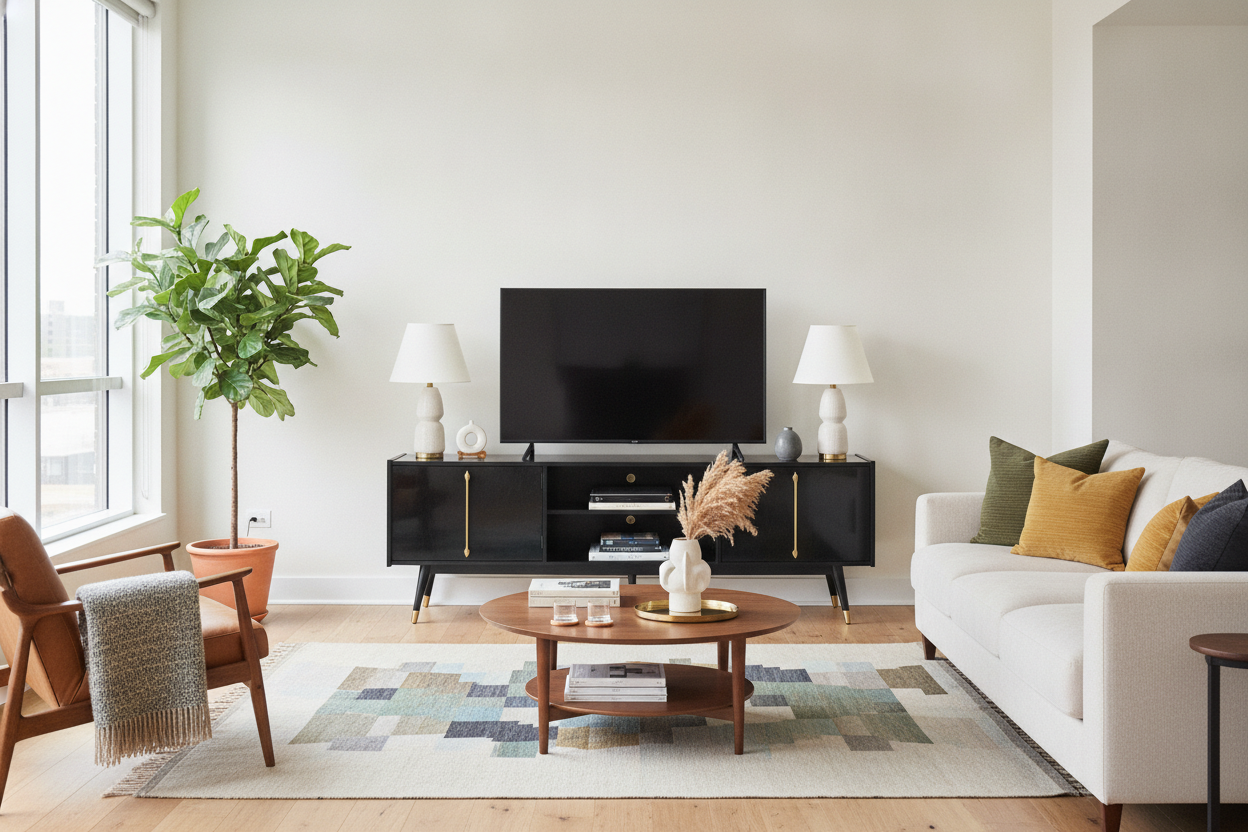
I used to be a total vintage purist. If it wasn't honey-toned teak or a perfectly oiled walnut, it didn't belong in my living room. I spent my weekends hunting estate sales for authentic 1960s pieces, convinced that anything with a dark finish was a modern-day sin. Then I bought a 65-inch flat screen and realized my 'perfect' wood-on-wood aesthetic looked like a cluttered cigar lounge from a movie set.
The problem with a mid century tv stand black is the stigma—we think it's 'hiding' the wood. But after staring at 47 browser tabs at 2 AM, I realized my walnut-heavy room needed a visual anchor. I needed something that didn't fight with the giant black rectangle hanging on my wall. I took the plunge, and honestly? It’s the best design decision I’ve made in years.
Quick Takeaways
- Black finishes absorb the 'black hole' effect of a large TV screen.
- The iconic MCM silhouette (tapered legs, low profile) remains the star.
- It provides a necessary break in rooms with too many wood tones.
- Textured details like slatted doors prevent the piece from looking flat.
The 'Too Much Brown' Dilemma in My Living Room
I had reached a breaking point. My floors are oak, my coffee table is walnut, and my shelving unit is teak. When I tried to add a walnut media console, the whole room felt heavy and dated. It wasn't 'curated' anymore; it was just a sea of brown. I realized I desperately needed a cure for wood fatigue before the space felt completely suffocating.
Most people think matching wood species is the goal, but in a real home, it just leads to a lack of contrast. The textures start to bleed into each other. By introducing a dark element, you actually make the surrounding wood grains pop. My walnut coffee table suddenly looked intentional rather than just 'more of the same.'
Why I Finally Caved for a Mid Century TV Stand Black
The breaking point was my partner's tech. Modern gaming consoles, soundbars, and that massive OLED screen are all black. Putting them on a light wood stand made them look like clutter. A mid century modern tv stand black finish acts as a bridge between 1965 design and 2024 technology. It’s what designers actually think about when they talk about 'transitional' spaces—it’s not about a specific era, it’s about making things coexist.
It Acts as Camouflage for the Giant Tech Box
When your TV is off, it’s just a giant, lifeless black void. On a light-colored console, that void is the only thing you see. But a stylish black TV stand absorbs that visual weight. The TV almost disappears into the furniture, making the whole setup feel like one cohesive unit rather than a screen sitting on a box.
You Still Get Those Iconic Tapered Legs
Choosing a mid century modern black tv stand doesn't mean you lose the soul of the era. You still get the splayed peg legs and the clean, horizontal lines that define the period. In fact, I’d argue that a black finish highlights the silhouette even better because you aren't distracted by the grain of the wood. It becomes about the shape and the architecture of the piece.
Styling a Mid Century Modern Black TV Stand (Without the Gloom)
The biggest fear with dark furniture is that it will look like a 'black hole' in the corner of the room. The trick is texture. I opted for a unit with slatted doors and open shelves to create shadows and depth. If the front is just a flat black slab, it looks cheap. If it has texture, it looks high-end.
I styled mine with a trailing pothos plant—the green looks incredible against the dark finish—and a few brass decorative objects. The brass provides a warm metallic contrast that keeps the vibe from feeling too gothic. Don't be afraid to leave some negative space on the shelves; it keeps the unit feeling light despite the dark color.
The Verdict: Breaking the Rules Worked
I was so worried about being a 'traitor' to the vintage aesthetic that I almost missed out on a piece that actually made my room functional. A mid century tv stand black isn't a compromise; it's a design tool. It solved my contrast issues and finally made my TV look like it belonged in the room instead of being an intruder. If you’re feeling stuck, go browse other TV stands and look past the wood grain—you might find that a dark finish is exactly what your space is missing.
FAQ
Does a black TV stand show more dust?
Yes, I won't lie to you. Every speck of dust and every fingerprint shows up more on a dark surface. Keep a microfiber cloth in one of the drawers for a quick 30-second wipe-down once a week.
Will a black console make my small living room look smaller?
Actually, no. Because it has those iconic MCM tapered legs, you can see the floor underneath it. That 'visual floor space' keeps the room feeling airy, even if the piece itself is dark.
How do I keep it from looking too modern?
Avoid high-gloss finishes. Look for a matte or satin finish where you can still see a hint of the wood texture underneath. Pair it with vintage-inspired accessories like ceramic vases or a record player to keep the retro soul alive.

Dejar un comentario
Este sitio está protegido por hCaptcha y se aplican la Política de privacidad de hCaptcha y los Términos del servicio.