










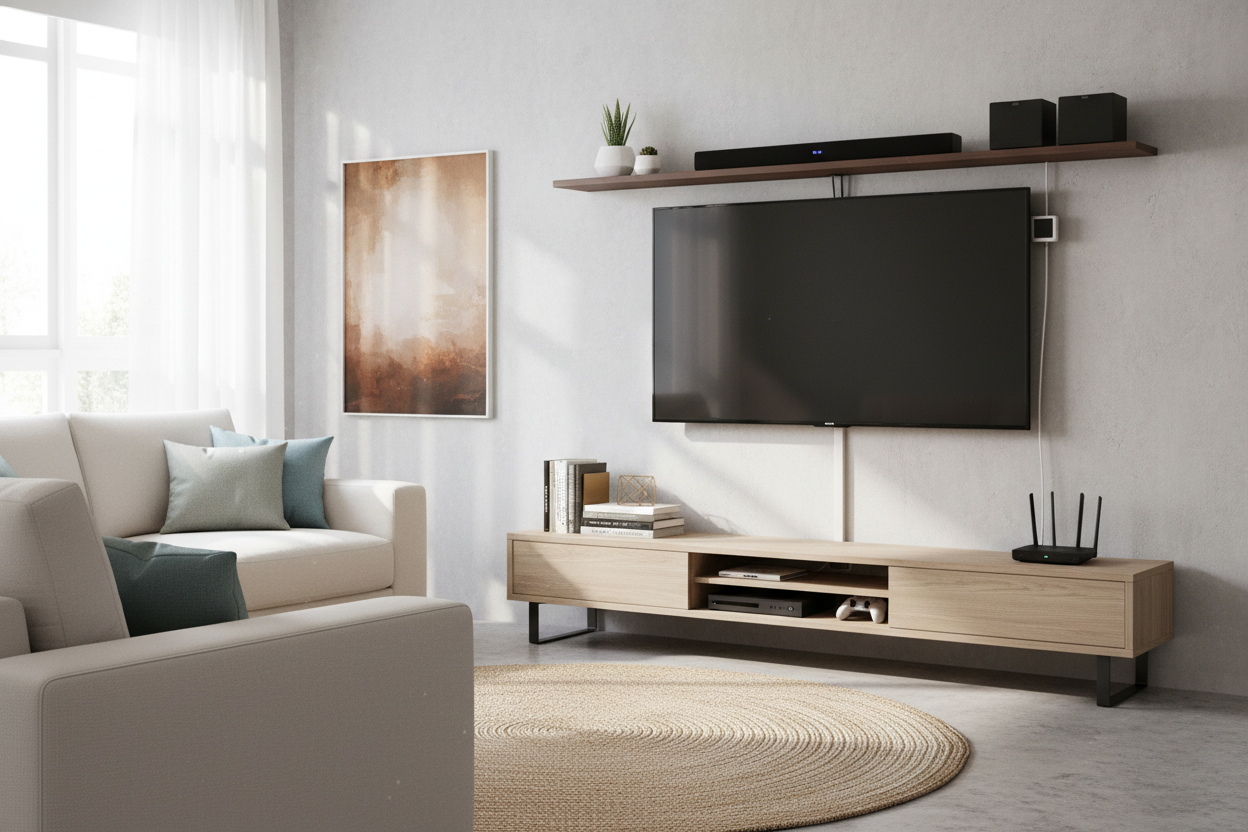
I recently spent three hours cable-managing my living room, only to realize I had nowhere to put my Apple TV. It was literally hanging off the back of the set by its HDMI cable, looking like a piece of tech-garbage. I didn't want to drill more holes into my rental’s drywall for a floating ledge, which is how I ended up looking at a shelf for top of tv.
- Best for lightweight streaming boxes like Roku, Apple TV, or Fire Stick.
- Zero tools required; they usually use a tension-based leg system.
- Not suitable for ultra-thin OLED bezels or heavy speakers.
- Keep the weight under 2-3 pounds to avoid stressing the screen panel.
What Even Is a TV Top Shelf? (And Why I Needed One)
A screen top shelf is basically a small, adjustable platform that hitches a ride on the upper bezel of your television. It uses a lip in the front and an adjustable leg in the back to create a level surface. Think of it as a tiny balcony for your gadgets.
I was skeptical at first. My 55-inch TCL isn't exactly a tank, and I worried a top of tv shelf would just fall off the moment I touched it. But after five minutes of fiddling with the wingnut on the back, I had a surprisingly sturdy 12-inch platform ready for action. It’s a weird little hardware hack that solves the 'where does the remote go' problem without requiring a trip to the hardware store.
The Big Question: Will It Break My Screen?
This is the first thing everyone asks: 'Is this going to crack my $1,000 panel?' The short answer is no, provided you aren't using a tv top shelf mount on a screen with a non-existent bezel. If your TV has at least a quarter-inch of plastic frame at the top, the shelf sits on that plastic, not the glass itself.
The physics are simple. The front lip catches the edge, and the back leg creates tension against the rear casing. The danger comes if you over-tighten the leg or try to force it onto a curved screen. I noticed that on my ultra-thin monitor, the tv screen shelf felt a bit precarious. On a standard flat-screen, though, the weight is distributed back toward the mount, keeping the pressure off the delicate LCD layers.
What Actually Belongs Up There? (Hint: Not Heavy Decor)
I’ve seen people try to put potted plants or heavy ceramic cats on a tv screen top shelf. Please, for the love of your security deposit, do not do this. Water and electronics don't mix, and a 5-pound planter is a one-way ticket to a shattered screen if the shelf slips.
Stick to the light stuff. Webcams, small soundbars, and streaming boxes are the intended residents. If you find yourself trying to balance a massive A/V receiver or a vintage gaming console, you’re asking too much from a plastic clip. In those cases, you’re much better off with a media console with an adjustable center shelf that can actually support 50+ pounds of gear without blinking.
No-Drill Clips vs. Drilling Into Your Drywall
The main appeal here is the lack of commitment. If you’re a renter or you just have a deep-seated fear of studs and power tools, a screen top shelf is a win. You can install it, move it, and pack it in a suitcase in under sixty seconds. It’s the ultimate 'good enough' solution for a temporary setup.
However, if you own your home and want a clean, professional look, a traditional on-wall TV shelf is still the gold standard. It handles more weight and doesn't put any stress on your television's chassis. But for my current apartment, where the walls are made of crumbly plaster, the clamp-on method is the only thing keeping my Apple TV from a floor-level demise.
My Final Verdict on the Top-of-Screen Hack
After a month of use, my tv top shelf hasn't budged. It hides the messy cables behind the screen and keeps the top of my media unit clear of clutter. It’s not a 'premium' piece of furniture, but it’s a functional tool that does exactly what it says on the box.
If you have more than two gadgets to store, or if you’re trying to build a serious home theater, you’ll quickly outgrow this. You’ll eventually want sturdier adjustable shelf storage to hold your controllers, headsets, and physical media. But for a quick, $15 fix? It’s a brilliant little invention.
FAQ
Can I use this on a curved TV?
Most don't work well on curves because the front lip is straight. You’ll end up with gaps and a wobbly shelf that’s prone to sliding off.
Will it block the remote sensor?
Usually no. Most sensors are at the bottom of the TV. If yours is at the top, just offset the shelf to the left or right.
How much weight can it really hold?
Most are rated for 4-6 pounds, but I wouldn't push it past 2 or 3 pounds. You want to avoid putting long-term torque on the TV's plastic frame.

Dejar un comentario
Este sitio está protegido por hCaptcha y se aplican la Política de privacidad de hCaptcha y los Términos del servicio.