










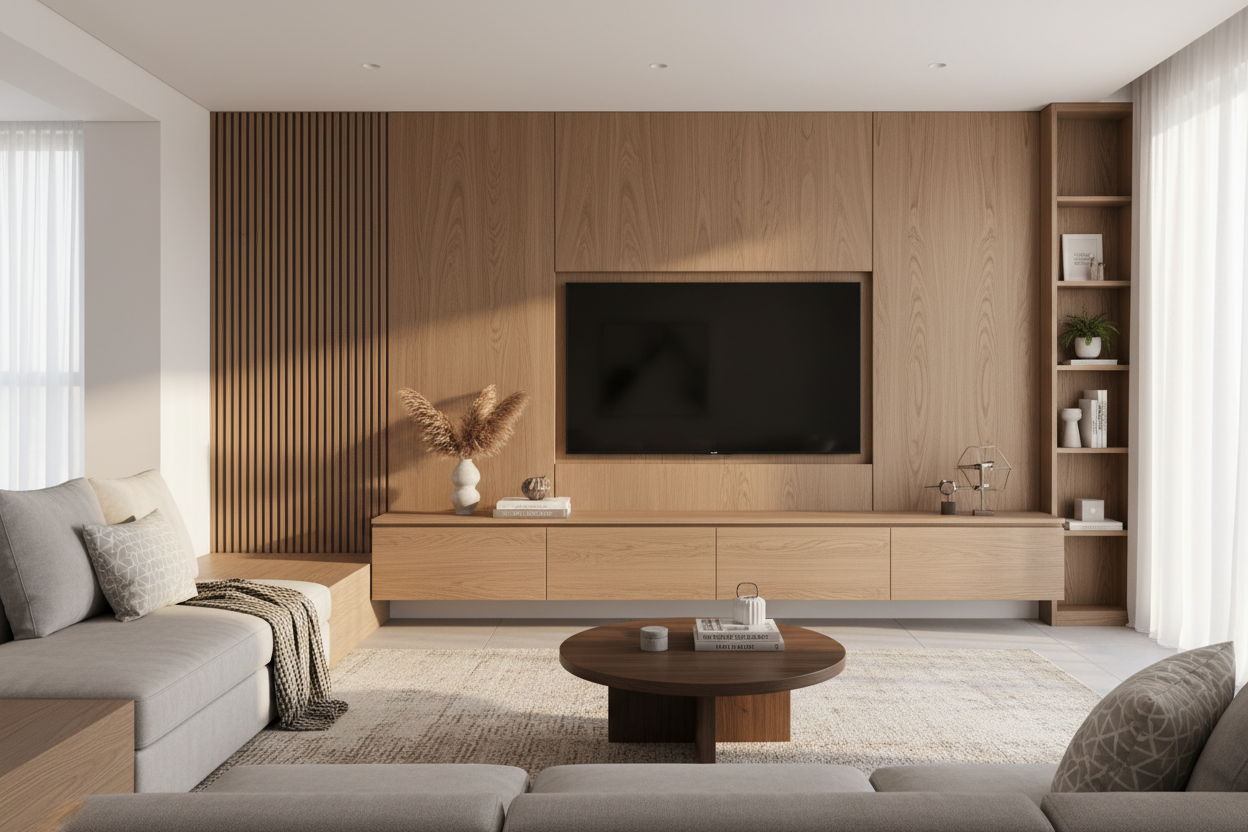
I spent three hours last Saturday on my hands and knees with a microfiber cloth, trying to reach a dust bunny colony living behind my media console. My robot vacuum had already given up, beeping a sad SOS from under the heavy oak legs. That was the moment I realized my living room didn't need a bigger rug; it needed a wood wall mounted tv unit.
Quick Takeaways
- Floating units make cleaning actually possible for humans and robots alike.
- Natural wood grain balances the 'cold' look of large glass screens.
- Stud-mounting is mandatory; never trust drywall anchors alone.
- Veneer is often smarter than solid wood for weight-bearing wall units.
The Day I Got Sick of Sweeping Around Furniture Legs
Traditional freestanding TV stands are magnets for pet hair and forgotten remote batteries. When you lift that weight off the floor, the whole room feels like it finally took a deep breath. It is not just about the dust; it is about the visual 'weight.' If you can see the floorboards stretching all the way to the baseboard, the room feels three feet wider.
I used to have a bulky mahogany unit that sat flush against the wall. Every time I moved it to clean, I found a graveyard of cat toys and enough lint to knit a sweater. Switching to a floating model meant I could actually run a mop under there without throwing out my back. It is a small change that makes the daily maintenance of a home feel significantly less like a chore.
Why Wood Is the Ultimate Antidote to Cold Tech
A 75-inch screen is a massive, cold slab of glass and metal. If you surround it with plastic or high-gloss white lacquer, your living room starts to feel like a dentist's waiting room. I eventually swapped glossy finishes for natural wood because the grain adds a layer of organic texture that 'hugs' the electronics. It makes the tech feel like part of the home rather than a spaceship that just landed.
There is something about the warmth of oak, walnut, or teak that softens the harsh glow of a screen. When the TV is off, the unit stands alone as a piece of furniture rather than just a mounting bracket. It turns the 'tech zone' into a focal point that actually feels cozy during a rainy evening.
Solid Wood vs. Veneer: What Actually Matters
Here is the truth most people will not tell you: solid oak is heavy. Like, 'pull-your-drywall-down' heavy if you are not careful. While solid wood TV stands are worth it for floor models, high-quality wood veneer on a plywood or MDF core is often the smarter play for floating units. You get the real wood look without the 150-pound weight penalty before you even add your components.
But Will It Fall Off the Wall? (Confronting the Anxiety)
I get it. The idea of hanging $2,000 worth of tech and furniture on a few screws is terrifying. I spent my first night after installation checking the gap between the unit and the wall every twenty minutes. But here is the secret: studs. If you hit two or three studs with a heavy-duty French cleat or the provided mounting brackets, that unit is not going anywhere.
I once tested a unit by (briefly) sitting on it. I am 180 pounds. It did not budge. The mistake people make is trying to use 'heavy duty' drywall toggles because they are too lazy to find the wood behind the plaster. Do not do that. Use a real stud finder—the $20 magnetic ones are better than the cheap electronic ones—and sleep soundly knowing your TV is secure.
What to Do With the Empty Space Underneath
This is the fun part. You can leave it empty for that ultra-minimalist gallery vibe, which makes mopping a five-second job. This works best in small apartments where every square inch of visible floor makes the place feel bigger. If you have the space, it is a great spot to add some life.
I tucked a couple of low-profile woven baskets underneath mine. They hide the messy stuff—extra blankets, dog toys, or the Nintendo Switch dock—while keeping the floor line clean. Just avoid the temptation to clutter it back up with shoes or loose wires. The goal is to maintain that 'floating' feeling, not create a new shelf on the floor.
FAQ
How high should I mount my TV unit?
Your eye level when seated should be roughly the center of the TV screen. Usually, this means the top of your unit will sit between 20 and 24 inches off the floor. Do not mount it like a stadium scoreboard.
Can I mount a wooden unit on a brick wall?
Yes, but you will need a hammer drill and masonry anchors. It is actually more secure than studs once it is in, but it is a much messier installation process. Wear a mask for the brick dust.
How do I hide the wires?
Most wood wall units have a pre-drilled hole for cables. To hide the wires running to the outlet, you can either fish them through the wall (if you are handy) or use a paintable cable channel that matches your wall color.


Dejar un comentario
Este sitio está protegido por hCaptcha y se aplican la Política de privacidad de hCaptcha y los Términos del servicio.