










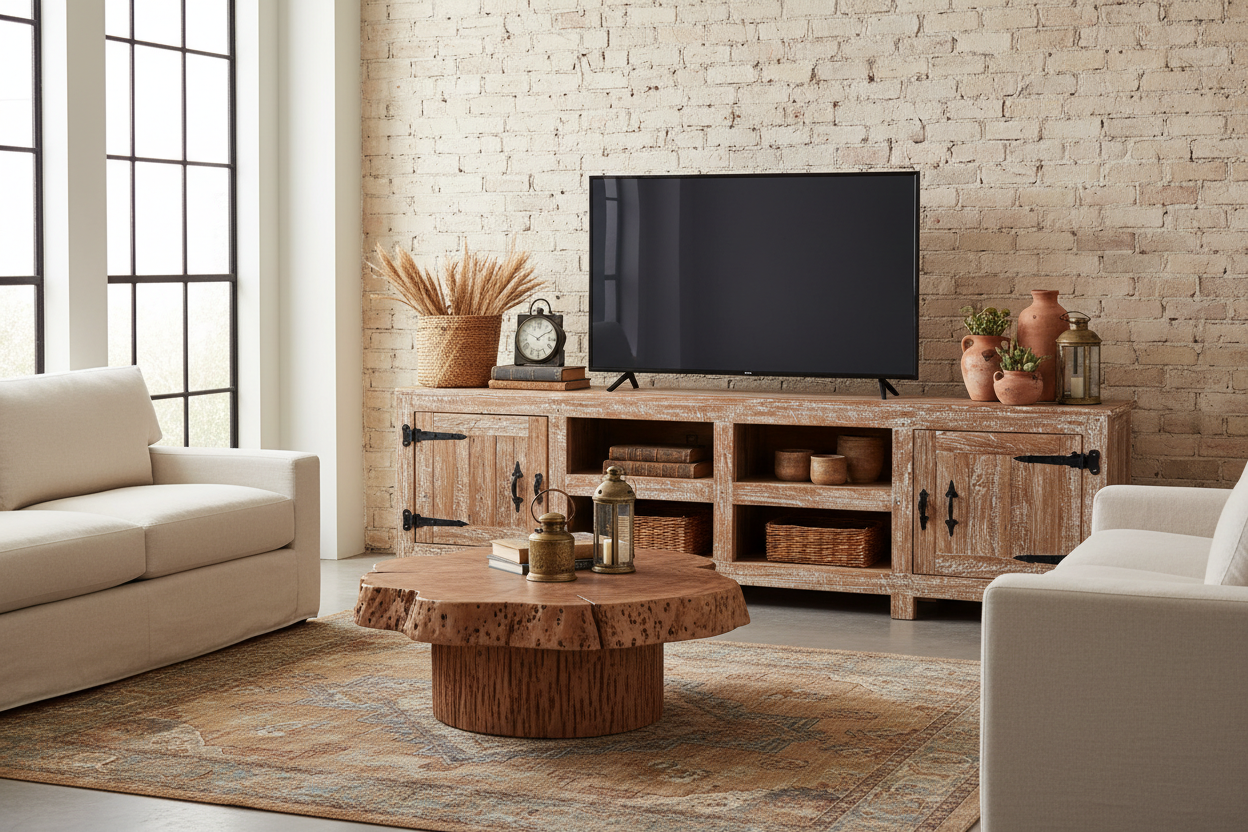
I remember staring at my 65-inch OLED and feeling like my living room had been colonized by a tech startup's waiting room. The screen was crisp, but the atmosphere was sterile. I needed primitive tv stand ideas that would stop my home from looking like a retail showroom.
The solution wasn't another piece of flat-pack particle board. It was something with a soul—something that had seen a century of history before Netflix was even a glimmer in someone's eye. Here is how I learned to balance high-definition glass with hand-hewn wood.
- Primitive furniture adds immediate warmth to cold, high-tech devices.
- Authentic pieces use 'honest' materials like solid pine, poplar, and milk paint.
- You will likely need to drill holes for cable management—it's okay, I promise.
- Scale is everything; measure your electronics twice before buying an antique.
The Glossy Console Trap (And Why I Escaped It)
A few years ago, I fell for the 'modern minimalist' look. I bought a stylish black TV stand thinking it would disappear into the background. Instead, it just amplified the black rectangle of the TV, making the whole wall feel heavy and uninviting.
While that piece might work in a high-contrast industrial loft, it felt soulless in my 1920s bungalow. I realized that the more tech we bring into our homes, the more we need 'imperfect' textures to balance it out. I wanted saw marks, not high-gloss finishes that show every fingerprint and speck of dust.
What Actually Counts as 'Primitive' Furniture?
When I talk about primitive, I'm not talking about 'distressed' stuff from a big-box store. I'm talking about utilitarian pieces from the 18th and 19th centuries. These were made by farmers and local woodworkers, not factories. They were built to last, not to be replaced in three seasons.
Look for square nails, hand-planed backs, and original milk paint that’s worn away in all the right places. The contrast of a $2,000 OLED screen sitting on a 150-year-old pine chest is design magic. It grounds the room and makes the technology feel like a guest, not the master of the house.
My Favorite Primitive TV Stand Ideas (That Actually Hold Gear)
Not every antique is a good candidate for media storage. You need depth and stability. My top pick is always an old apothecary cabinet. The dozens of tiny drawers are perfect for hiding remotes, controllers, and manuals, while the flat top provides a sturdy base.
If you have a soundbar and a few consoles, compare the depth of an antique chest to standard TV stands. Most modern consoles are about 18 to 20 inches deep; many primitive benches or 'dough boxes' are narrower, so check your footprint. A long Shaker-style bench can work beautifully if you mount the TV on the wall and just use the bench for a few curated objects and a cable box.
Going Bigger: Rustic Entertainment Center Ideas
Sometimes a single low console isn't enough, especially if you're trying to fill a massive wall. This is where rustic entertainment center ideas come into play. I’m a huge fan of using a step-back cupboard or a large jelly cupboard as the anchor for the room.
If you find a piece with removable shelves, you can tuck the TV right inside. This allows you to close the doors and hide the screen entirely when you're not using it. For more inspiration on how to utilize vertical space, check out this look at a rustic entertainment center with shelves. It’s about creating a focal point that features your books and pottery as much as your screen.
Rustic TV Stand Decor Ideas That Don't Look Cluttered
The mistake people make with rustic tv stand decor ideas is over-styling. You don't want a graveyard of tchotchkes blocking your remote's IR sensor. Keep it simple and heavy. Think stoneware crocks to hold extra blankets or a single, chunky wrought iron candlestick.
I like to stack three or four vintage books (the ones with the linen covers, not the shiny dust jackets) next to the TV base. It softens the transition from the screen to the wood. If you have a mess of wires, a well-placed wicker basket on a lower shelf can hide a power strip perfectly. Texture is your friend; clutter is your enemy.
The 'Will It Hold My Cables?' Reality Check
Here is the hard truth: most 19th-century furniture builders weren't thinking about HDMI cables. To make these pieces functional, you’re going to have to drill. I remember the first time I took a hole saw to an 1850s cupboard. My hands were shaking.
But here’s my take: if the piece is already 'primitive' and shows a lifetime of wear, a two-inch hole in the back panel isn't a sin—it's a modification that keeps the piece useful for another fifty years. Just use a clean drill bit and keep the hole as low as possible. If you can't bear to drill, look for pieces with 'slat' backs where you can snake a wire through the gaps.
Can I put a heavy TV on an old pine chest?
Usually, yes. Primitive furniture is often built from solid wood, which is much stronger than modern MDF. However, check for any 'bowing' in the top and ensure the legs are sturdy. If it wobbles when you nudge it, skip it or reinforce the base.
How do I stop my TV from scratching the old wood?
I use small felt pads on the bottom of the TV stand or a low-profile rubber mat. It protects the original finish and prevents the TV from sliding around on smoother, waxed surfaces.
What if the piece smells like an old barn?
A common issue with true primitives. Clean it with a mixture of white vinegar and water, then let it sit in the sun for a day. If the smell persists, a coat of clear shellac on the inside or unfinished areas usually seals in the odor for good.

Dejar un comentario
Este sitio está protegido por hCaptcha y se aplican la Política de privacidad de hCaptcha y los Términos del servicio.