










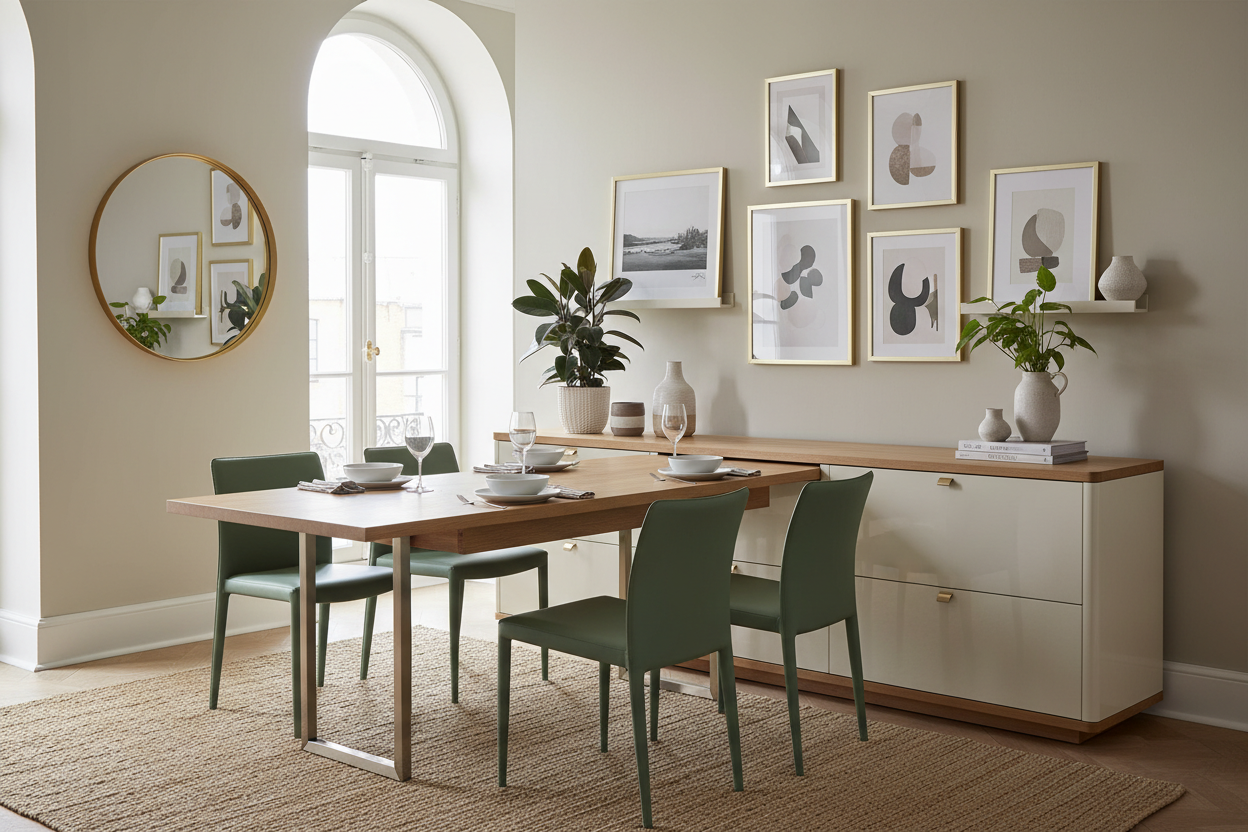
I used to host dinner parties where the buffet was actually just my guests balancing plates on their knees while I frantically cleared the dining table to make room for dessert. My old bar cart looked cute on Pinterest, but it was a disaster in reality. It wobbled if I even looked at a bottle of wine too hard, and the shelves were so narrow I couldn't even fit a standard dinner plate on them without it overhanging the edge. I finally realized I needed a cabinet with table functionality—something with a footprint that didn't eat the room but offered a real, heavy-duty surface for serving.
- Vertical storage is the only way to survive a dining room under 100 square feet.
- Standard console tables are usually 12 inches deep; you need at least 15 inches for a serving tray.
- Adjustable internal shelves are mandatory for storing bulky items like slow cookers.
- Always measure the 'door swing' to ensure you aren't blocking walkways when grabbing a napkin.
Why Standard Dining Furniture Completely Failed Me
For the longest time, I fell for the 'decorative console' trap. You know the ones—they are about as thick as a piece of toast and designed to hold exactly one lamp and a small bowl of keys. I tried using one as a sideboard during a Thanksgiving dinner, and the results were embarrassing. The legs were so spindly that every time someone scooped mashed potatoes, the whole table shivered. It offered zero storage, meaning my extra glassware stayed in the kitchen, forcing me to run back and forth like a marathon runner just to refill a drink.
The frustration peaked when I realized I was avoiding hosting because the logistics were too stressful. I eventually swapped my console table for something that actually had some weight to it. I stopped looking at furniture as just a 'filler' for a blank wall and started looking for utility. If a piece of furniture doesn't solve at least two problems—like storage and surface area—it doesn't get a spot in my house. I needed something that could handle a 20-pound turkey without bowing in the middle.
Enter the Cabinet With Table (My Hosting Lifesaver)
The shift happened when I found a hybrid unit that functioned as a cabinet with table top. This isn't just a cupboard; it’s a dedicated station. The surface is deep enough to actually hold a row of wine bottles and a cheese board simultaneously. When you have a dedicated, sturdy surface to place heavy serving dishes, the flow of the room changes. Guests naturally gravitate toward the sideboard to help themselves, which clears the 'traffic jam' around the main dining table.
I specifically looked for a piece that could function as a console table for living room or dining room use. Why? Because versatility is king in a small apartment. The height is the most important factor. If it’s too high, it feels like a bar; too low, and it looks like a TV stand. I found that a 34-inch height is the sweet spot for serving food without straining your back. It acts as an extension of my kitchen counter, providing that extra three feet of workspace I desperately lack when I'm plating dinner for six people.
The 'Hidden Depth' Benefit Nobody Mentions
While the top surface is the star during the party, the internal storage is what keeps my sanity the rest of the year. Most people don't realize how much 'kitchen overflow' they actually have until they try to fit it all in one place. A table with cabinet storage underneath finally gave a home to the awkward stuff. I'm talking about the 6-quart slow cooker, the oversized wooden salad bowls, and the stacks of 'fancy' plates that I don't want gathering dust on an open shelf.
I ended up choosing a buffet cabinet with storage because the internal dimensions were wide enough for my largest serving platters. One mistake I made in the past was buying a cabinet with fixed shelves. Never do that. You want adjustable pegs so you can move a shelf up three inches to fit a tall blender or down to accommodate a stack of pizza stones. It’s about maximizing every cubic inch of that 'hidden' space so your kitchen counters can actually stay clear for once.
How I Style the Top When I'm Not Hosting
On a random Tuesday, I don't want my dining room looking like a buffet line at a hotel. The beauty of a cupboard with table surface is that it transitions into a 'normal' piece of furniture instantly. I keep it simple: a dimmable lamp for ambiance, a few thick art books, and maybe a single tray for mail. It keeps the surface from becoming a clutter magnet while still looking intentional. I’ve seen people turn these into mini libraries or even a plant stand, which works great if the top is water-resistant.
If you have a collection of nice glassware that you’re proud of, you might consider pairing a solid wood unit with a black cabinet with glass doors nearby. I like the contrast of one 'hidden' storage piece and one 'display' piece. In my own space, I turned one end of the cabinet into a permanent coffee station. My espresso machine lives there, which frees up about 14 inches of precious real estate on my actual kitchen counter. It makes the dining room feel like a destination rather than just a pass-through space.
The Three Measurements You Actually Need to Take
Before you hit 'buy,' you have to do more than just measure the length of your wall. The first measurement is the 'door swing.' I once bought a gorgeous three-door unit only to realize I couldn't open the middle door all the way because it hit the corner of my dining table. You need at least 36 inches of clearance between the cabinet and the table to allow someone to walk behind a seated guest. If you're tighter than that, you might want to look for sliding doors instead of swinging ones.
Second, check the height against your dining chairs. If the cabinet is significantly higher than the chairs, it can feel like it's looming over the room. A medium storage cabinet usually hits that 30-to-34-inch mark that feels balanced. Lastly, check the depth of your largest tray. If your favorite Thanksgiving platter is 16 inches wide and the cabinet is only 14 inches deep, you're going to have a very precarious (and potentially messy) situation on your hands. Measure twice, or you'll be the one balancing plates on your knees again.
Is a cabinet with table sturdy enough for a microwave?
Generally, yes, provided the unit is made of solid wood or high-density MDF. Check the weight capacity of the top surface—most buffet-style cabinets can handle 50 to 100 pounds easily. Just make sure the depth of the cabinet exceeds the depth of the microwave's feet by at least two inches for safety.
How do I keep the cabinet from looking cluttered?
Use the 'rule of three.' Place one large item (like a lamp), one medium item (a stack of books), and one small item (a candle) on the surface. Use the internal storage for everything else. If you see more than five items on the top, it’s time to start tucking things away inside the doors.
What is the difference between a sideboard and a cabinet with table?
It’s mostly terminology, but a 'cabinet with table' usually implies a flatter, more functional work surface and deeper internal storage. Sideboards are often more decorative and can sometimes be lower to the ground. For hosting, you want the height and depth that a hybrid cabinet provides.

Dejar un comentario
Este sitio está protegido por hCaptcha y se aplican la Política de privacidad de hCaptcha y los Términos del servicio.