










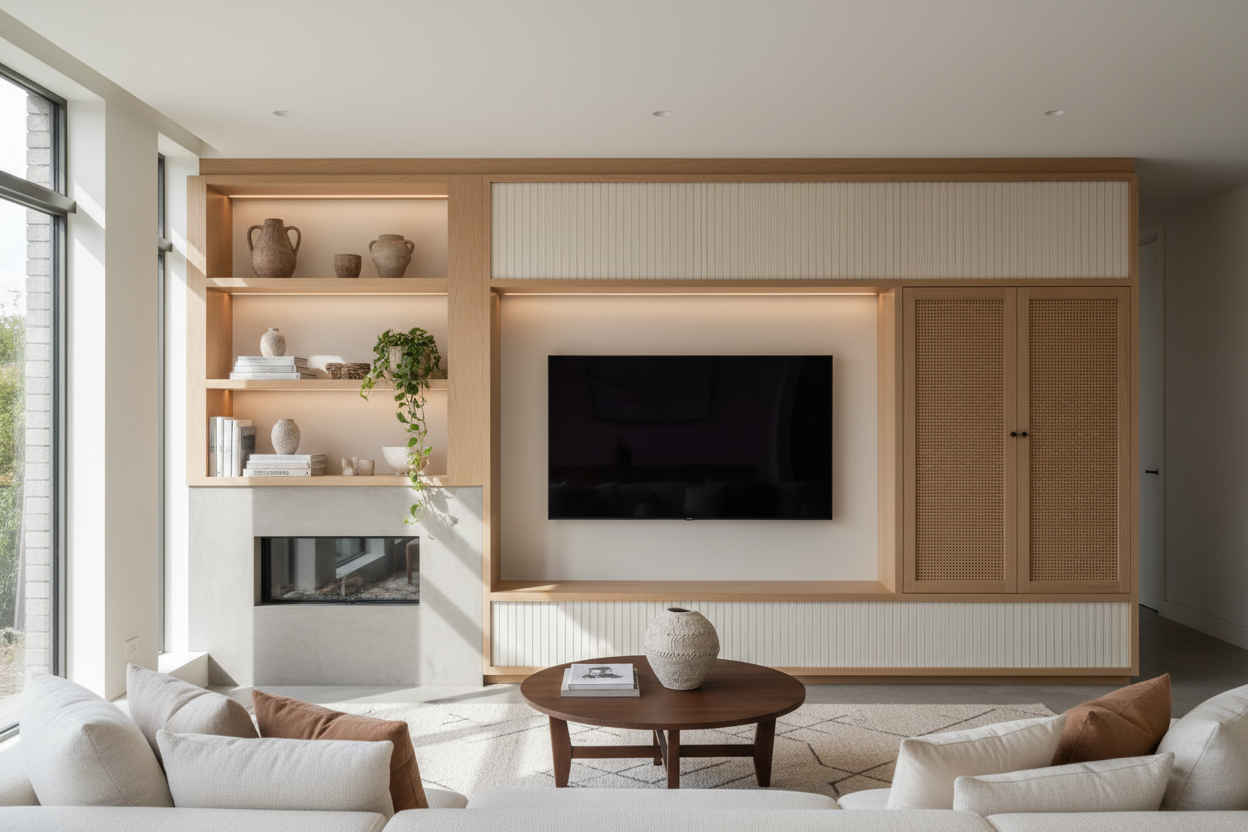
I spent three years staring at a 65-inch flat screen that looked like a giant black sticker slapped onto a featureless white wall. I tried the whole gallery wall thing, I tried a fiddle-leaf fig in the corner, and I even tried one of those mid-century credenzas that everyone on Instagram has. Nothing worked. The room felt like a temporary staging area rather than a home. It wasn't until I committed to a built ins tv wall that the proportions of the room finally clicked into place.
Quick Takeaways
- Depth is non-negotiable: Your base cabinets need at least 18-20 inches to house modern tech.
- Scale up: If the unit is too small, it looks like a cheap add-on rather than architecture.
- Ventilation matters: Don't trap your Xbox in a wooden coffin; use mesh or slats.
- The 'Fake' route: High-quality stock cabinets can look custom with the right crown molding.
The 'Blank Box' Living Room Dilemma
My living room was a classic 'blank box.' No fireplace, no architectural molding, just four drywall rectangles and a dream. I realized that freestanding furniture, while great for flexibility, often fails to anchor a large room. Every time I sat on the sofa, my eyes were drawn to the messy tangle of HDMI cables and power strips peeking out from behind my media console. It was visual clutter that made me feel like I was still living in my college apartment.
I eventually ditched my TV stand for a built in because I wanted that 'always been there' look. Standard furniture is usually 16-18 inches deep and 60 inches wide. In a 15-foot-wide room, that just leaves awkward gaps on either side that collect dust and cat toys. Investing in wall built ins for tv isn't just about storage; it's about defining the focal point of your home so the TV doesn't feel like an uninvited guest.
Getting the Proportions Right (Bigger Is Always Better)
The biggest mistake I see in DIY forums is the 'postage stamp' effect. People build a small surround that just barely fits the TV, leaving three feet of empty wall on either side. It looks timid. A built in media wall unit should command the space. If you have the wall, use it. I designed mine to go floor-to-ceiling and wall-to-wall, which actually made the room feel larger because it drew the eye upward and eliminated those choppy visual breaks.
When planning your built in tv cabinet design, remember that your TV will likely get bigger in five years. I left a 70-inch opening for a 65-inch TV. If I had built it tight to the frame, I'd be stuck with that screen size forever or be looking at a very expensive demolition job. Aim for at least 4 inches of clearance on the top and sides. This prevents the 'crammed' look and allows for better airflow, which is vital for the longevity of your electronics.
Making Sense of Under TV Built In Cabinets
The lower third of the unit is the workhorse. This is where people usually mess up the depth. Most traditional TV stands are surprisingly shallow, around 15 to 16 inches. That is barely enough room for a standard AV receiver once you account for the cables sticking out the back. For my under tv built in cabinets, I insisted on a 22-inch depth for the base. It sounds bulky, but once it's built-in, that extra depth disappears into the room's footprint.
I also opted for closed doors on the bottom. Open shelving is a trap for dust and makes your router look like a piece of decor (it isn't). Use solid doors or, if you use a remote that requires line-of-sight, look into infrared repeaters or perforated metal inserts. I also recommend 2.0 lb/ft³ HR foam for any bench seating integrated into the base—cheap foam sags within a year, and you want this to last a decade.
Finding the Sweet Spot: Built In Bookcase With TV Space
A built in bookcase with tv space needs a hierarchy. If every shelf is the same height, it looks like a retail display. I varied my shelf heights—taller on the bottom for coffee table books and shorter on the top for smaller objects. This creates a more organic, 'collected' feel. The goal is to make the TV part of the composition, not the only thing you see.
One trick I learned: paint the back of the shelves a slightly darker shade than the frame. It adds depth and makes your decor pop. In my tv room built in cabinets, I used a matte charcoal behind the TV and on the shelf backs. When the screen is off, it almost disappears into the dark background, which is a massive upgrade from a black rectangle staring at you from a white void.
My Favorite Built In Media Cabinet Ideas for Hiding Cords
Wire management is what separates the pros from the amateurs. I've seen beautiful built in tv console ideas ruined by a single white cord dangling from the bottom. I used a 'false back' system. My shelves aren't actually flush against the drywall; there is a 3-inch gap behind them where all the wires live. This allows me to run cables from the TV down to the base cabinets without drilling holes in my actual walls.
I actually stole this idea from a modern TV console cabinet I owned previously, which had a clever internal wire track. For the built-in, I used 2-inch PVC pipe inside the walls to act as a 'chute' for HDMI cables. If a cable fails or I need to upgrade to a 10K cable in the future, I just drop it through the pipe. No fishing wires through insulation or drywall surgery required.
When to Fake It vs. When to Go Fully Custom
Let's talk money. A fully custom, solid wood built in cabinets tv wall from a local cabinet maker can easily run you $8,000 to $12,000. If that's in the budget, do it. The quality of kiln-dried hardwood beats everything else. But if you're on a budget, you can 'hack' it. I used pre-finished kitchen base cabinets and built the upper shelving from 3/4-inch plywood. The secret is the trim. Adding a thick baseboard and beefy crown molding makes the whole thing look like one solid piece of architecture.
My biggest regret? Not adding enough outlets. I thought four was plenty. Between the TV, the soundbar, the gaming console, the router, and the smart home hub, I was out of plugs instantly. Double whatever number of outlets you think you need. It's much cheaper to add them during the framing stage than to call an electrician back once the paint is dry.
FAQ
How deep should my built-in shelves be?
For the upper shelves, 12 inches is standard for books and decor. For the bottom cabinets, go at least 18-22 inches to accommodate media components and provide a sturdy base.
Should I paint my built-ins the same color as the walls?
If you want them to feel like part of the architecture, yes. Using the same color in a different sheen (like satin on the cabinets and flat on the walls) creates a sophisticated, seamless look.
How do I prevent my electronics from overheating in a cabinet?
Never put a console or receiver in a fully sealed wooden box. Use slotted doors, mesh inserts, or install a small, silent USB-powered fan in the back of the cabinet to pull hot air out.


Dejar un comentario
Este sitio está protegido por hCaptcha y se aplican la Política de privacidad de hCaptcha y los Términos del servicio.