










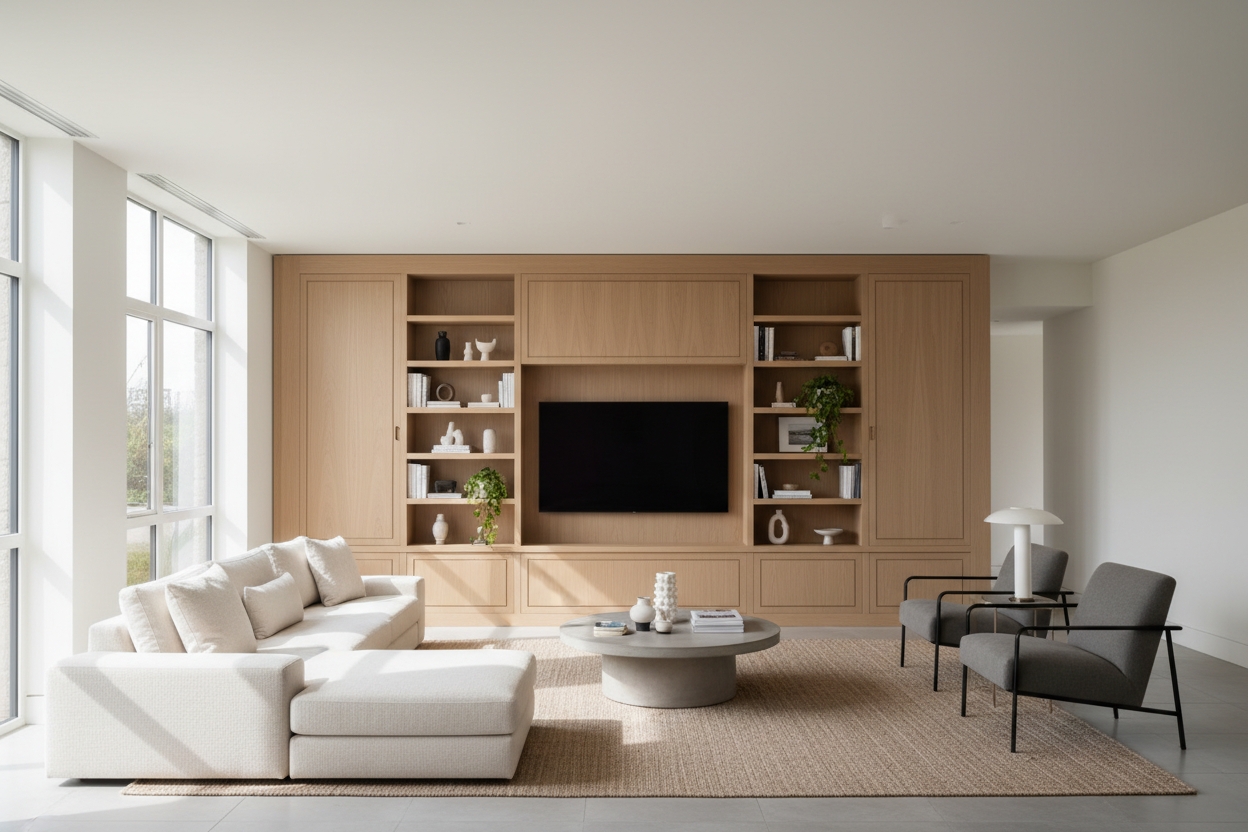
I spent an entire Saturday last spring trying to 'mask' my 65-inch television with a gallery wall of vintage botanical prints. By Sunday, I realized I hadn't made the TV disappear; I’d just created a visual migraine. It’s a common trap: we treat the wall behind the screen like a canvas instead of a piece of architecture.
If you are currently staring at a Pinterest board full of painted arches or peel-and-stick wood slats, take a breath and put down the level. These 2D DIYs rarely solve the core problem of a big screen. Instead of distracting from the technology, wall unit entertainment centers embrace it, providing the physical structure and depth that a coat of 'Terracotta' paint simply can't offer.
- Depth over Decor: Furniture adds literal inches of dimension that paint lacks.
- Cable Chaos: Built-in cord management beats plastic cord hiders every time.
- Visual Weight: Large rooms need large furniture to feel grounded.
- Storage: You can't put a PlayStation or a stack of board games inside a painted arch.
The 'TV Accent Wall' Trap (And Why It Usually Fails)
We’ve all seen the trend: a perfectly symmetrical arch painted in a muted sage green, or those vertical wood slats that every DIY influencer seems to be installing. On a phone screen, they look great. In your actual living room, they often feel like a stage set. These solutions are two-dimensional attempts to solve a three-dimensional problem.
When you place a massive black rectangle against a flat, painted wall, the contrast is jarring. No amount of 'boho' decor can hide the fact that you have a giant plastic box hanging on your drywall. Worse, these trends tend to date themselves within eighteen months. Remember the 'Keep Calm and Carry On' posters? That’s where the painted TV arch is headed. Plus, you’re still left looking at that messy tangle of black cords snaking down to the outlet. It’s not a vibe; it’s a distraction.
Why Physical Depth Beats 2D Visual Noise
The real secret to a high-end living room isn't the color of the walls—it's the architecture of the space. Most modern homes are essentially drywall boxes. By introducing wall and entertainment units, you are essentially adding custom cabinetry that changes the shape of the room. It’s the difference between a house and a home that feels 'designed.'
A proper unit provides a recessed 'niche' for your screen. This physical depth creates shadows and layers that make the TV feel like it belongs there, rather than being an afterthought. If you’ve been scrolling through 47 tabs of DIY tutorials, consider shopping for an entertainment center instead. You’ll find that a unit with a 16-inch or 18-inch depth does more for the room's 'expensive' feel than any amount of accent paint ever could. It anchors the wall, giving your eyes a place to rest.
Framing the Black Box Instead of Fighting It
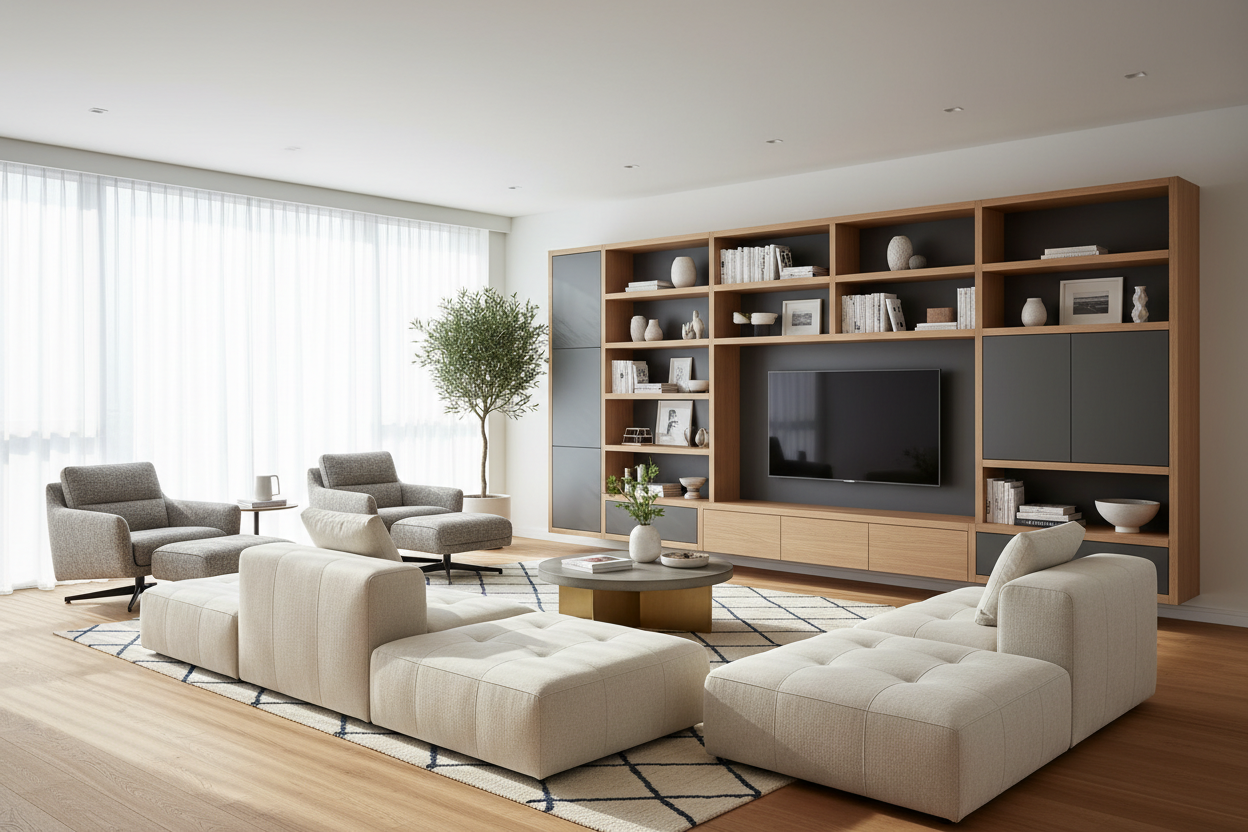
Stop trying to hide the TV. You use it every day; it’s okay to let it be part of the room. The beauty of living room entertainment wall units is that they use symmetry to balance the visual weight of the screen. When you have tall towers or shelving on either side of the television, the screen becomes the center of a balanced composition rather than a black hole sucking the life out of your decor.
The key is styling those surrounding shelves with intention. Mix your books with some ceramic vessels or a few trailing plants. This 'frames' the technology with organic textures. Just be careful with the scale—you don't want your accessories to look like dollhouse furniture. When sizing your unit correctly, ensure there is at least a few inches of 'breathing room' between the edge of the TV and the shelving. If it’s too tight, the TV looks like it’s being strangled; if it’s too wide, it looks lost.
The Practical Bonus: Hiding Your Actual Life
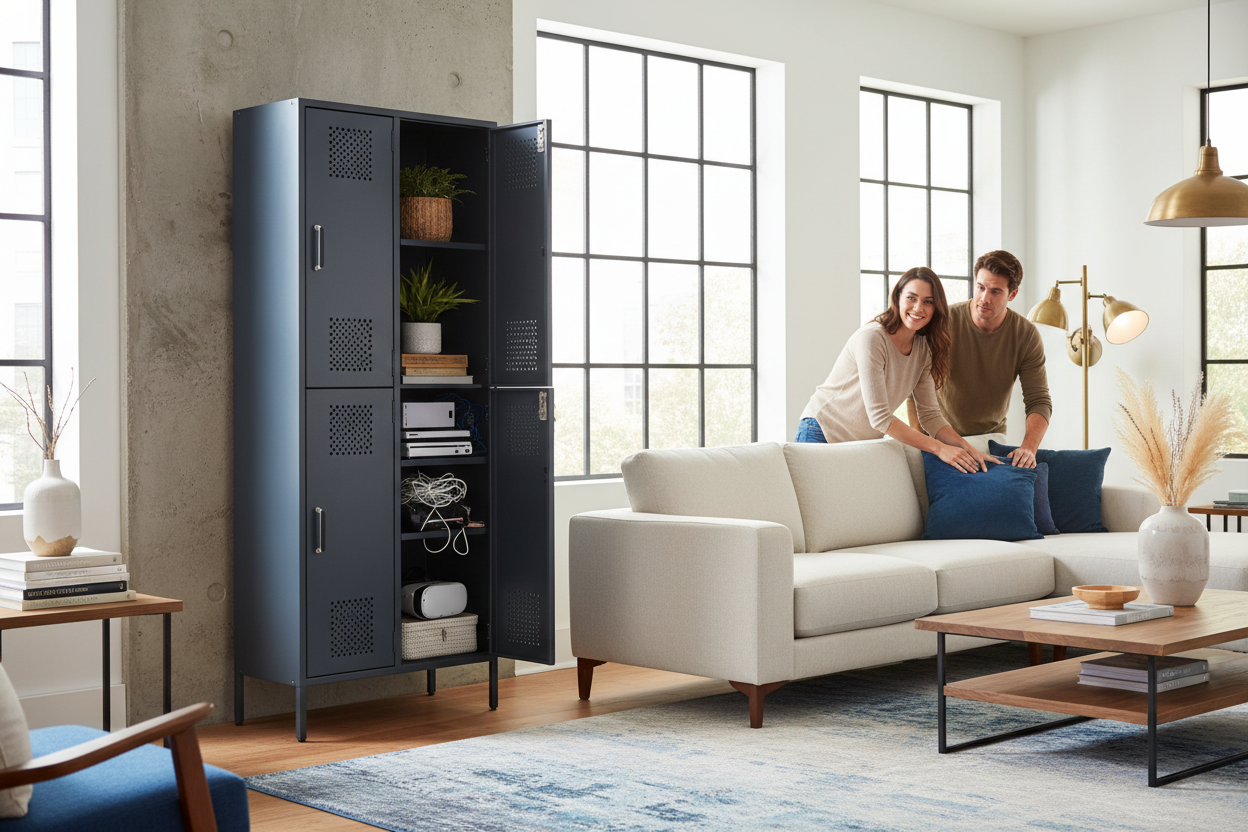
Let’s be honest: your living room isn't just a showroom. You have a router with blinking lights, three different remotes, a messy stack of coasters, and maybe a gaming console that looks like a miniature space station. A painted wall does nothing to help you manage this clutter. Wall entertainment centers are the ultimate 'functional' decor because they hide the ugly stuff behind closed doors.
I’m a big fan of units that feature a mix of open shelving and closed cabinetry. Use the top for your 'pretty' things and the bottom for the stuff you don't want guests to see. If a massive floor-to-ceiling unit feels a bit too heavy for your specific floor plan, you can always opt for a wide adjustable TV stand as a base and add floating shelves above it to mimic the look of a full unit without the bulk. This gives you the storage you need while keeping the 'visual footprint' a bit lighter.
My Honest Experience with the 'Big Unit' Move
I used to be a 'minimalist' who insisted on mounting the TV directly to the wall with nothing underneath it. I thought it looked 'clean.' In reality, it looked like a doctor's office waiting room. I finally caved and bought a solid wood wall unit with a dark walnut finish. Was it a pain to assemble? Yes. I spent four hours on my living room floor with a hex key and a glass of wine. But the second I pushed it against the wall and tucked those messy cords into the back panel, the room finally felt finished. The downside? It’s heavy as lead. If you’re a frequent mover, look for modular units rather than one solid piece.
Frequently Asked Questions
Will a large wall unit make my small room look smaller?
Actually, the opposite is often true. Using one large, tall piece of furniture creates a vertical line that draws the eye upward, making the ceiling feel higher. A bunch of small, scattered pieces of furniture usually makes a room feel more cramped and cluttered.
How do I know if my TV will fit?
Always measure the actual width of your TV, not just the diagonal screen size. A '65-inch TV' is usually about 57 inches wide. Ensure your unit’s center opening has at least two inches of clearance on all sides to prevent overheating and to make installation easier.
Are wall units out of style?
The '90s oak monsters with glass doors and CD racks are out. Modern versions with clean lines, matte finishes, and integrated LED lighting are very much in. Look for 'floating' styles or units with thin metal frames if you want a more contemporary look.

Dejar un comentario
Este sitio está protegido por hCaptcha y se aplican la Política de privacidad de hCaptcha y los Términos del servicio.