










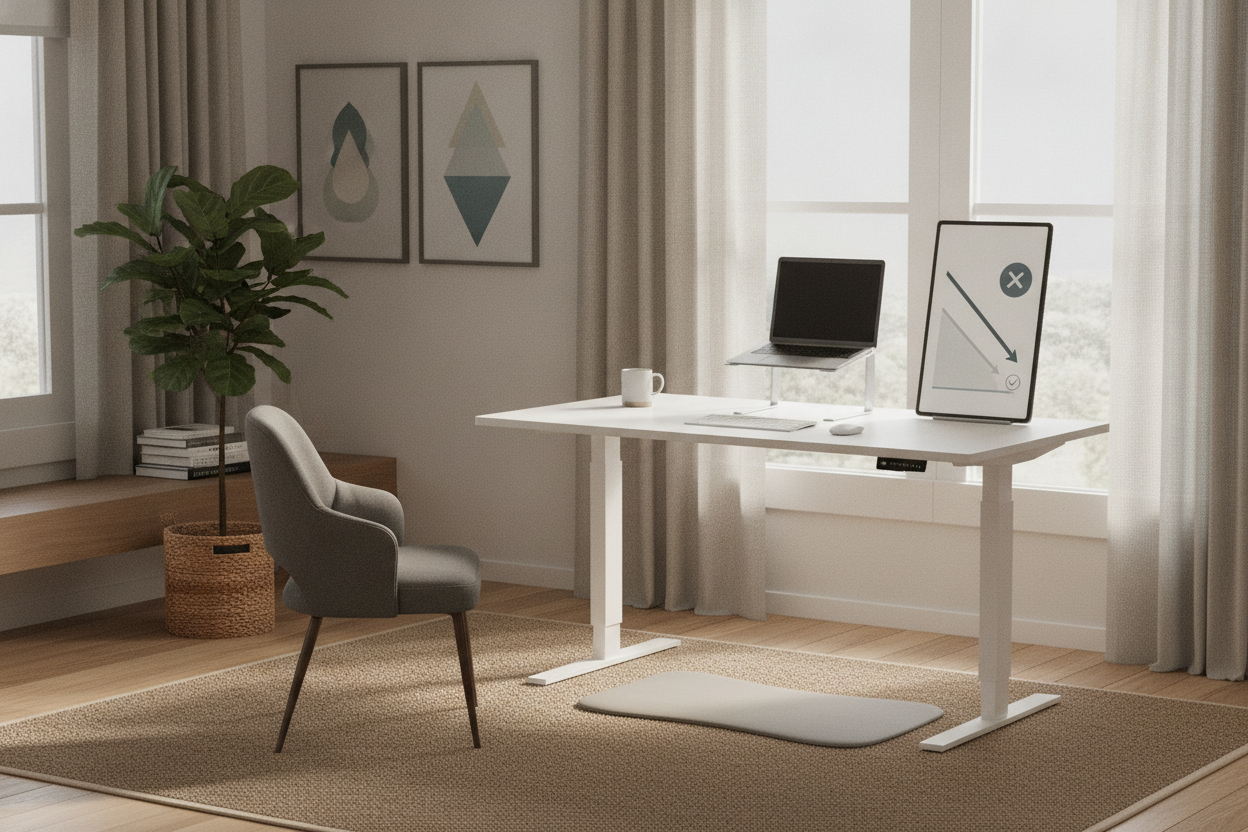
I remember staring at a '70% off' price tag for three months straight, waiting for the timer to run out. It never did. That was my first lesson in the murky world of office furniture: if a deal looks too good to be true, it is probably just a standard price dressed up in a costume. Finding a legitimate discount standing desk shouldn't feel like a shell game, but retailers make it hard to tell the gems from the junk.
- Ignore the 'MSRP'—it is almost always an arbitrary number designed to make a 20% discount look like a 60% steal.
- Check the motor warranty; if it is less than three years, the brand doesn't trust its own product.
- Memory presets are the difference between a desk you actually use and one that stays at sitting height forever.
- Price-tracking tools are your best friend for spotting genuine seasonal drops.
The 'Always on Sale' Illusion
Some of the biggest names in budget furniture use a tactic called 'price anchoring.' They list a desk at $800, but it has never actually sold for that price. They immediately mark it down to $349 and call it a massive sale standing desk event. This is a huge red flag. If a company is constantly running a 'closing soon' sale, they are usually overcompensating for a lack of quality.
It is much easier to gauge fair pricing on a traditional writing computer desk because there are fewer moving parts to hide behind. With motorized desks, brands hide cheap, noisy motors and flimsy 1.2mm steel frames behind a 'limited time' discount. I have seen these $200 'deals' wobble like a Jenga tower the moment you put a dual-monitor setup on them. If the price never changes, that is just the cost of a cheap desk, not a bargain.
How to Tell if a Stand Up Desk Sale is Actually Real
To find a real stand up desk on sale, you have to look at the calendar. Genuine deep discounts usually happen in late August (Back to School) and during the 'Big Three' holidays: Labor Day, Black Friday, and New Year’s. If you see a price drop during these windows, it is likely a legitimate move to clear inventory for next year's models.
I always use browser extensions like CamelCamelCamel or Honey to look at the price history. If a desk has been $299 for six months and suddenly drops to $249, that is a real win. If it was $499 yesterday and $299 today, but it was also $299 last Tuesday? Move on. You want a brand that values price integrity over psychological tricks.
Don't Compromise on the Controller (Seriously)
The biggest mistake I see people make when hunting for a bargain is buying a desk with a simple 'up/down' button. It sounds fine until you realize that finding your perfect ergonomic height takes twelve seconds of micro-adjustments every single time you stand up. You will eventually stop standing because it is a chore.
Even a budget-friendly model should have a keypad that saves your heights. I usually point people toward a sit stand up desk with memory preset controller because that one-touch movement is what makes the habit stick. If you have to hold the button down while your coffee sloshes around, you bought the wrong desk.
Are Open-Box and Clearance Models Worth the Risk?
If you are looking for a stand up desk for sale at a massive discount, the 'Open Box' section is where the real gold is buried. Most of these are just 'buyer's remorse' returns where the person realized the desk was too big for their corner. You can often snag a $600 frame for $250 just because the box is beat up.
However, there is a catch. Most manufacturers void the warranty the second a desk is sold as 'Open Box.' Since the motor is the part most likely to fail, you are taking a gamble. Check the listing for 'missing hardware' notes. I once bought a clearance frame that was missing the proprietary M6 bolts, and I spent three days hunting through hardware stores just to get the legs to stay on. If it says 'sold as is,' bring your own toolbox and a healthy dose of skepticism.
Making a Smaller, Cheaper Desk Work for Big Screens
To hit those 'too low to resist' price points, many brands shrink the desktop. A standard desk is 30 inches deep, but a discount model is often only 24 inches. This puts your monitor right in your face, which is a recipe for eye strain and a cramped workspace. I tried this with a 34-inch ultrawide and felt like I was sitting in the front row of a movie theater.
You can fix this by getting the screen off the desk entirely. Try a TV monitor on stand or a heavy-duty C-clamp monitor arm to reclaim that lost surface area. By pushing the screen back a few inches past the edge of the desk, a cheap 24-inch deep surface suddenly feels like a premium executive workstation. It is the easiest way to make a budget purchase feel high-end.
FAQ
Is a single-motor desk okay?
For a basic laptop setup, yes. But if you have two monitors and a heavy PC tower, single motors struggle and often burn out within a year. Dual motors are quieter and much more reliable.
What is a 'good' price for a budget desk?
Between $250 and $350 is the sweet spot. Anything under $200 usually uses a thin, two-piece desktop that will sag in the middle after a few months.
Should I buy a desk with a glass top?
They look cool, but you can't use monitor arms with most glass tops, and they are total fingerprint magnets. Stick to laminate or solid wood if you actually plan to work there.

Dejar un comentario
Este sitio está protegido por hCaptcha y se aplican la Política de privacidad de hCaptcha y los Términos del servicio.