










I spent three years living in a house that looked like a blank sheet of paper. Every time a guest came over, they would ask if I had just moved in, even though I had been there since 2019. I was so obsessed with the 'minimalist' look—hiding every single possession behind solid white doors—that I accidentally erased my entire personality. My home felt like a high-end dentist's waiting room.
The truth is, a home without visible objects feels unlived in. It lacks soul. I finally broke my 'hide everything' rule when I realized that living room display furniture isn't about creating clutter; it is about curation. It is the difference between a house that looks like a catalog and a home that tells a story.
Quick Takeaways
- Glass doors keep the dust off your stuff while keeping it visible.
- Vertical cabinets (70 inches+) make small rooms feel taller by drawing the eye upward.
- The best pieces mix glass tops with solid bottom cabinets to hide ugly essentials.
- Negative space is your friend—leave about 30% of every shelf empty.
The 'Hide Everything' Trend Has Officially Gone Too Far
For the last decade, we have been told that 'clean' means 'empty.' We bought wardrobes with no handles and sideboards that blended into the drywall. But after spending way too much time at home recently, many of us realized that staring at blank walls is boring. It makes your space feel like an Airbnb where you are afraid to touch the remote.
I am a reformed minimalist. I used to think a single candle on a marble slab was 'design.' Now, I want to see my weird thrifted ceramics, my grandmother’s tea set, and the books that actually shaped my brain. Bringing these items out into the open adds warmth and texture that paint and rugs just can't provide. It makes a room feel human.
Finding the Right Living Room Display Furniture
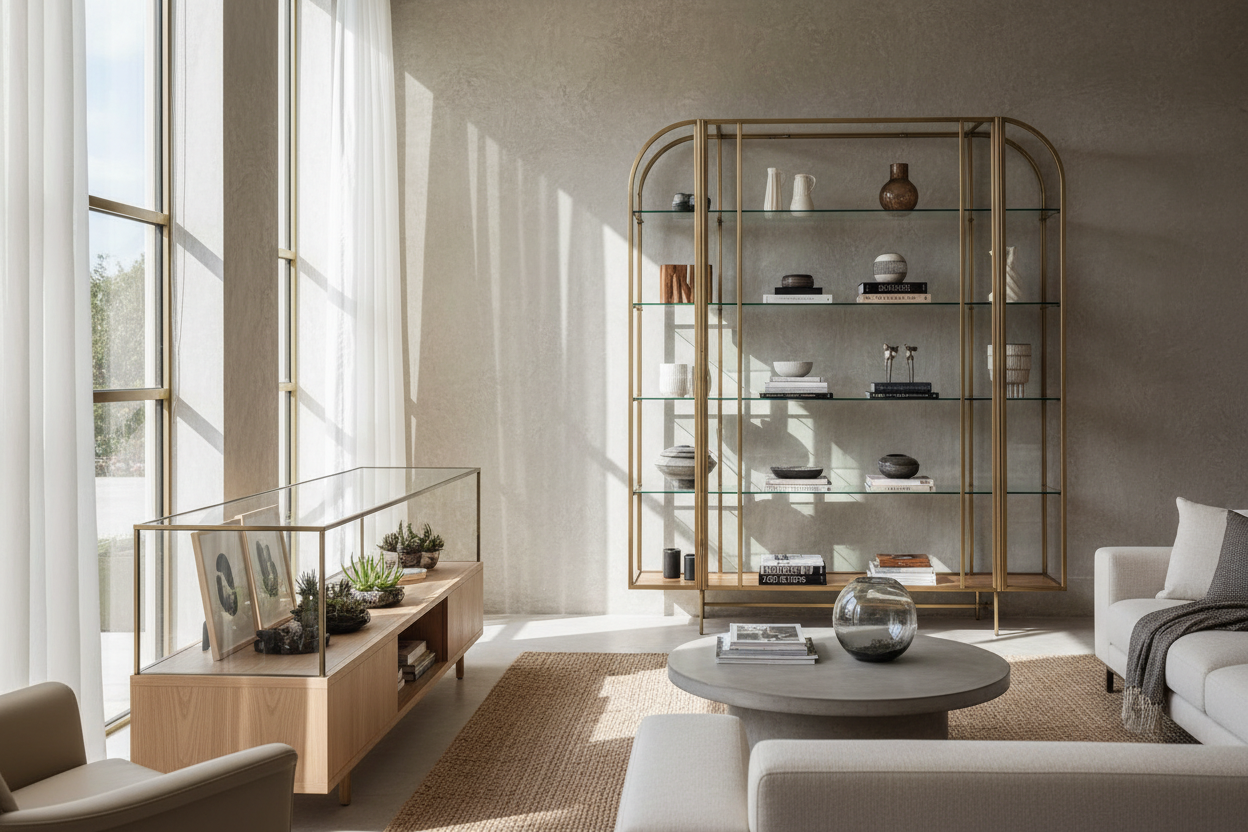
We are not talking about those massive, honey-oak curio cabinets from the 90s that weighed 400 pounds and held nothing but porcelain bells. Modern silhouettes are much leaner. Think matte black steel frames, arched tops, and tempered glass that feels substantial, not flimsy. When you are updating your living room, look for pieces with a depth of 14 to 16 inches. Anything deeper starts to eat into your walking paths and feels bulky.
I always check the glass quality first. You want tempered glass—usually 1/4-inch thick—so it doesn't rattle every time someone walks past. I once bought a cheap unit with thin glass panes, and it sounded like a wind chime every time the dog barked. Never again.
Why the Living Room Showcase Cabinet is Making a Comeback
The living room showcase cabinet has evolved. We are seeing a huge surge in 'industrial-chic' and 'modern-arch' styles that act as a frame for your life. Fluted glass is a personal favorite of mine; it offers a bit of mystery by blurring the objects inside, which is great if you aren't a master at perfectly straight book stacks.
If you have high ceilings, go big. A tall display cabinet with glass doors creates a focal point that doesn't feel heavy because the transparency keeps the room airy. I’ve found that a 70-inch height is the sweet spot—it’s tall enough to be commanding but doesn't require a ladder to clean the top.
How to Style Your Pieces Without the Clutter
The biggest fear people have with glass doors is that their house will look like a thrift store shelf. The secret is the 'Rule of Three.' Group items in odd numbers and vary the heights. Place a tall vase next to a medium-sized stack of books, and finish it with a small decorative object. It creates a visual triangle that the eye loves.
Don't just line things up like soldiers. Lean a small piece of art against the back of the cabinet to create depth. When you're learning how to style a glass display cabinet, remember that white space is just as important as the objects themselves. If every inch is covered, it’s storage. If there is room to breathe, it’s a gallery.
The Golden Rule: Mix Open Display with Closed Storage
Let’s be real: not everything you own is 'display-worthy.' I still have tangled HDMI cables, half-finished puzzles, and a collection of coasters that have seen better days. You don't want those behind glass. The most functional pieces of furniture are hybrids.
I always recommend a large sideboard display buffet for this exact reason. You get the glass-fronted doors on top for your pretty glassware or collectibles, but you have solid drawers or wooden doors at the bottom for the 'ugly' necessities of life. It’s the best of both worlds.
My Honest Mistake
I once bought a gorgeous display case made of cheap MDF because it looked great in photos. Within six months, the shelves started to 'smile'—they bowed right in the middle under the weight of my hardback books. Now, I only buy units with reinforced metal frames or solid wood shelves. If you're planning on displaying heavy items, check the weight capacity per shelf. You want at least 30-40 lbs of support if you're a book lover like me.
FAQ
Is glass furniture hard to keep clean?
If you have kids with sticky fingers, yes, you will be using Windex. But for most adults, a quick wipe once a week is all it takes. The upside? The glass actually protects your items from dust, so you spend less time cleaning your knick-knacks.
Should I add lighting inside my cabinet?
Yes, absolutely. Battery-operated LED puck lights are a cheap way to make a $300 cabinet look like a $3,000 custom built-in. Stick them to the underside of the shelves for a high-end glow at night.
Are tall cabinets a tipping hazard?
Yes, especially on carpet. Most modern manufacturers include an anti-tip kit. Use it. I don't care if you don't have kids; an earthquake or a heavy vacuum bump can send a 70-inch cabinet over in a second.


Dejar un comentario
Este sitio está protegido por hCaptcha y se aplican la Política de privacidad de hCaptcha y los Términos del servicio.