










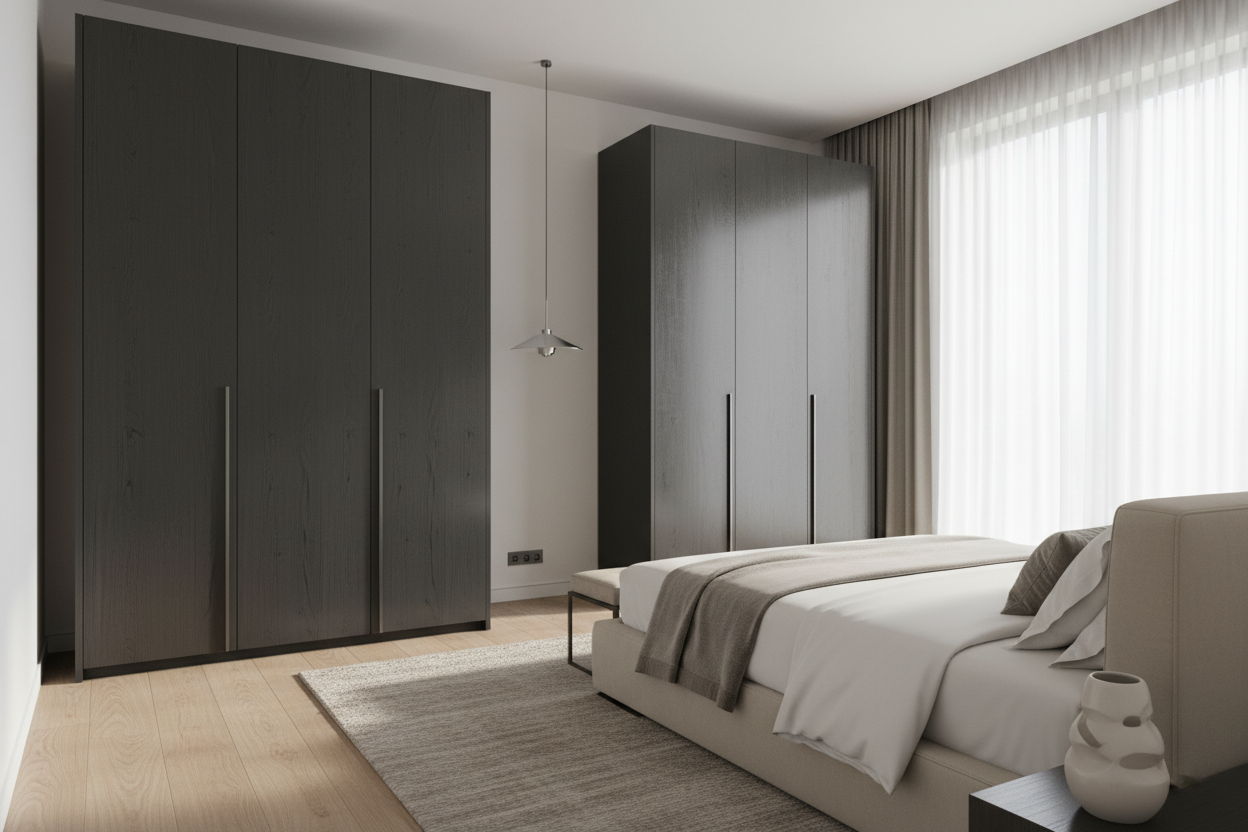
We have all seen it: the infamous bedroom chair that slowly disappears under a mountain of half-worn clothes. When standard closets fail and dressers take up too much floor space, the instinct is to build upward. Incorporating a tall cabinet for bedroom organization is one of the most effective ways to reclaim your floor plan, but it is also incredibly easy to get wrong. A piece that looks perfectly scaled in a massive, brightly lit furniture showroom can suddenly feel like a looming monolith when delivered to a standard twelve-by-twelve suburban bedroom.
After fifteen years of designing residential interiors across North America, I have learned that vertical furniture requires a completely different approach to space planning. In this guide, we will break down exactly how to choose, scale, and place a tall cabinet so you gain maximum storage without sacrificing the airy, restful feel your bedroom deserves.
Quick Decision Guide
- Mind the depth: Keep the cabinet depth between 15 and 18 inches to prevent it from encroaching on primary walkways.
- Match the visual weight: If you have a bulky upholstered bed, choose a cabinet with raised legs to allow light to pass underneath.
- Anchor it immediately: Tall furniture on carpeted bedroom floors will lean forward over time. Wall anchoring is non-negotiable for safety.
- Check the door swing: Always measure the distance between the cabinet and the bed to ensure doors can open fully without hitting the mattress.
Space Planning: Making Vertical Storage Work
The biggest challenge with tall bedroom cabinets is proportion. When you introduce a piece of furniture that reaches past the standard eye level, it immediately becomes a focal point, whether you want it to or not.
The Walkway Clearance Rule
A common mistake is treating a tall cabinet like a standard dresser. Because of its height, a tall piece requires more negative space around it to breathe. If you are placing a tall storage cabinet for bedroom use directly opposite the foot of your bed, you need a minimum of 36 inches of clearance. Anything less, and you will feel like you are shimmying through a canyon every time you walk to the en-suite bathroom. If your room is tight, look for sliding doors or split double doors to minimize the swing radius.
Managing Visual Weight
Dark woods and matte black finishes absorb light, making large pieces appear heavier. If you are working with a smaller room, consider a cabinet with glass-front upper doors, woven cane panels, or a finish that closely matches your wall color. This allows the piece to blend into the architecture rather than standing out as a bulky add-on.
Material and Build Quality
Not all vertical storage is built to handle the daily friction of a busy morning routine. When designing a tall storage bedroom layout, the materials dictate both longevity and structural integrity.
Solid Wood vs. Engineered Veneer
Because tall cabinets have long, unsupported side panels, structural bowing is a real concern. Solid woods like oak or walnut offer incredible durability and a beautiful, grounding texture. However, high-quality engineered wood with a thick wood veneer is often more resistant to the humidity fluctuations common in master bedrooms with attached bathrooms. Avoid low-density particleboard at all costs; the weight of heavy sweaters and denim on the upper shelves will cause the internal boards to sag within a year.
Designer's Honest Take: Lessons from My Own Projects
I once specified a stunning, matte-charcoal tall storage cabinet bedroom piece for a client's narrow Chicago townhouse. In the floor plan, the dimensions worked perfectly. In reality, I learned a hard lesson about door swing clearance and daily habits. The 24-inch wide solid doors hit the edge of the bed frame every time they were fully opened, making it incredibly frustrating for the client to put away laundry.
We eventually had to swap it out for a piece with narrow, bifold doors. The honest downside to any tall, deep cabinet is that it can easily turn into a dark abyss. If the piece doesn't come with interior lighting, you absolutely must install motion-sensor LED puck lights on the upper shelves. Otherwise, you will never find that black sweater pushed to the back corner.
Frequently Asked Questions
Where is the best place to put a tall cabinet in a bedroom?
The ideal placement is tucked into a recessed alcove or placed on a secondary wall adjacent to the bed, rather than directly opposite the door. Keeping tall pieces out of the direct line of sight when you enter the room makes the space feel larger and more inviting.
Can I use a tall cabinet instead of a dresser?
Yes, but look for a hybrid design. The most functional pieces feature deep drawers on the bottom half for undergarments and folded pants, and adjustable shelving on the top half for lighter items like t-shirts, sweaters, and accessories.
How do I keep a tall cabinet from looking out of place?
Tie it into the rest of the room by coordinating the hardware. If your nightstands have brushed brass pulls, swap the factory knobs on your cabinet for a matching finish. You can also balance its height by hanging a large piece of art or a mirror on the opposite wall.

Dejar un comentario
Este sitio está protegido por hCaptcha y se aplican la Política de privacidad de hCaptcha y los Términos del servicio.