










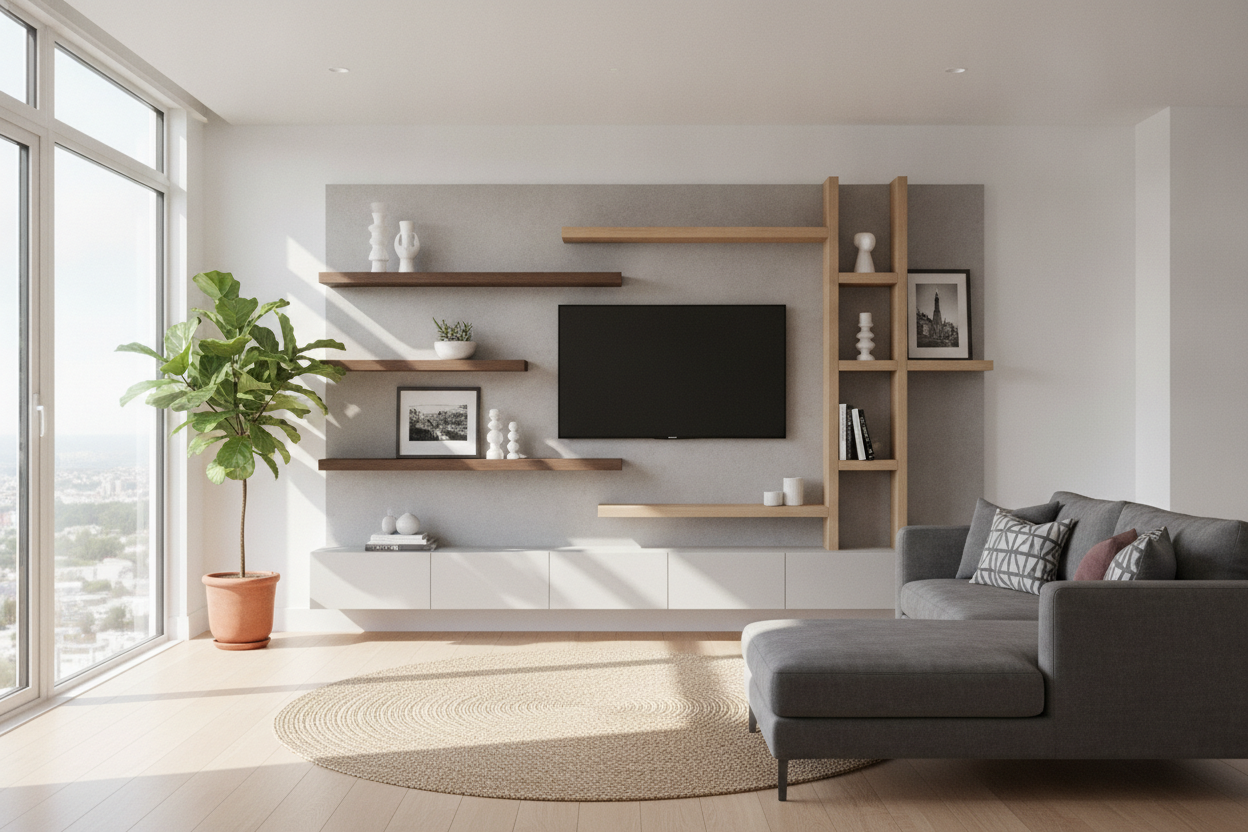
I spent three hours last Sunday staring at my living room wall with a level and a roll of blue painter's tape. I was trying to find the exact center of my console to mount my new 65-inch screen, and it just looked wrong. It felt like a lobby in a mid-range hotel—functional, sure, but completely devoid of soul. That is when I decided to scrap the tape and embrace the wall shelf tv layout that actually looks like a human lives there.
Quick Takeaways
- Symmetry often feels clinical; asymmetry feels intentional and curated.
- Counterbalance is the golden rule—if the TV is on the left, put something tall on the right.
- Staggered shelves create movement and prevent the 'big black box' from dominating the room.
- Cable management is harder with off-center setups but easily solved with a dedicated tech shelf.
Why Symmetrical Media Walls Feel So Rigid
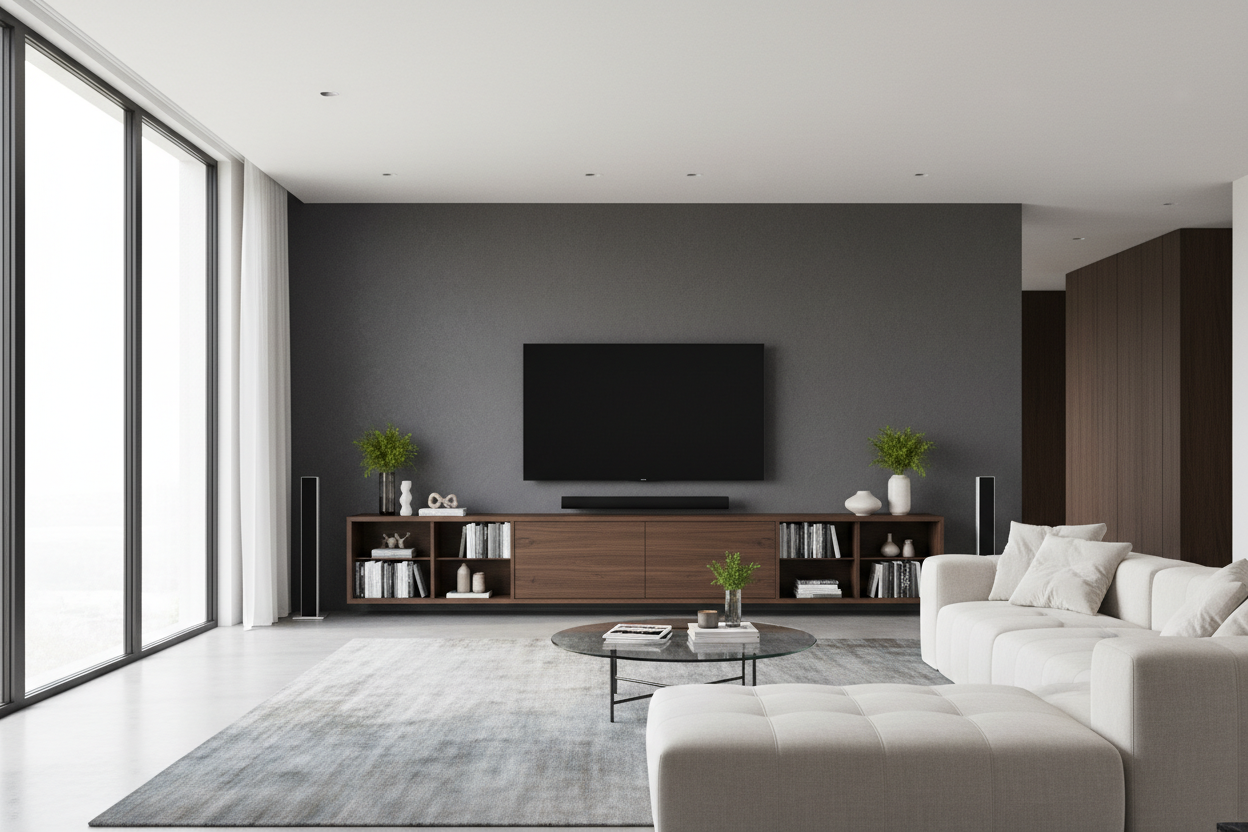
We have been conditioned to think that the TV must be the bullseye of the room. This 'hotel room effect' happens when you perfectly center a screen over a matching cabinet. It’s stiff. It’s predictable. By shifting the visual weight to one side, you break that rigid grid and make the room feel more relaxed. Before you commit to the drill, you might ask yourself: Do You Really Need an On Wall TV Shelf for a Mounted Screen? Often, the answer is about style rather than just utility.
The Secret to an Off-Center Setup (Without Looking Messy)
The biggest fear with an off-center tv shelf wall unit is that it will look like an accident. The trick is balance, not symmetry. If your TV is shifted to the left, you need something with height on the right to act as a counterweight. I usually recommend a tall display book cabinet to anchor the opposite side. This creates a diagonal line of interest that keeps your eyes moving across the wall rather than getting stuck on the heavy black rectangle of the screen.
Staggering Your TV Wall Mounted Shelves
Instead of one long, boring ledge, try staggering your tv wall mounted shelves. I like to place one longer shelf for flat screen tv components slightly lower and to one side, then two smaller ledges higher up on the opposite side. This architectural approach makes the wall mounted tv and shelves feel like a custom built-in rather than something you slapped together from a big-box store. Just make sure you're hitting studs; a 40-pound TV on a wall shelf to hold tv weight will rip through drywall anchors in a heartbeat.
Balancing the Void With Books and Art
An asymmetrical layout creates 'negative space.' If you leave that space empty, it looks like you ran out of money or ideas. Use that gap for framed art, a trailing Pothos plant, or a stack of oversized coffee table books. I’m a huge fan of using adjustable shelf storage for this because it lets you swap out taller vases or different art pieces as your collection grows. It turns the wall shelving units for tv into a living gallery.
Handling the Tech: Where Does the Cable Box Go?
The practical downside of shifting your screen is that your wires are no longer hidden by a centered console. You need a hanging shelf for tv components that sits close to the screen but doesn't ruin the lines. I actually bought a floating wall tv shelf specifically to keep my Apple TV and soundbar tucked away. It’s a small shelf for tv accessories that keeps the floor clear and the 'tech clutter' at eye level where it’s easier to manage.
Will This Actually Work in a Small Room?
In a tight 12x12 room, a centered TV can make the space feel even smaller by creating a single focal point that screams 'I AM A MEDIA ROOM.' An asymmetrical tv wall shelf stand actually tricks the eye. By spreading the elements out, you draw the eye across the entire width of the wall. Using a tv hanging shelf instead of a bulky floor unit also saves precious square footage, making a wall mounted tv stand with shelf the superior choice for apartment dwellers.
My Personal Experience
I once tried to force a perfectly centered 55-inch TV into a corner-heavy living room. It looked like the furniture was wearing the TV as a hat. After three days of hating it, I shifted the TV 18 inches to the left and filled the right side with three staggered wall shelves tv stand ledges. The room finally breathed. The only mistake? I didn't plan for the power cord length. Make sure your shelf to hold tv gear is within reach of an outlet, or you'll be staring at a dangling black cable for the next three years like I did.
FAQ
How high should a wall shelf for tv to sit on be?
Your screen should be at eye level when you are seated. Usually, this means the center of the TV is about 42 inches from the floor. Don't be the person with the 'TV too high'—your neck will thank you.
Can a floating shelf really hold a TV?
Only if it's specifically rated as a wall shelf for tv to sit on. Most standard decorative ledges are made of MDF and will sag. You need solid wood or steel brackets bolted directly into the wall studs.
What is the best way to hide cables in an asymmetrical layout?
Use paintable cord covers that match your wall color, or if you own the home, install an in-wall power kit. It makes the shelves to put tv on look much cleaner.

Dejar un comentario
Este sitio está protegido por hCaptcha y se aplican la Política de privacidad de hCaptcha y los Términos del servicio.