










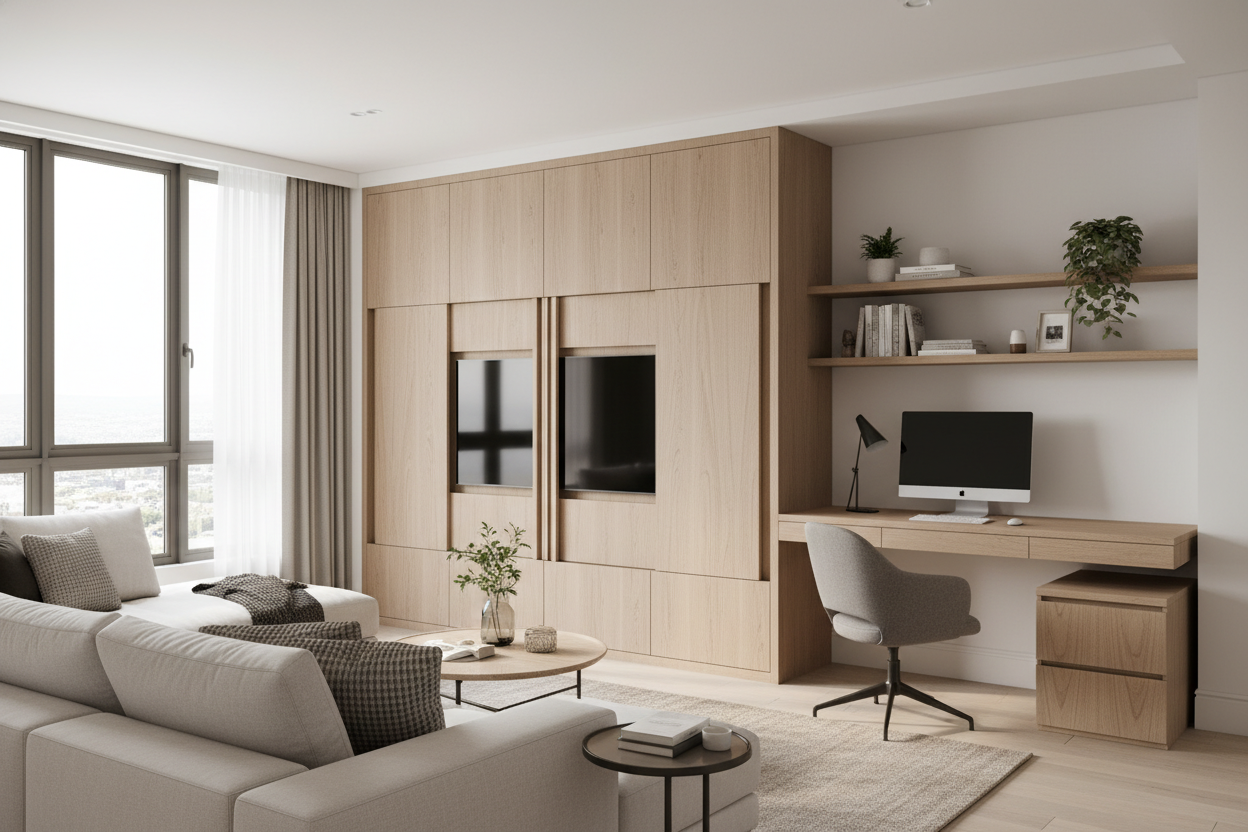
I’ve spent the last three years working from a 600-square-foot apartment where my office is also my dining room and my movie theater. There is a specific kind of madness that sets in around 2 PM when the sun hits the living room and you spend twenty minutes staring at your own reflection in the television instead of your spreadsheets. It’s a constant, glossy reminder that Netflix is just one button press away. That is why I finally caved and installed flat screen tv wall mount cabinets with doors to literally shut out the noise.
Quick Takeaways
- Eliminates visual clutter by hiding the 'black hole' of a powered-off screen.
- Creates a psychological boundary between the workday and relaxation time.
- Keeps floor space clear, making small rooms feel significantly larger.
- Hides messy peripherals like routers, gaming consoles, and tangled HDMI cables.
The 3 PM Distraction: Staring at a Giant Black Square
When you work from home, your environment is your boss. If your environment says 'chill on the sofa,' your brain follows suit. Having a 55-inch screen dominating my peripheral vision all day was killing my output. It wasn’t even that I was watching it; it was just the presence of it. It makes the room feel like a lounge, not a workspace. I started asking myself, Are Flat Screen TV Wall Mount Cabinets With Doors Actually Practical? or am I just overthinking my lack of discipline?
The reality is that a giant black rectangle is an aesthetic void. In a small apartment, that void sucks the light out of the room. By mounting a cabinet, you replace that void with texture—wood grain, matte lacquer, or even fluted glass. It changes the room's energy from 'waiting for a movie' to 'a curated living space.' I found that once the screen was physically behind closed doors, my brain stopped registering it as an option. It’s the 'out of sight, out of mind' rule, but for adults with short attention spans.
Why I Chose Flat Screen TV Wall Mount Cabinets With Doors
I looked at traditional consoles for weeks. The problem? They take up three to four square feet of precious floor real estate. In a tight living room, that’s the difference between having a walkway and shimmying past the coffee table. A floating unit keeps the floor visible, which is an old interior design trick to make a room feel twice as big. But I didn't just want a shelf; I needed a large tv cabinet spacious storage solution that could swallow my PS5, the mesh router, and the mountain of cables I’ve accumulated.
The 'doors' part of the equation was non-negotiable. Most wall-mounted units are just open cubbies. Open cubbies are just shelves for dust and messy wires. I wanted a clean, flat surface that looked like high-end millwork. When those doors are shut, you’d never know there’s a piece of tech behind them. It’s about regaining control over the room's purpose. From 9 to 5, it’s a sophisticated home office. At 5:01, it’s a theater. The physical act of opening those doors is the best 'clocking in' ritual I’ve ever had.
Finding the Right Flat Screen TV Wall Cabinet With Doors
Material choice is where most people mess up. If you buy a cheap, thin particle board unit, it will sag under the weight of the TV and the doors will eventually misalign. You want something with a solid core or high-density MDF. I’m a fan of natural wood tones to warm up a room, but if you want something a bit more modern, a black cabinet with glass doors can look incredible—provided the glass is smoked or fluted so you aren't just looking at the TV through a window.
Think about the door mechanism too. Bifold doors are great because they don’t stick out as far into the room when open. Traditional swing doors need clearance, so make sure your floor lamp or armchair isn't in the way. I opted for a unit with soft-close hinges because there is nothing worse than the 'bang' of a cabinet door echoing through a Zoom call when your partner decides to grab a remote.
Installation Reality: Wall TV Cabinets for Flat Screens With Doors
Here is the part where I get honest: mounting these things is a two-person job and a three-beer frustration level. You are not just mounting a TV; you are mounting a heavy wooden box that then holds a TV. You must find the studs. If you try to use drywall anchors for a full-sized cabinet, you are going to wake up to a very expensive pile of kindling and broken glass on your floor. I used a magnetic stud finder and marked everything twice.
Cable management is the second hurdle. To get that clean 'floating' look, you have to route the wires behind the wall. I cut two holes—one behind the TV and one near the baseboard—and used a brush plate kit to feed the power and HDMI through. It took an hour, but it’s the difference between a professional look and a DIY disaster. Also, check your TV’s depth. Some older flat screens are actually quite thick, and you don't want the screen pressing against the cabinet doors when they’re closed.
The 5 PM Reveal: Clocking Out and Opening the Doors
The best part of my day is now the ritual of the reveal. When I finish my last email, I stand up, walk over, and swing the doors wide. It’s a physical transition that a laptop lid just can’t provide. It signals to my brain that the workday is dead and the evening has begun. Comparing this to a traditional tv cabinet table modern with storage, the floating version feels much more intentional and architectural.
My one regret? Not doing it sooner. I spent two years trying to 'discipline' myself into not looking at the TV. It turns out, I didn't need more willpower; I just needed a better cabinet. If you’re struggling with that WFH blur where work and life bleed together, hide the screen. It’s the smartest furniture investment I’ve made for my mental health. Just make sure you have a level and a patient friend to help you lift it.
FAQ
Do these cabinets cause the TV to overheat?
Only if you leave the doors closed while the TV is on. Most units have an open back or cable cutouts that allow for some airflow, but you should always open the doors fully during use. If you're running a high-end gaming console inside the cabinet, make sure it has at least 3 inches of clearance on all sides.
Can I mount this on a plaster wall?
It’s risky. Plaster and lath are much more brittle than modern drywall. You absolutely must hit the structural studs behind the plaster. If your studs are spaced weirdly, you might need to mount a plywood cleat to the wall first, then mount the cabinet to the cleat.
What is the best height to mount a wall cabinet?
Eye level should be the center of the screen when you are seated. Most people mount their TVs way too high (the 'TV over the fireplace' mistake). Aim for the bottom of the cabinet to be about 24 to 30 inches off the floor, depending on your sofa height.


Dejar un comentario
Este sitio está protegido por hCaptcha y se aplican la Política de privacidad de hCaptcha y los Términos del servicio.