










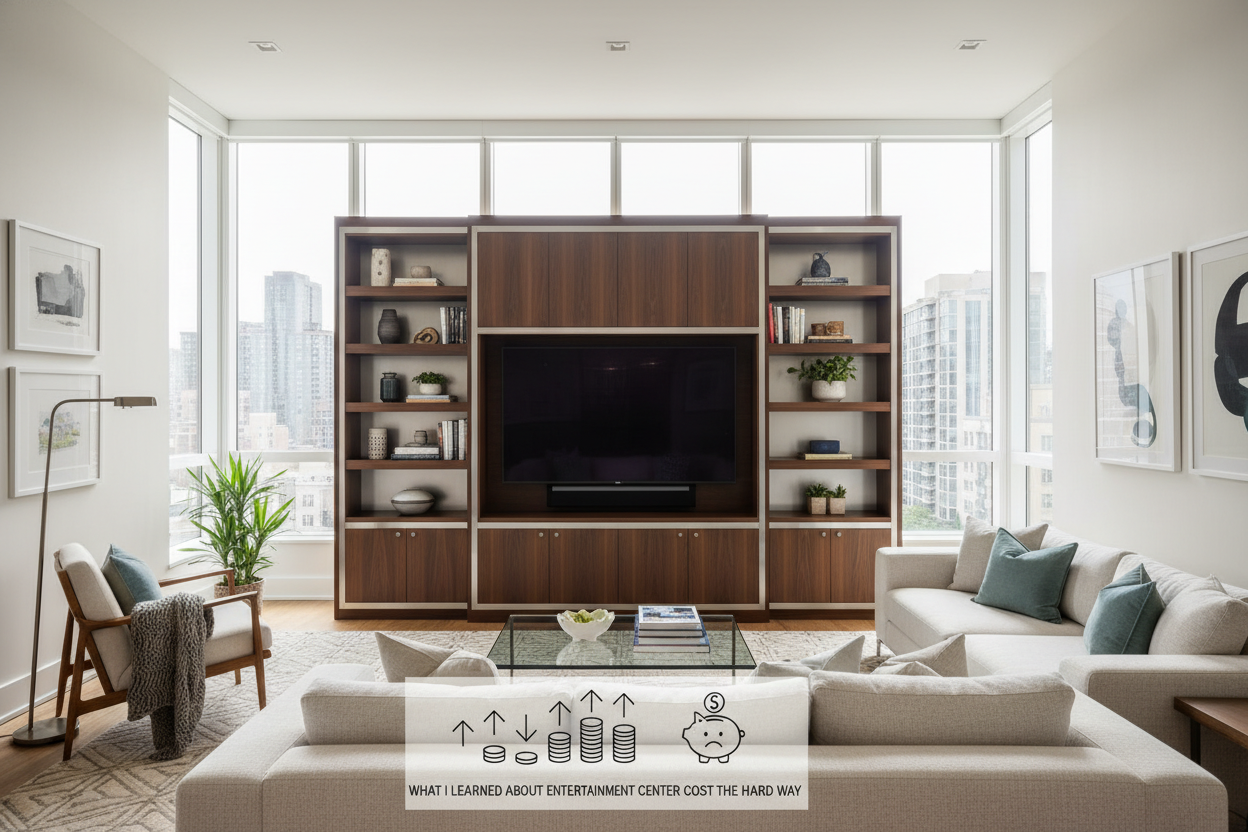
I spent three hours last Tuesday scrolling through fourteen different tabs, trying to figure out why one walnut media console cost as much as a used Honda Civic while another was cheaper than my weekly grocery bill. It is a total head-scratcher until you actually start building the stuff and see where the corners were cut.
The first time I bought a cheap unit, it sagged in the middle within six months because my receiver was too heavy. When you are entertainment center cost hunting, you are not just paying for a shelf; you are paying for the engineering that keeps your expensive tech from hitting the floor.
- Material density is the biggest price driver—solid wood beats particleboard every time.
- Shipping a 150-pound box is never actually free; it is just hidden in the sticker price.
- Hardware quality (hinges and drawer slides) adds about $50-$100 to the manufacturing cost.
- Assembly labor is a hidden tax—if it arrives pre-assembled, expect to pay a $200 premium.
Why is the price gap so ridiculously wide?
The sticker shock is real. When you start shopping for an entertainment center, you will see a $150 unit next to a $3,000 one. The cheaper one is likely hollow-core or thin particleboard held together by cam-locks and prayers. The high-end designer pieces use kiln-dried hardwoods and integrated cable management systems that actually hide the spaghetti mess of wires behind your Xbox.
The entertainment center price you see at big-box retailers is usually achieved by high-volume manufacturing and flat-pack shipping. You are essentially the final assembly line. Designer brands charge more because they use better finishes that do not peel off when you accidentally spill a drink during the Super Bowl.
Flat-pack vs. Solid Wood: What you're actually paying for
Materials dictate everything. If you buy the cheapest option, you are getting wood chips glued together with a paper-thin laminate. It looks fine in photos, but it feels like cardboard. If you move apartments twice, that unit is going to the landfill because the screw holes will strip out.
I usually recommend a middle ground. A wood grain color entertainment center made from high-grade MDF with a quality veneer is often sturdier than cheap 'solid' pine. It handles the weight of a 75-inch TV without bowing, and the finish actually mimics the texture of real oak. You get the longevity of a heavy piece without the $2,500 custom furniture price tag.
The sneaky fees that inflate your entertainment center cost
The price on the screen is rarely what you actually pay. Freight shipping for oversized items is a beast. If a unit is over 90 inches wide, it usually cannot go through standard ground shipping. That means a truck with a liftgate has to come to your house, which can add $150 to the total cost if the retailer doesn't eat that fee.
Then there is the 'white-glove' trap. Do you want someone to carry that 200-pound box up your three-story walk-up and take the cardboard away? That is another $100-$200. I once spent four hours putting together a 'simple' media cabinet because the instructions were just blurry drawings. My time is worth more than the $50 I saved by choosing the DIY assembly option.
My exact formula for a realistic living room budget
If you want something that lasts five years or more, expect to spend at least $300 to $600. For a 65-inch TV, look for a stand that is at least 60 inches wide—anything smaller makes the room look top-heavy and awkward. A stylish black tv stand in this price range usually offers decent door hinges and enough depth for a modern soundbar.
If your budget is under $200, you are firmly in the 'temporary furniture' zone. That is fine for a dorm or a first apartment, but do not expect it to survive a move. If you are looking at a 'forever' piece for a dedicated home theater, your baseline should start at $1,200 for solid construction and soft-close hardware.
When to buy cheap and when to seriously invest
I always tell people to look at their lease before they look at their wallet. If you are renting and likely to move in twelve months, do not buy a heavy, expensive solid wood unit. It will get dinged in the moving truck, and it might not fit your next layout. In that case, save your money and go for a budget-friendly, lightweight option.
However, if you own your home and have a specific wall carved out for your media setup, it is worth the space to invest in something substantial. A high-quality entertainment center acts as an anchor for the whole room. I once bought a cheap, spindly stand for my living room and regretted it every time I saw the messy cables peeking out from the sides. Investing in a unit with proper ventilation and cord routing is a gift to your future self.
How much weight can a cheap entertainment center hold?
Most budget units are rated for 50 to 75 pounds. Modern 75-inch TVs are lighter than they used to be, but once you add a receiver, a center-channel speaker, and some books, you are pushing the limit. Always check the 'static load' rating before buying.
Does a higher price mean better cable management?
Usually, yes. Cheaper units just have a single hole in the backboard. Premium units have internal channels, 'brush' strips to hide wires, and even built-in power strips. It is one of those 'invisible' features that makes a huge difference in how clean your room looks.
Is solid wood always better than MDF?
Not necessarily. Solid wood expands and contracts with humidity, which can cause doors to stick. High-quality MDF is more stable and won't warp, making it a great choice for areas with big temperature swings, like a basement or a sunroom.

Dejar un comentario
Este sitio está protegido por hCaptcha y se aplican la Política de privacidad de hCaptcha y los Términos del servicio.