










I have spent way too many hours staring at my living room wall, wondering why it looked so unfinished despite having a massive TV. We have all been there: you buy the 75-inch screen, mount it to the wall, and suddenly it looks like a black postage stamp lost in a sea of beige drywall. The scale is just wrong. A tiny console underneath doesn't cut it because it leaves three feet of awkward emptiness on either side.
That is where a coordinated entertainment piece comes in. It is not just about having a place to put your remote; it is about reclaiming the architecture of your room. When you stop thinking about just a 'stand' and start thinking about a 'system,' that intimidating blank wall finally starts to feel like a home.
Quick Takeaways
- Scale is everything: A TV should occupy about 60-70% of the horizontal furniture width below it.
- Verticality matters: Use towers or bridges to draw the eye up toward the ceiling.
- Avoid the 'monolith' look: Choose pieces with mixed materials or open shelving to keep the room feeling airy.
- Storage is a bonus: Hide the cable boxes and display the stuff you actually like looking at.
The Floating TV on a Massive Wall Epidemic
We are currently living through a design crisis I call the 'Floating Island' effect. People mount these ultra-thin TVs on massive 14-foot walls and then place a standard 60-inch media console underneath. The result? A giant, gaping hole of negative space that makes your expensive tech look small and your room look cold. It is a classic proportions mistake.
I have seen this in at least a dozen of my friends' apartments. They think a minimalist stand is the 'modern' way to go, but without visual weight to ground the TV, the whole wall feels unbalanced. You need something that spans at least 80% of that wall's width to make the room feel intentional rather than accidental. If your furniture is too small, your walls will always feel like they are closing in on you.
What Actually Counts as a Full Entertainment Piece?
A standalone console is a great start for a bedroom, but for a primary living space, you need more muscle. A full setup usually involves a central base unit paired with flanking piers or overhead shelving. This creates a frame. It tells the eye where to look and anchors the entire seating area. If you are tired of the 'dorm room' aesthetic, it might be time to upgrade to a full entertainment center that actually fills the footprint of your room.
The goal isn't just to hold the TV; it is to create a focal point. When you have a multi-part system, you aren't just buying furniture—you are creating a built-in look that defines the layout of the entire house. It stops the 'drifting furniture' problem where everything feels like it’s just hovering near the walls.
The Magic of Flanking Towers and Overhead Storage
This is my favorite trick for fixing high ceilings. By adding tall towers on either side of the screen, you are essentially framing your television like a piece of gallery art. These specific entertainment center pieces work because they utilize the vertical real estate that usually goes to waste. I personally love a modern 3 piece entertainment center because the overhead bridge connects the towers, creating a cohesive 'nook' for the TV.
This setup also gives you a place for things that aren't electronics. Use those towers for books, a ceramic vase that actually has some personality, or a trailing Pothos plant. It breaks up the 'tech-heavy' vibe and makes the room feel lived-in. Plus, overhead cabinets are the perfect spot to hide those board games you only pull out twice a year.
How to Add Heavy Furniture Without Darkening the Room
One of the biggest fears people have is that a large wall unit will feel like a 1990s oak behemoth. I get it; we all have trauma from those massive, clunky wardrobes. But modern design has fixed this. The key is to look for 'negative space'—open shelving, tapered legs, or glass doors. You can successfully pull off a stylish black TV stand entertainment center if you balance the dark finish with lighter decor or natural wood accents.
I recommend the 70/30 rule: 70% of your shelves should be functional or 'heavy' (books, storage boxes), and 30% should be empty or light (a single small object, a candle). This keeps the unit from feeling like a solid wall of wood. If you choose a unit with a mix of wood grain and black metal, you get the weight you need to fill the wall without the visual heaviness that sucks the light out of the room.
Faking the Custom Built-In Look for Less
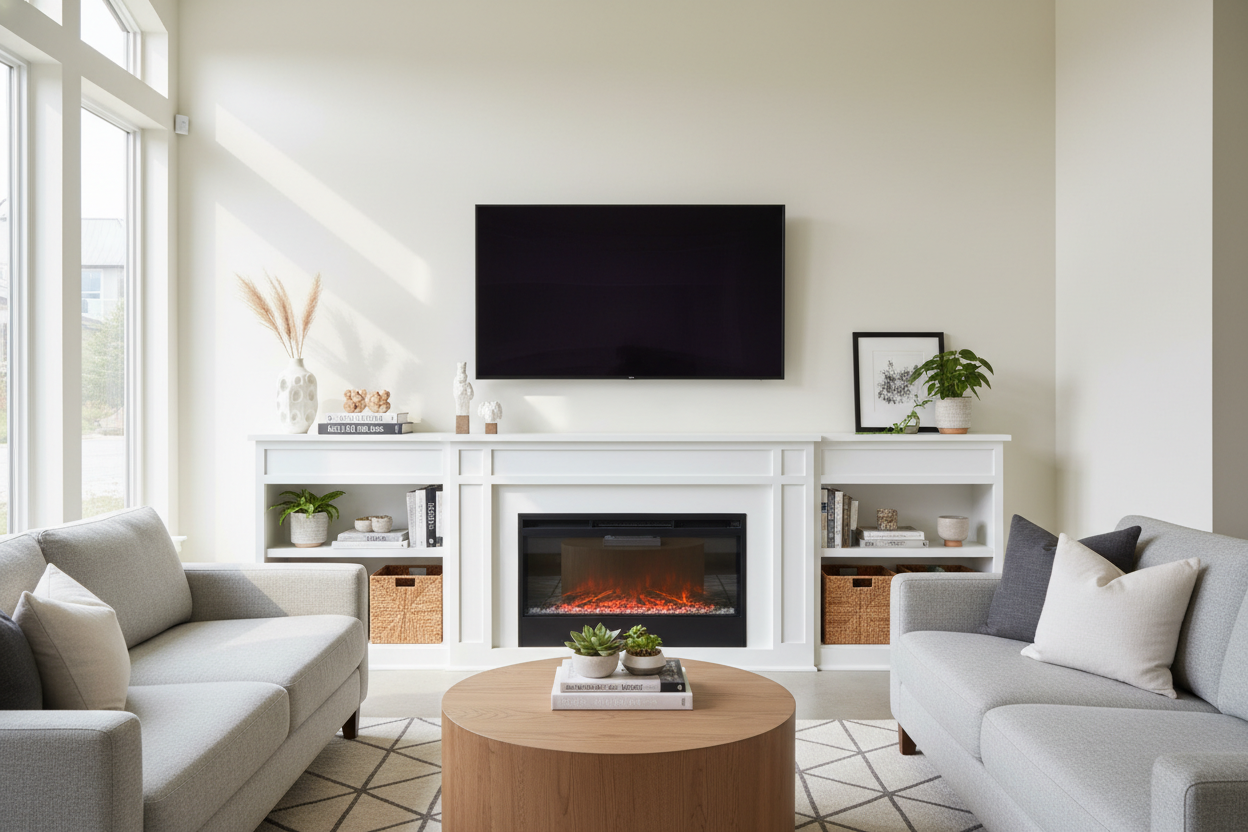
If you called a contractor to build custom cabinetry for a 12-foot wall, you’d be looking at a $5,000 bill, minimum. And heaven help you if you ever want to move. A multi-part set gives you that high-end, architectural look for a fraction of the cost. I’ve seen a 4 piece entertainment center with fireplace completely transform a cold, modern 'white box' apartment into something that felt like a cozy library.
The best part? It’s modular. If you move, you can take it with you. If you get bored, you can rearrange the towers. You get the polish of a custom renovation without the permanence or the massive invoice. It’s the smartest way to fix a 'bad wall' without picking up a sledgehammer.
My Personal Lesson Learned
I once tried to 'save space' by buying a tiny 48-inch mid-century stand for a massive 15-foot wall in my first house. I thought it would make the room feel bigger. Instead, it made the room feel like a waiting room. I eventually swapped it for a 3-piece unit with side towers, and the difference was instant. The room felt 'finished' for the first time. The biggest mistake you can make is being afraid of large furniture; sometimes, the bigger piece actually makes the room feel more spacious because it brings everything into proportion.
FAQ
Do I have to mount my TV if I have a large entertainment center?
Not necessarily. Most modern units are designed to hold the weight of the TV on the base, but mounting it slightly above the console within the 'frame' of the towers often looks the cleanest.
Will a black entertainment center show too much dust?
If it has a high-gloss finish, yes. But most modern matte or wood-textured black finishes are actually quite forgiving. Just keep a microfiber cloth in one of the drawers for a quick 30-second wipe-down once a week.
How wide should my entertainment center be compared to the wall?
Aim for at least two-thirds of the wall's width. If your wall is 12 feet wide, you want a setup that spans at least 8 to 9 feet to avoid that 'floating island' look.


Dejar un comentario
Este sitio está protegido por hCaptcha y se aplican la Política de privacidad de hCaptcha y los Términos del servicio.