










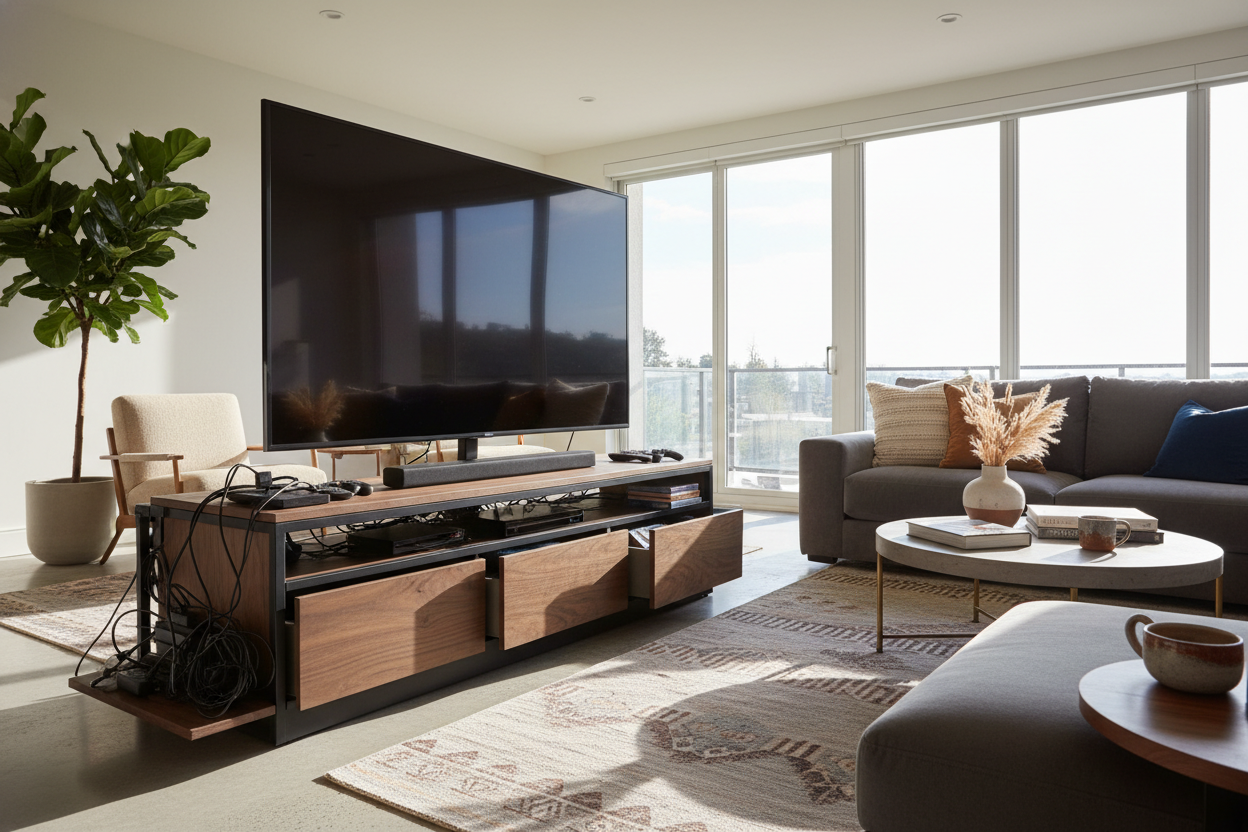
I spent three weeks scouring the internet for the perfect mid-century modern credenza. It was 14 inches deep, walnut-veneered, and looked like a dream in the staged photos. Then it arrived, and I realized my mistake the second I tried to hook up my receiver. The doors wouldn't close, the cables were bent at a 90-degree angle, and my living room looked like a tech graveyard.
Choosing a tv unit entertainment setup shouldn't just be about the aesthetic. If you're like me and you actually own things beyond a slim remote, you need to think about the physical footprint of your gear. Modern screens are getting thinner, but the hardware that powers them is still surprisingly chunky.
Quick Takeaways
- Standard AV receivers need at least 18-20 inches of depth for airflow and cables.
- Repurposed sideboards usually lack the ventilation needed for gaming consoles.
- Always measure your deepest component plus three inches for cable slack.
- Free-standing units offer more flexibility for cable management than built-ins.
The Sneaky Illusion of the Paper-Thin Screen
We’ve all been seduced by those minimalist living room shots on Instagram. You see a razor-thin OLED mounted on the wall with a tiny, floating shelf underneath. It looks airy and sophisticated. But unless that wall is hollow and hiding a server rack in the next room, those photos are lying to you. They never show the bulky power bricks, the tangled HDMI cords, or the router that glows like a radioactive toaster.
When you shop for tv media centers, it’s easy to forget that the TV isn't the problem—it's everything else. A PS5 or an Xbox Series X has a massive footprint. If you try to shove them into a shallow console, they’ll stick out like a sore thumb, or worse, you’ll be forced to leave the cabinet doors open 24/7 just to keep them from melting.
The Tape Measure Reality Check: Why Depth Matters
Before you hit 'add to cart,' grab a tape measure. A standard AV receiver is often 15 to 17 inches deep. Once you plug in your HDMI cables and speaker wires, you’re looking at a 19-inch requirement. Most trendy furniture is only 14 to 16 inches deep. If you want a setup that actually hides your gear, you need a Tv Bench Large Entertainment Center that prioritizes depth over just looking 'sleek.'
A large tv entertainment unit isn't just about the width of your 75-inch screen; it's about the internal volume. If your cables are pressed hard against the back panel, you risk damaging the ports on your expensive equipment. I’ve seen $2,000 receivers with snapped HDMI inputs because someone tried to force a 15-inch box into a 14-inch shelf. It’s a literal square peg, round hole situation that ends in a very expensive repair bill.
Why Repurposed Sideboards Make Terrible TV Media Centers
I know the temptation. You found a gorgeous vintage buffet at a thrift store and think it’ll make the perfect media stand. It won't. Sideboards were designed for plates and linens, not electronics that generate heat. Using dining room furniture is a major reason Why Your TV Entertainment Center Looks So Awkward (And How to Fix It)—the height is usually off, and the lack of cord holes is a nightmare.
Beyond the aesthetics, there’s the heat factor. A closed-back sideboard is a slow cooker for your electronics. Without proper ventilation, your gaming console’s fans will ramp up to jet-engine levels within twenty minutes. I once ruined a perfectly good router by trapping it in a solid oak drawer with zero airflow. It’s not a mistake I’ll make again.
The Ventilation Argument for a Free Standing Entertainment Center
Built-ins look great, but they are permanent and often poorly ventilated. A free standing entertainment center is almost always the better choice for the long haul. You can move it when you rearrange the room, and most importantly, they usually have slatted backs or open-shelf designs that let your gear breathe.
If you're worried about the 'messy' look of an open back, look for units with mesh doors or slatted wood fronts. These allow infrared signals from your remote to pass through while keeping the 'black box' tech hidden. It’s the only way to get that clean look without sacrificing the lifespan of your hardware. Longevity beats a 'Pinterest-perfect' moment every single time.
Who Sells Entertainment Centers That Actually Fit Real Tech?
If you're wondering where to buy entertainment center pieces that don't suck, you have to look past the big-box retailers that focus on flat-pack fluff. You want to buy entertainment unit options from brands that specifically mention 'AV-ready' features. Look for keywords like 'cord management,' 'ventilated shelves,' and 'removable back panels.'
Whether you need a small entertainment center nearby for an apartment or a massive 3 tv entertainment center for a basement man cave, check the specs for a minimum of 18 inches of internal depth. An entertainment center table should be sturdy enough to hold the weight of a 100-pound TV without sagging. Browse a dedicated Entertainment Center collection to find pieces that were actually engineered for 21st-century technology, not just for holding a vase of flowers.
Personal Experience: My $600 Mistake
I once bought a beautiful, slim walnut console for my living room. It was 15 inches deep. My Denon receiver was 15.1 inches deep. I spent a whole Saturday with a hole saw, cutting out the back panel just so the receiver could stick out the back by two inches. It looked terrible from the side, and the structural integrity of the piece was shot. I ended up selling it on Marketplace for half what I paid. Now, I never buy anything under 19 inches deep.
FAQ
Who sells entertainment centers with the best depth?
Look for specialty furniture retailers or brands that focus on 'media credenzas.' Standard big-box stores often sell units that are too shallow for high-end AV gear, so always check the 'internal dimensions' section of the product page.
Can I put a TV on a regular table?
You can, but an entertainment center table is built at a specific height (usually 22-30 inches) to keep the screen at eye level. A standard dining table is too high, and a coffee table is too low, leading to some serious neck strain.
How do I hide wires on a free-standing unit?
Use Velcro cable ties and adhesive clips to run wires down the legs of the unit. If the unit has an open back, you can also staple a piece of dark landscape fabric or mesh to the back to hide the wall behind it while still allowing air to flow through.

Dejar un comentario
Este sitio está protegido por hCaptcha y se aplican la Política de privacidad de hCaptcha y los Términos del servicio.