










I spent three hours staring at a massive 65-inch OLED box in my hallway, feeling like an absolute idiot. My apartment is one of those 'modern' units where the architect apparently decided walls were a suggestion, not a requirement. Every square inch of vertical space is claimed by floor-to-ceiling windows or a radiator that looks like it belongs on a Victorian steamship.
The problem? I wanted the big-screen experience without living in a dark cave. Putting a standard 24-inch tall console in front of my only source of Vitamin D felt like a crime against interior design. That is when I discovered the low profile 65 inch tv stand—a piece of furniture so close to the floor it practically needs a permit to be that low.
- Low profile stands usually sit between 10 and 15 inches off the ground.
- They keep the bulk of your screen below the windowsill line.
- These units create a 'gallery' look rather than a 'dorm room' look.
- Weight distribution is superior, making them safer for heavy panels.
The 'Blank Wall' Shortage in Modern Living Rooms
We are currently dealing with a crisis of open-concept architecture. Don't get me wrong, I love not being trapped in a tiny box, but where the hell am I supposed to put a TV? Most modern floor plans prioritize glass and 'flow,' leaving you with exactly zero solid walls that aren't interrupted by a pantry door, a thermostat, or a heating vent. If you do find a wall, it is usually directly across from the windows, meaning you spend your afternoons fighting a losing battle against glare that no curtain can fully stop.
In my case, the only logical place for the sofa left the TV floating in the middle of the room or parked right in front of the glass. When you have a 65-inch screen, you are essentially trying to park a small aircraft in your living room. A traditional media cabinet—the kind that stands 30 inches high—would have cut off the bottom third of my view. It makes the room feel cramped, cluttered, and frankly, a bit desperate. I realized that if I couldn't hide the TV, I had to lower it. By reclaiming those 15 inches of vertical air space, the whole room opened up.
Why a Low Profile 65 Inch TV Stand Was My Only Option
I spent an embarrassing amount of time shopping for TV stands, filtering by height until my eyes crossed. Most 'standard' consoles are designed for people sitting in high-backed armchairs from 1985. But my furniture is low, slouchy, and modern. A high stand meant the TV was looming over me like a monolith from a sci-fi movie. I needed something that felt grounded, something that didn't scream 'I AM A GIANT BLACK RECTANGLE' the second you walked through the front door.
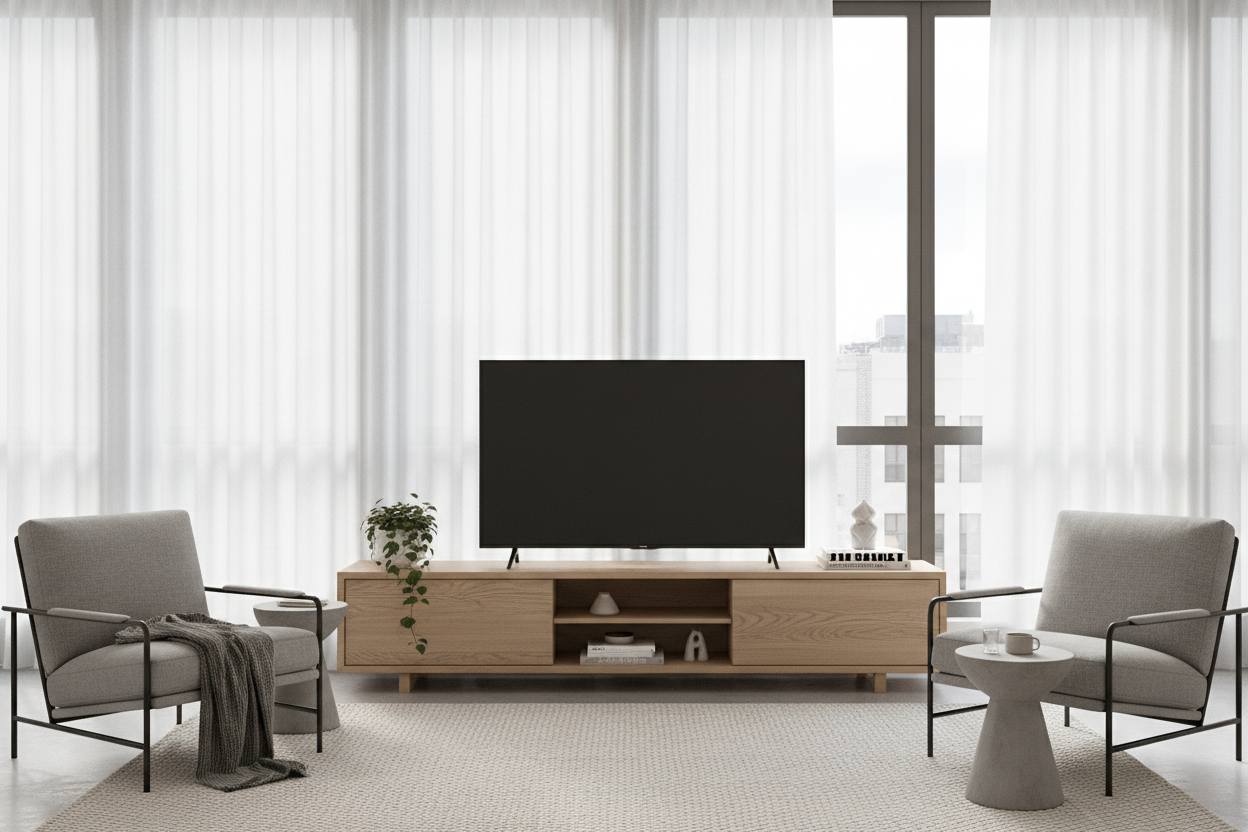
The low-profile design works because it respects the sightlines of the room. When the TV sits just 12 inches off the floor, your eyes naturally travel over the top of it to the view outside. It tricks your brain into thinking the space is less occupied than it actually is. I chose a model made from solid white oak—none of that hollow-core honeycomb paper stuff—because when a piece of furniture is that close to the floor, you see every detail of the grain. It feels like an architectural choice rather than just a place to dump your Xbox and cable box. Plus, it keeps the cables closer to the baseboards, which is a win for anyone who hates the 'spaghetti monster' look behind their tech.
Wait, Will a Low Profile TV Stand for 65 Inch TV Ruin My Neck?
This is the first thing my mom asked when she saw the setup. 'Aren't you going to be hunched over like a gargoyle?' The short answer is no. The long answer involves a bit of ergonomic math. If you are sitting on a modern sofa with a seat height of 16-18 inches, your 'relaxed' eye level is actually much lower than you think. When you lean back into the cushions, your gaze naturally drops. A low profile tv stand for 65 inch tv actually puts the center of the screen right at that sweet spot.
Think about a movie theater. You aren't looking up at the ceiling; the best seats in the house are the ones where you are looking slightly downward or dead-on at the center of the frame. If your TV is mounted too high—the classic 'TV over the fireplace' mistake—you end up with permanent neck strain. By dropping the screen to knee-height, I found I could marathon three hours of prestige TV without needing a chiropractor on speed dial. The key is viewing distance. Since I'm sitting about nine feet back, the angle is perfect. If you’re sitting three feet away, yeah, you might have a problem. But for a standard living room? It’s arguably more comfortable than a high mount.
How to Keep It from Looking Like a Skateboard on the Floor
The biggest risk with ultra-low furniture is that it can look like you just forgot to buy legs for your cabinet. You have to be intentional with the styling. I didn't just plop the TV down and call it a day. I used the extra horizontal surface area to 'ground' the piece. I'm talking chunky, oversized art books stacked on one end and a trailing pothos plant on the other. The greenery helps soften the hard edges of the screen and blends the tech into the window view behind it.
Another thing to consider is the build quality. Because these stands are low, they have to be wide to look proportional. This actually makes them incredibly stable. I’ve found that these designs are often sturdy enough for a 65 inch display because the center of gravity is so low to the ground. You don't get that terrifying wobble when someone walks heavy-footed across the room. To finish the look, I added a small, warm-toned LED strip behind the stand. It creates a soft glow on the floor at night, making the whole unit look like it's floating rather than just sitting in the dust bunnies. It turns the 'problem' of a low TV into a high-end design feature.
Other Alternatives When You Have Zero Wall Space
If the floor-hugging look feels a bit too 'bachelor pad' for your taste, there are other ways to deal with a window-heavy room. You could go the easel route, but those always feel a bit flimsy to me for a heavy 65-inch set. There's also the option of ceiling mounts, but unless you want your living room to look like a sports bar or a hospital waiting room, I'd skip that. It's a vibe, just not a good one.
For those with a bigger budget and a true hatred for seeing a black screen when it's off, a hidden TV mechanism is the gold standard. These cabinets allow the TV to rise up when you need it and disappear completely when you don't. It’s the ultimate solution for a bedroom or a high-end living space where the view is worth more than the Netflix subscription. But for most of us, simply dropping the height of our furniture is the smartest, most cost-effective way to have our sunlight and our 4K movies too.
FAQ
Is a low profile stand okay if I have kids or pets?
It depends on your dog. If you have a tail-wagger that clears coffee tables, a low TV is a target. However, because they are so low, they are almost impossible to tip over, which is actually a safety bonus for toddlers compared to top-heavy tall dressers.
What is the ideal height for a low profile stand?
Look for something between 12 and 16 inches. Anything lower than 10 inches starts to look like a literal plank on the floor, and anything higher than 18 inches starts to block the windows again.
How do I manage cables on such a low unit?
Most high-quality low stands have 'channels' or grommets built into the back. Since the stand is so close to the floor, you can tuck your power strip directly inside the unit and run one single cord to the outlet for a clean look.

Dejar un comentario
Este sitio está protegido por hCaptcha y se aplican la Política de privacidad de hCaptcha y los Términos del servicio.