










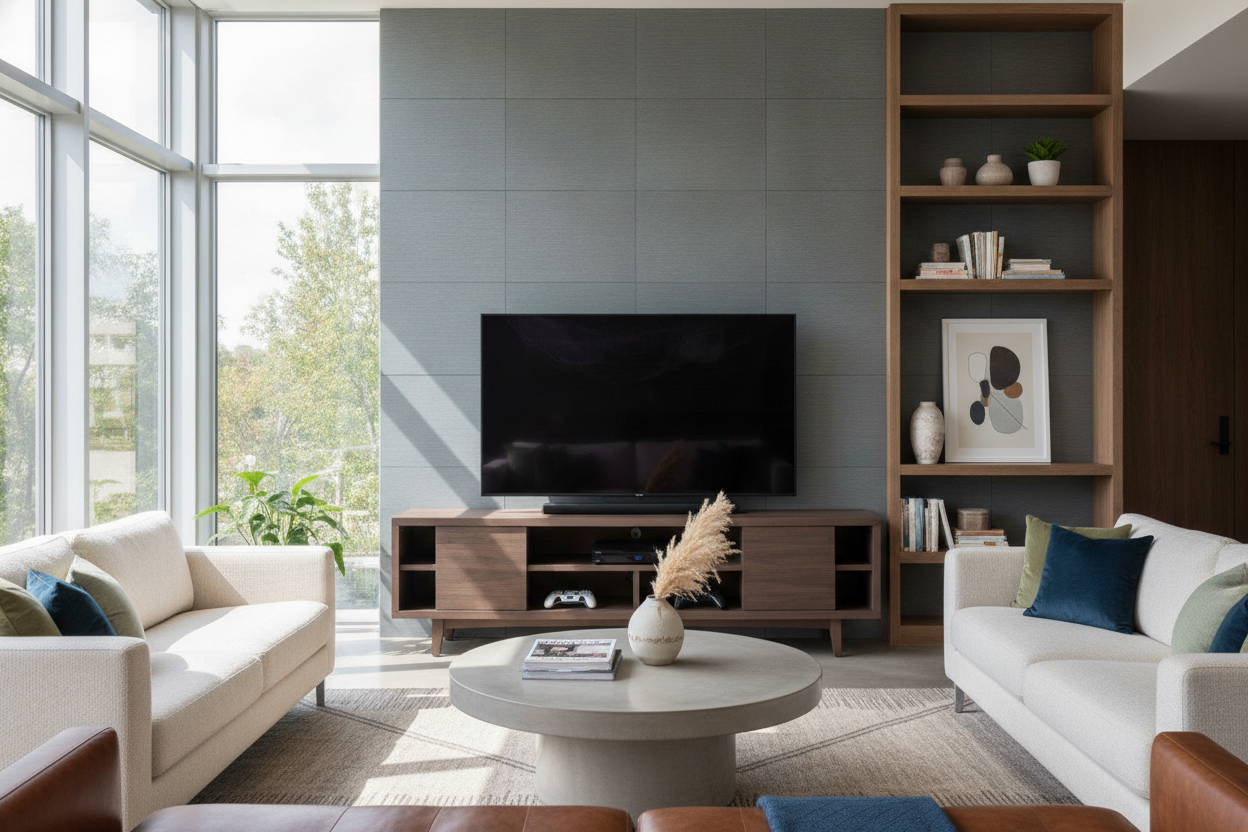
I sat there on my living room floor, staring at a 75-inch OLED box that cost more than my first car, and then at my existing media console. My old stand was 50 inches wide. The math was offensive. I had exactly forty-eight hours before my friends arrived for a watch party, and I was looking at a potential disaster where my premium screen would overhang by a foot on each side.
I needed a home depot 70 inch tv stand and I needed it immediately. Most high-end furniture stores quoted me three weeks for delivery. Home Depot had one in stock three miles away. I took the gamble, hauled the 95-pound box into my SUV, and hoped I wasn't about to put a $2,000 TV on a piece of junk.
- Assembly is a two-person job due to the sheer length of the boards.
- The center support legs are essential for preventing the 'smile' sag.
- Cable management is actually thoughtful, with oversized cutouts.
- The veneer is surprisingly scratch-resistant against heavy gaming consoles.
The Panic of the Oversized Screen
There is a specific kind of stress that comes with realizing your tech has outpaced your furniture. You can't just 'make it work' with a screen this size; if the feet of the TV don't have a solid surface, the whole thing is going down. I had actually skipped IKEA for a Home Depot TV stand once before for a smaller guest room, and that unit held up better than the particle board Swedish stuff usually does.
The physical reality of a 70-inch-plus stand is that it becomes the focal point of the room. You can't hide it. It needs to be wide enough to balance the visual weight of the black rectangle sitting on top of it. Going to a hardware store for furniture feels weird until you realize they specialize in things that are meant to hold weight.
Unboxing the Flat-Pack Reality
Let’s be real: this is flat-pack furniture. You aren't getting hand-carved mahogany for this price. However, the density of the MDF used in the Fufu Gaga Home Depot collection and similar brands they carry is noticeably higher than the airy, honeycomb stuff you find at big-box retailers. The box was brutal to move, but that weight is usually a good sign for stability.
The instructions were actually legible. No weird translation errors or missing hardware. I spent about 75 minutes with a manual screwdriver—don't use a power drill unless you want to strip the pre-drilled holes instantly. The cam-locks felt tight, and the back panel, which is usually just cardboard, actually had some structural heft to it.
The Dreaded Middle Sag Test
If you buy a wide stand without center legs, you are asking for a catastrophe. Most 70-inch TVs weigh between 60 and 90 pounds. Over time, gravity wins, and the middle of the stand starts to bow. This Home Depot unit came with two adjustable center feet. I spent ten minutes making sure they were perfectly flush with my hardwood floor. Three months later, there isn't a millimeter of dip in the top surface.
Does It Actually Look Good in a Living Room?
It passes the 'eye test' from six feet away. The wood grain texture isn't that shiny, plastic-looking film that screams 'cheap.' It has a matte finish that actually mimics real oak grain. I chose a model that looked like a modern TV stand with cabinets and drawers because I have a PS5, an Xbox, and a tangled mess of HDMI cables that I never want to see again.
The storage is deep enough for a standard AV receiver, which is a rare find in budget furniture. Most 'slim' stands are too shallow for real gear. Here, the doors align properly without that annoying gap in the middle, provided you take the time to adjust the hinges during the final step of the build.
The Final Verdict: Is It Worth the Money?
If you are a renter who moves every two years or a homeowner who just spent their entire budget on the screen itself, this is a win. It’s sturdy, it’s wide enough to make the room look proportional, and it doesn't wobble when the cat jumps on it. It’s not an heirloom piece you’ll pass down to your kids, but it’s a reliable workhorse that looks significantly more expensive than the receipt suggests.
FAQ
Will a 75-inch TV fit on a 70-inch stand?
Usually, yes. TV sizes are measured diagonally, so a 75-inch TV is actually about 66 inches wide. It will fit with a couple of inches to spare on either side, provided the TV's legs aren't wider than the stand itself.
How hard is it to move once assembled?
It is heavy and awkward. Do not try to slide it across carpet or hardwood while the TV is on it, or you might snap the support legs. Empty the cabinets and have two people lift it from the ends.
Does the finish scratch easily?
I've dragged a heavy soundbar across the top and didn't see any visible marks. It's much tougher than the paper-thin veneers found on entry-level budget furniture.


Dejar un comentario
Este sitio está protegido por hCaptcha y se aplican la Política de privacidad de hCaptcha y los Términos del servicio.