










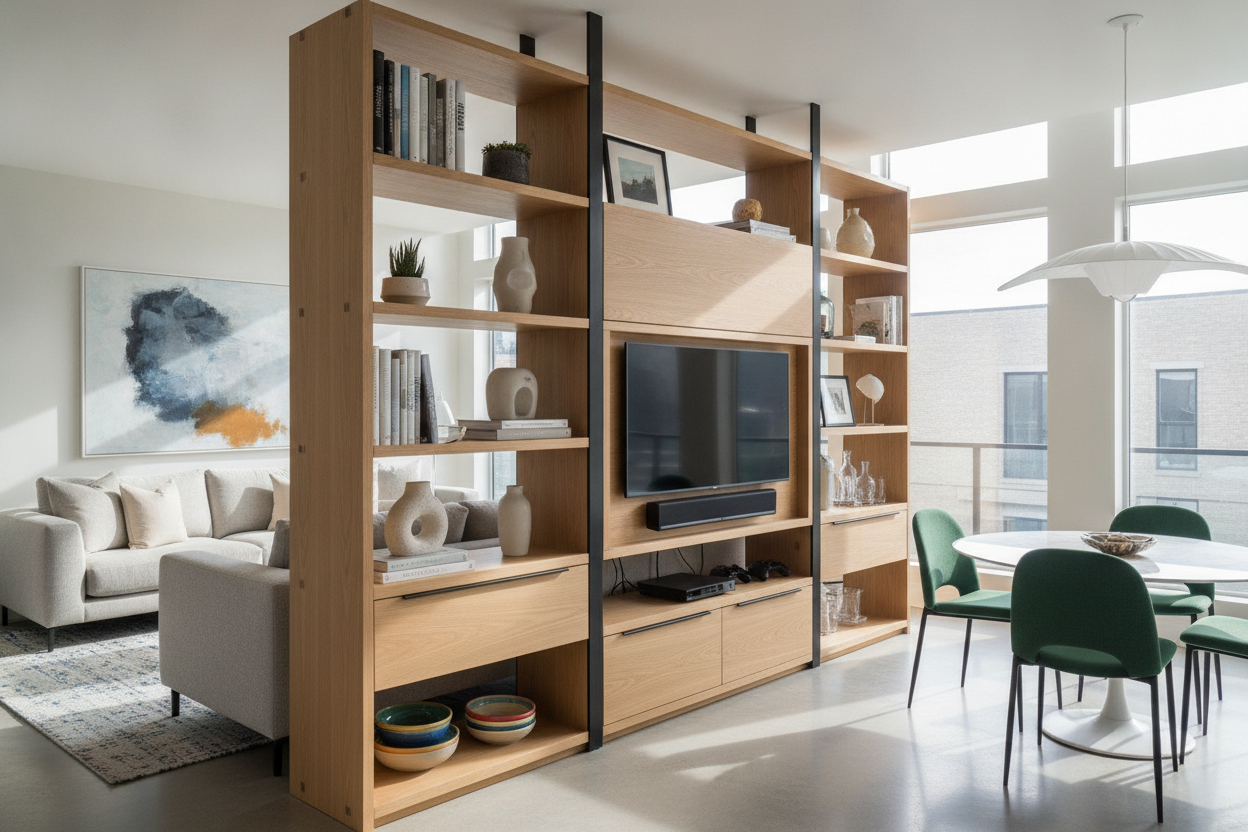
I spent three months staring at my living room floor plan like it was a complex calculus equation. The space was a massive 22-foot rectangle with zero architectural soul, and my sofa looked like a lonely island in a sea of gray oak laminate. I tried rugs, I tried plants, but nothing stopped the 'bowling alley' vibe until I bought a massive entertainment shelf unit and literally dragged it into the center of the room.
- Create instant zones in a large, echoing room.
- Storage on one side, 'architectural wall' on the other.
- Choose units with open shelving to keep natural light flowing.
- Prioritize safety by weighting the base of floating furniture.
The 'Bowling Alley' Living Room Problem
Open floor plans are a scam sold by real estate agents who don't have to live in them. My 14x22 space was an echo chamber. When I sat on the couch, I could see the pile of mail on the kitchen island and the crumbs under the dining table. There was no 'cozy,' just a giant, drafty void where sound bounced off the walls like a racquetball court.
The problem is the 'perimeter' layout. Everyone pushes their furniture against the walls because they think it makes the room look bigger. It doesn't. It just makes the middle of the room feel like a dance floor no one wants to use. I needed a way to break the line of sight without spending $5,000 on a contractor to build a pony wall.
Why I Chose a Media Center Over a Folding Screen
I thought about a folding screen, but those things are flimsy. One accidental bump from my dog and the whole thing would be flat on the floor. I needed something with actual mass. A tall entertainment shelving unit gave the room a new wall without the commitment of drywall and studs.
The trick was finding a unit that didn't feel like a monolith. I looked for something with adjustable shelf storage so I could keep the top tiers relatively sparse. This let light from the big south-facing window hit the dining area while still creating a visual boundary for the 'den' area. By pulling the TV off the wall and into the center of the room, I suddenly had a focal point that actually made sense for the seating arrangement.
Styling the Backside (When It Is Not Against a Wall)
The biggest fear with floating a large unit is the back. Most cheap MDF pieces have that hideous, unfinished cardboard backing with visible staples. Avoid those like the plague. I opted for a unit with a finished back, but even then, a large flat surface can look a bit sterile.
My fix was to treat the back of the unit like a new wall. I realized I could fit a desk and shelf unit setup right against it. By backing a slim console desk against the rear of the media center, I created a dedicated home office zone that felt completely separate from the TV area. It turned one piece of furniture into a multi-functional room divider that looks intentional from 360 degrees.
Transitioning from Tech to Entertaining
As the shelving unit stretches toward the dining room, the vibe has to shift. You cannot have a tangle of HDMI cables and dusty routers sitting next to your dinner plates. I learned to 'gradient' my styling. The shelves closest to the TV hold the tech, but as the unit moves toward the dining zone, the items become more social.
If you pick the right piece, the end of the unit basically functions as a wine bar cabinet. I put the router and the ugly black boxes on the bottom shelves behind woven baskets and kept the eye-level shelves for decanters, cookbooks, and nice glassware. It bridges the gap between 'tech hub' and 'dinner party' perfectly.
The Golden Rule for Floating Heavy Furniture
Safety is the one area where you can't wing it. If you're floating a 6-foot tall entertainment shelving unit, you can't just balance it and hope for the best. I weighted the bottom shelves with my heaviest art books and used museum putty on the smaller decor items to keep them from vibrating when the bass hits.
For the power cords, I ran a heavy-duty power strip under a thick wool rug. If you don't hide the 'tail' of wires running to the wall outlet, someone is going to trip and take the whole 65-inch TV down with them. Use cord covers that match your flooring color to make the transition from the unit to the wall outlet invisible.
FAQ
Does it make the room feel smaller?
Yes, and that's the point. It makes it feel like two intentional, cozy rooms instead of one giant warehouse. You lose the 'empty' space, but you gain functionality.
How do I hide the wires if the back is exposed?
Use adhesive cable clips along the frame of the unit to channel wires down to the floor. Never let them just dangle off the back.
Is it stable without being anchored to a wall?
Only if the unit has a deep base (at least 15-18 inches) and you keep the heavy items on the bottom. If you have toddlers or large pets, you should look for units specifically designed to be freestanding with weighted bases.


Dejar un comentario
Este sitio está protegido por hCaptcha y se aplican la Política de privacidad de hCaptcha y los Términos del servicio.