










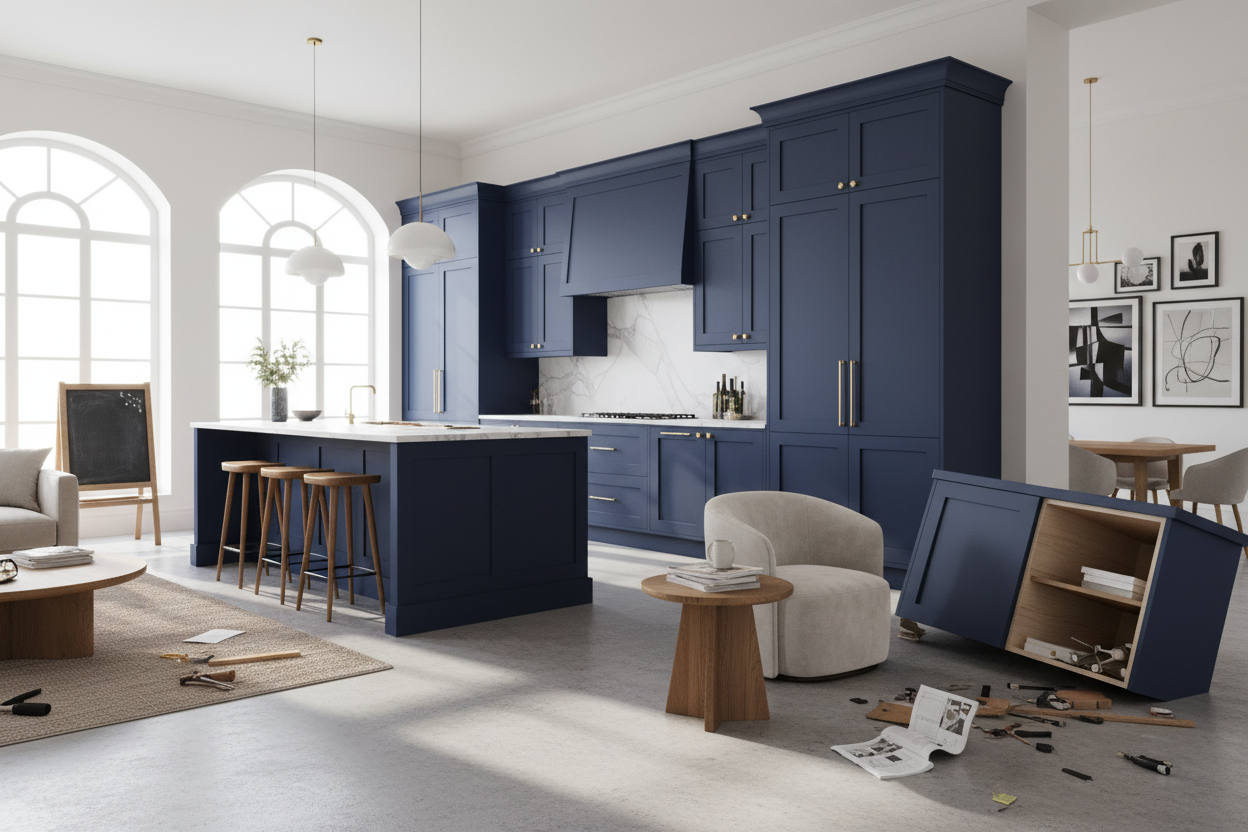
I stood in my kitchen with a $400 laser level I’d just bought and a look of pure, unearned confidence. I had the boxes, the screws, and a long weekend. Six hours later, I was sitting on the floor crying into a pile of cedar shims because my 'perfectly flat' wall was actually shaped like a Pringles chip. I learned the hard way that custom cabinet installation is not a weekend hobby—it is a high-stakes surgical procedure for your house.
Quick Takeaways
- Your walls and floors are never level; a pro spends 80% of their time shimming and 20% hanging.
- Custom cabinets are significantly heavier than flat-pack furniture; you need serious muscle and structural knowledge.
- A single mistake in 'scribing' can ruin a cabinet door that takes six weeks to replace.
- Professional labor is the best insurance policy for your five-figure cabinetry investment.
The Delusion of 'How Hard Could It Be?'
You see the line item for labor on your estimate and your brain starts doing that dangerous math. You think about how many fancy espresso machines or high-end light fixtures you could buy with that money. Cutting out the professional labor is usually the first thing homeowners do when they see the hidden costs in your custom kitchen cabinet quote. I was that homeowner.
I figured if I could assemble a complex dresser, I could hang a few boxes. I was wrong. High-end millwork doesn't come with pre-drilled holes or 'Step A' instructions. It requires precision woodworking skills, a deep understanding of load-bearing studs, and the patience of a saint. When you're dealing with $1,500 uppers, 'close enough' isn't an option.
Your Walls Are Never, Ever Straight
Here is the universal truth of home construction: your house is a liar. Every wall has a bow, every corner is slightly more (or less) than 90 degrees, and your floor definitely slopes toward the back door. A professional custom cabinet install is a masterclass in deception. They use a technique called scribing—literally shaving the back edge of a finished cabinet to match the exact, wonky curve of your drywall.
If you don't scribe, you end up with massive, ugly gaps that even the thickest crown molding can't hide. I spent four hours trying to get one base cabinet to sit flush against a corner before I realized the corner was actually a 92-degree angle. Pros have the scribing tools and the specialized saws to make a rigid wooden box look like it grew out of your organic, uneven walls.
The Sheer Weight Will Break Your Spirit
We aren't talking about 1/2-inch particle board here. Real custom units are built with 3/4-inch maple plywood and solid hardwood face frames. They are incredibly heavy. Trying to hold a 42-inch-tall upper cabinet against a wall while simultaneously leveling it and driving screws into studs is a recipe for a torn rotator cuff or a shattered toe.
If the thought of lifting 80-pound boxes over your head makes your back ache, you are better off buying a freestanding buffet cabinet with storage instead of attempting wall-mounted uppers. Freestanding pieces give you that high-end storage without the risk of a cabinet crashing down in the middle of the night because you missed the stud by half an inch.
When to Fake It Instead of Building It In
If you aren't ready to pay for a pro but want that tailored look, there are ways to cheat. You can style a cabinet desk combo using modular pieces that look integrated but don't require structural surgery. It’s a great way to get a bespoke office vibe without the permanent carpentry headache.
Another pro move is using statement furniture as a focal point. Instead of building a custom bar from scratch, I’ve seen people use a dramatic black cabinet with glass doors to house their glassware. It looks intentional, expensive, and—best of all—you can take it with you when you move. No shims required.
What a Custom Kitchen Cabinet Installation Actually Costs
Realistically, you should expect to pay between $100 and $250 per cabinet box for a professional custom kitchen cabinet installation. For a standard kitchen, that might add $3,000 to $5,000 to your total. It feels like a lot until you realize what you're actually paying for: their $10,000 tool trailer, their insurance, and the fact that they can finish in two days what would take you three months of Saturdays.
The peace of mind knowing your cabinets won't sag over time is worth the price. Plus, if a pro scratches a door during the install, they pay to replace it. If you scratch it? That's just a very expensive 'oops' you have to look at every morning while you make your coffee.
How long does a professional install usually take?
For an average-sized kitchen, a pro crew of two can usually knock it out in 2 to 3 days. If you’re doing it yourself and you have a job and a life? Plan for at least three weeks of living in a construction zone.
Can I save money by doing the demo myself?
Absolutely. Most contractors are happy to skip the messy part. Just make sure you don't rip out the plumbing or electrical lines you'll need for the new layout. Clear the space, and let the pros handle the precision work.
What tools do I absolutely need if I ignore your advice?
At a minimum: a 6-foot level, a laser level, a high-quality impact driver, a table saw with a fine-finish blade, and a set of heavy-duty cabinet jacks. If you don't own these, the cost of buying them will practically equal the labor fee you're trying to avoid.



Dejar un comentario
Este sitio está protegido por hCaptcha y se aplican la Política de privacidad de hCaptcha y los Términos del servicio.