










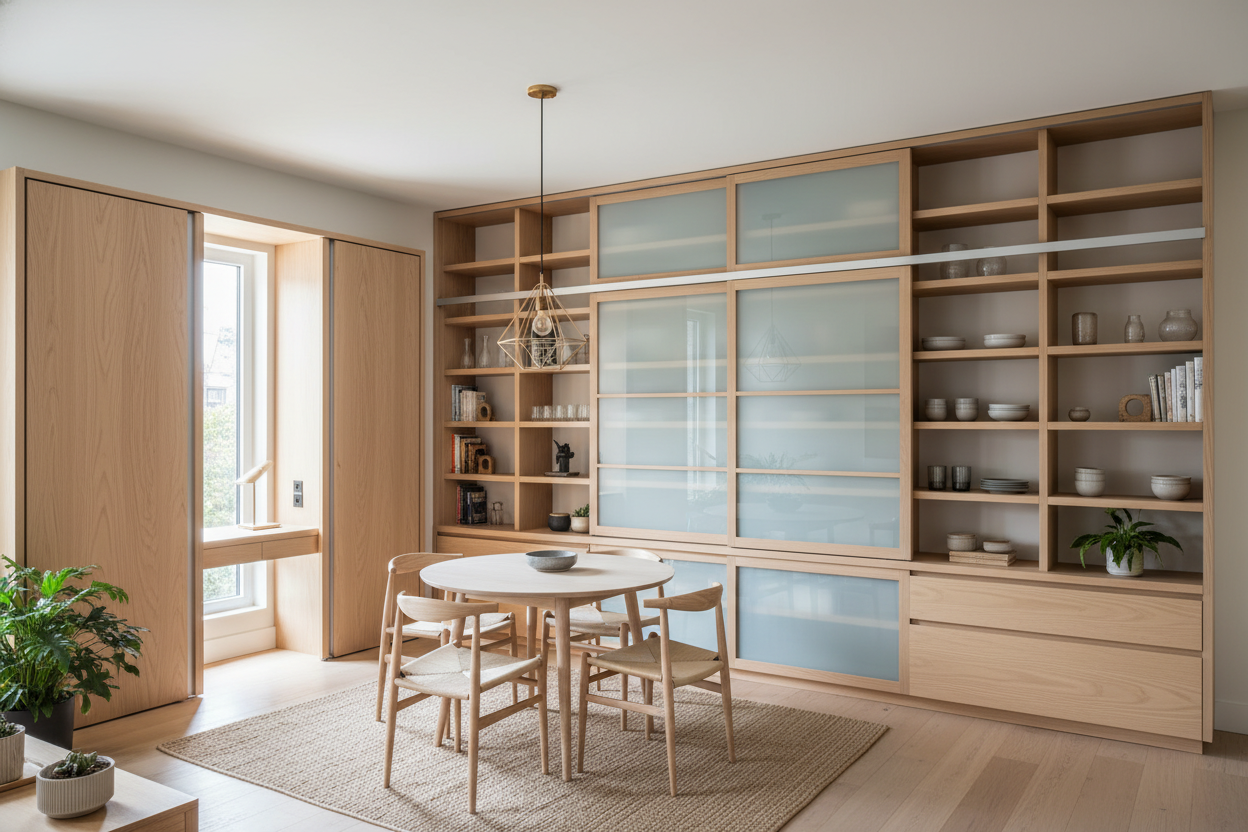
My dining room is roughly the size of a walk-in closet in a suburban McMansion. It is a 10-by-11-foot rectangle that has to fit a table for six, a rug, and enough clearance for human beings to actually move. For years, I had this beautiful mid-century sideboard with three heavy, swinging doors. I loved it until the first time I hosted a dinner party. Every time I needed to grab a spare fork or a stack of napkins, I had to ask two guests to stand up, move their chairs, and wait while I swung a 20-inch door into the very space they were just occupying. It was a nightmare of logistics that made me want to stop hosting altogether.
I spent months looking for a solution that didn't involve knocking down a wall or buying a tiny, useless bar cart. I realized the bottleneck wasn't my table or my guests; it was the 'swing tax' my furniture was charging. That is when I discovered shelves with sliding doors. By removing the need for outward clearance, I suddenly gained back nearly two feet of usable floor space. It sounds small on paper, but in a tight room, two feet is the difference between a comfortable dinner and a traffic jam.
- Sliding doors eliminate the 18-to-24-inch 'swing zone' required by traditional cabinets.
- Metal ball-bearing tracks are essential for longevity; avoid plastic friction glides.
- Tall units with sliding doors maximize vertical storage without encroaching on walkways.
- Adjustable internal shelving is a must for storing everything from flat plates to tall decanters.
The 'Excuse Me' Dance: My Dining Room's Biggest Flaw
Every host knows the feeling of a 'cramped' party. You want people to feel relaxed, but instead, they are constantly apologizing for being in the way. In my house, this manifested as the 'Excuse Me' dance. The buffet lived against the only wall with enough length to hold it, but it sat exactly three feet away from the back of the dining chairs. When someone was sitting there, the gap narrowed to about 12 inches. Opening a hinged door to get a clean wine glass was physically impossible without a full-scale evacuation of the left side of the table.
I remember one Thanksgiving specifically where I dropped a gravy boat because I was trying to hook a cabinet door open with my foot while balancing a tray. The door swung back, hit my shin, and the rest was history (and a very stained rug). It was the breaking point. I realized that my furniture was working against the architecture of my home. I needed storage that stayed within its own footprint.
The Clearance Math Nobody Tells You About
We often measure furniture by its width and depth, but we forget to measure its 'active' footprint. A standard 18-inch deep cabinet with 18-inch doors actually requires 36 inches of depth to be fully functional. If you only have a 40-inch walkway between your wall and your table, that cabinet is effectively a wall once it is opened. You are left with four inches of space—not even enough for a cat to squeeze through.
This is where the math gets frustrating. When you extend hinged doors into high-traffic zones, you aren't just blocking the path; you are creating a hazard. I can't tell you how many times I've walked away from an open cabinet only to turn back and catch the sharp corner of a door right on my hip bone. To keep your sanity and your skin intact, you should Stop Banging Your Shins: Get a Bookcase With Glass Sliding Doors. By keeping the doors on a single plane, you keep the walkway clear 100% of the time, whether you're grabbing a plate or just walking by.
Enter the Geometric Savior: A Sliding Door Shelf
The switch to a sliding door shelf felt like I’d suddenly added five square feet to my room. Because the doors bypass each other on a track, the 'active' footprint is exactly the same as the 'static' footprint. I could pull my dining table six inches closer to the wall because I no longer needed to account for the door swing. That extra six inches on the other side of the table made the main entrance to the kitchen feel twice as wide.
I opted for a unit that combined open shelving on top with sliding doors on the bottom. This gave me a place to display my favorite cookbooks and ceramics while hiding the 'ugly' stuff—the mismatched Tupperware and the heavy cast iron pans—behind the sliders. The visual weight of the room shifted. Instead of a bulky piece of furniture that felt like it was invading the room, I had a sleek, functional wall unit that felt like it belonged there.
Finding the Right Track (And Avoiding Cheap Glides)
Not all sliding mechanisms are created equal. I learned this the hard way with a cheap entryway bench I bought years ago. If the track is just a plastic groove in the wood, it will eventually fill with dust, pet hair, and grit, making the door jump or stick. It’s incredibly frustrating to have to 'heave' a door open when you're in the middle of plating dinner.
When you are shopping, look for metal ball-bearing rollers. They should glide with a single finger. I eventually upgraded to a 78 7 H X 31 5 Standard Storage Bookcase With Glass Door Shelves for my glassware collection. The weight of the glass doors requires a serious track system, and the smooth movement makes the whole piece feel more expensive than it actually was. If the door rattles or feels like it's grinding, walk away. Your ears (and your patience) will thank you.
How I Styled My New Zero-Clearance Buffet
Once the logistics were solved, I could actually focus on the fun part: making it look good. The beauty of a sliding door unit is that you can leave one side 'open' for a semi-exposed look without a door hanging awkwardly into the room. I use one side to store my heavy white ceramic platters, which are beautiful but take up a ton of vertical space.
I made sure to look for Adjustable Shelf Storage options. Interior flexibility is the secret to a clean-looking cabinet. I set one shelf high to accommodate my tall wine decanters and another shelf low for stacks of dinner plates. Being able to customize the interior meant I didn't have any wasted 'dead air' inside the cabinet, allowing me to fit about 20% more items than I could in my old hinged sideboard. Now, when I host, I don't have to ask anyone to move. I just slide the door, grab the wine, and keep the conversation going.
Frequently Asked Questions
Do sliding doors get stuck easily?
Only if you buy the cheap stuff. High-quality units use metal tracks and rollers that stay aligned. Keep the bottom track clear of crumbs and dust with a quick vacuum every few months, and they will glide perfectly for years.
Can I store heavy items like Le Creuset pans in these?
Absolutely, as long as the shelves themselves are rated for the weight. The sliding mechanism doesn't bear the weight of the contents; the internal shelves do. Just ensure you aren't overloading the actual door tracks.
Are sliding doors harder to clean than hinged doors?
The doors themselves are easier because you don't have to clean around hinges. However, the tracks can collect dust. A quick swipe with a damp cloth or a crevice tool on your vacuum once a season is all it takes to keep them moving smoothly.


Dejar un comentario
Este sitio está protegido por hCaptcha y se aplican la Política de privacidad de hCaptcha y los Términos del servicio.