










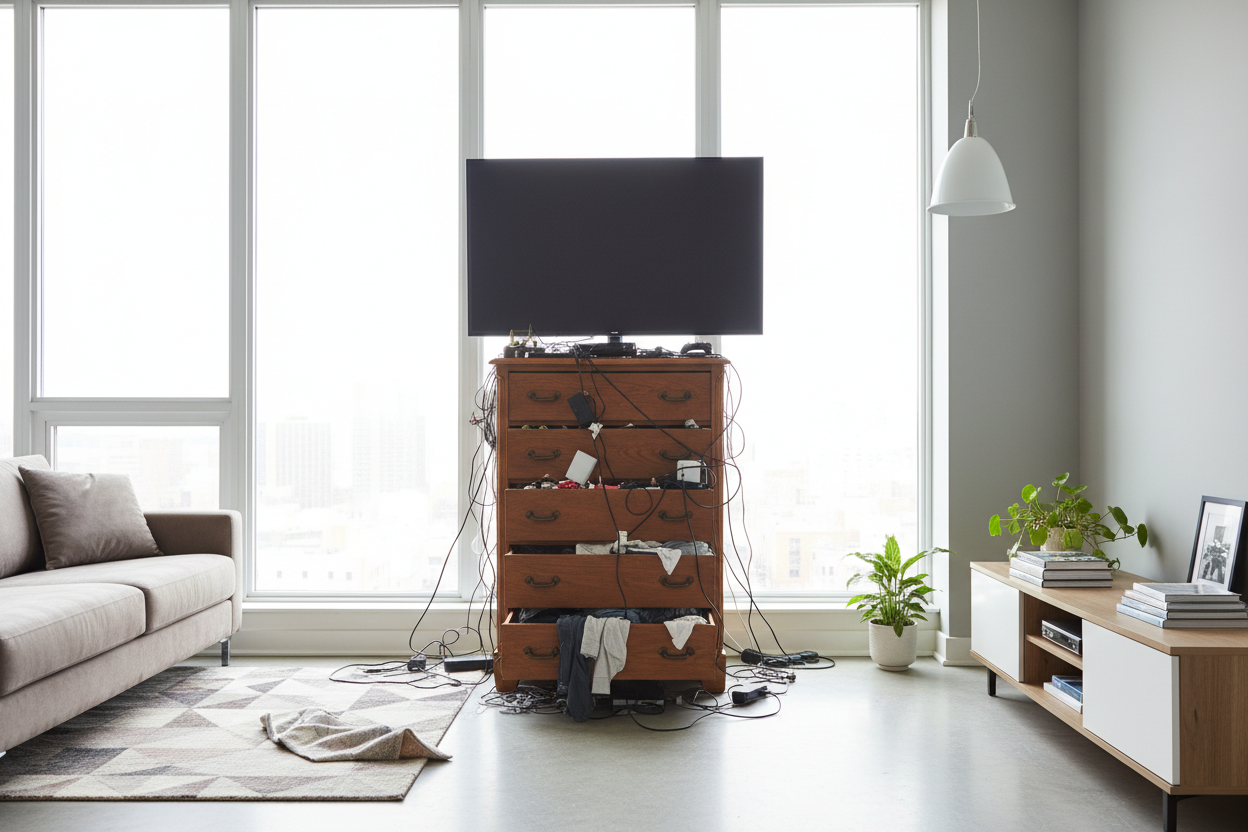
I spent three hours last night scrolling through vintage credenzas because I am convinced my current setup is the reason I have a permanent crick in my neck. We have all been there—trying to save a buck or 'reuse' a piece of furniture by dragging that old bedroom dresser into the living room to serve as a stand for a tv. It looks great in a curated Pinterest photo with a few brass candlesticks, but in reality, it is a functional disaster that your chiropractor will eventually thank you for.
Repurposing furniture feels like a win for the budget, but bedroom pieces were never meant to handle the weight, depth, or tech requirements of a modern living room. If you are currently staring at a 65-inch screen perched precariously on a chest of drawers, it is time for a reality check.
- Ergonomics: Dressers are built for standing height; TVs need to be at eye level from a seated position.
- Cable Chaos: Unless you are okay with drilling through solid wood, your cords will be a visible mess.
- Depth Issues: Dressers take up too much floor space while offering too little stability for wide TV legs.
- Heat: Enclosed drawers trap heat, which is a slow death sentence for your gaming consoles and streaming boxes.
The Thrifted Dresser Epidemic
The mid-century modern trend has a lot to answer for. We saw those beautiful teak 6-drawer dressers and decided they were the 'it' piece for under the television. I get the appeal—they offer tons of storage for things you do not actually need in your living room, like spare linens or old tax returns. But a dresser is a bulky, vertical object. It creates a massive visual block in the room that makes even a large space feel cramped and cluttered.
When you use a piece of furniture designed for a bedroom, it always looks like a bedroom piece. It lacks the intentionality of a unit designed for media. Instead of a sleek focal point, you end up with a heavy wooden box that screams 'I did not have a plan for this room.'
Your Neck Is Hurting for a Reason
The math just does not add up. A standard dresser sits anywhere from 32 to 36 inches high. Add a large TV on top, and the center of your screen is now five feet off the ground. Most sofas have a seat height of 18 inches. You are essentially sitting in the front row of a movie theater every single night. If you have to tilt your chin up even slightly to see the screen, you are straining your cervical spine.
A proper stand for t.v is usually 22 to 28 inches tall. That 10-inch difference is the gap between a comfortable movie marathon and a tension headache. You want your eyes to hit the top third of the screen while sitting naturally. If you are looking up, you are doing it wrong.
The Cable Management Nightmare
Dressers are solid boxes. They are designed to keep dust out of your socks, not to let air flow around a hot PlayStation 5. The moment you set up your tech, you realize there is nowhere for the wires to go. You end up with a 'waterfall' of black cables cascading down the back or sides of the unit, which completely kills the aesthetic you were going for.
I have seen people try to DIY their way out of this by drilling 2-inch holes into the back of a vintage piece. It is messy, it splinters the wood, and it still does not solve the airflow problem. A wide adjustable TV stand is built with these realities in mind, featuring pre-drilled routing and open or vented shelving that keeps your gear from melting.
The Tipping Hazard: Why Depth Matters
Most dressers are 18 to 20 inches deep because they need to fit folded clothes. Most modern TV legs are designed for much shallower surfaces. When you put a slim TV on a deep dresser, you either have a huge, wasted 'porch' of wood in front of the screen, or you push the TV back and create a tipping hazard. Because dressers are top-heavy—especially when those top drawers are full—adding a 50-pound screen is asking for trouble.
When you browse dedicated TV stands, you will notice they are often narrower (around 14-16 inches). This slim profile keeps the screen closer to the wall, opening up your floor plan and providing a much more stable center of gravity. It is safer for your tech and anyone walking past it.
Want the Height? Use a Sideboard Instead
If you absolutely hate low-profile furniture or you need to keep the screen out of reach of a sticky-fingered toddler, do not reach for a dresser. Reach for a sideboard or a buffet. These are designed for dining rooms, but they translate much better to media use. They are usually slightly lower than dressers and offer cabinets instead of drawers, which are far better for housing speakers or receivers.
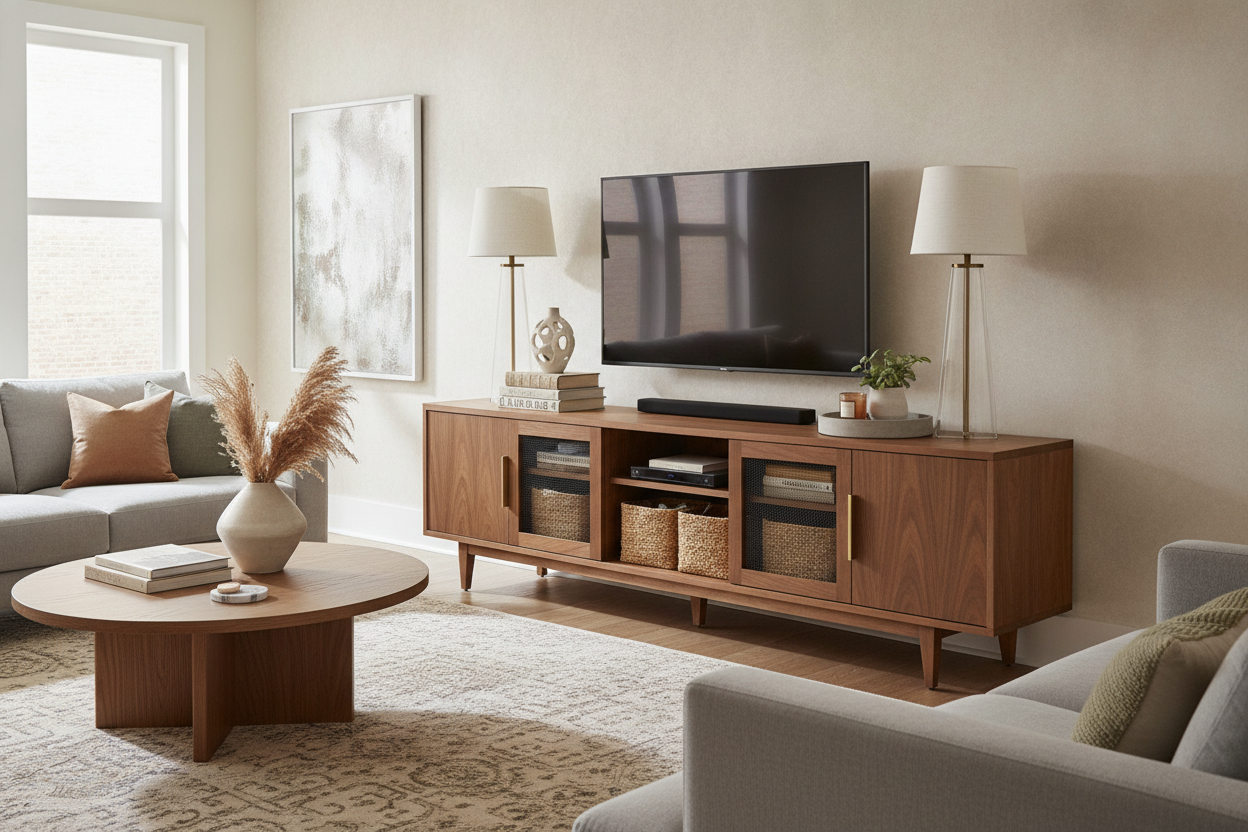
You can style a sideboard TV stand to look incredibly high-end by using the extra surface area for a lamp or a few books, but you still need to be mindful of that viewing height. If the sideboard is over 30 inches, consider wall-mounting the TV slightly above it to bridge the gap.
Making Your Media Zone Look Intentional
If you are worried that a low TV stand will look too 'small' on a big wall, the solution is not a taller piece of furniture. The solution is styling. You can create a built-in bookcase look by flanking a low media unit with tall, thin shelving units or even large potted plants. This draws the eye upward without forcing your neck to follow.
A low, wide unit makes the room feel grounded and expensive. It allows the TV to be part of the room rather than the king of it. Trust me, once you swap that dresser for a piece of furniture that actually knows its job, you will never go back.
My Personal Lesson in 'Good Enough' Furniture
A few years ago, I found a 'gorgeous' 1960s walnut tallboy at a flea market. I spent a whole weekend refinishing it, convinced it would be the centerpiece of my living room. I put my TV on it, sat down on my velvet sofa, and realized within ten minutes that I hated it. I had to sit perfectly upright like I was in a job interview just to see the subtitles. Two weeks later, I was back at the store buying a proper media console. I ended up using the dresser for, you know, clothes. Lesson learned: specialized furniture exists for a reason.
FAQ
Can I just wall mount the TV above a dresser?
You can, but it usually looks 'off' because the dresser is already so tall. The TV ends up near the ceiling (the dreaded 'TV too high' syndrome). It is better to mount it over a lower console.
Is it okay to drill holes in a cheap dresser for cables?
If it is a particle-board piece you do not care about, sure. But keep in mind that dressers lack the ventilation needed for electronics, so your devices might overheat in closed drawers.
What is the best depth for a TV stand?
Look for something between 14 and 16 inches. This is deep enough for almost any TV base but shallow enough to keep your living room feeling spacious.


Dejar un comentario
Este sitio está protegido por hCaptcha y se aplican la Política de privacidad de hCaptcha y los Términos del servicio.