










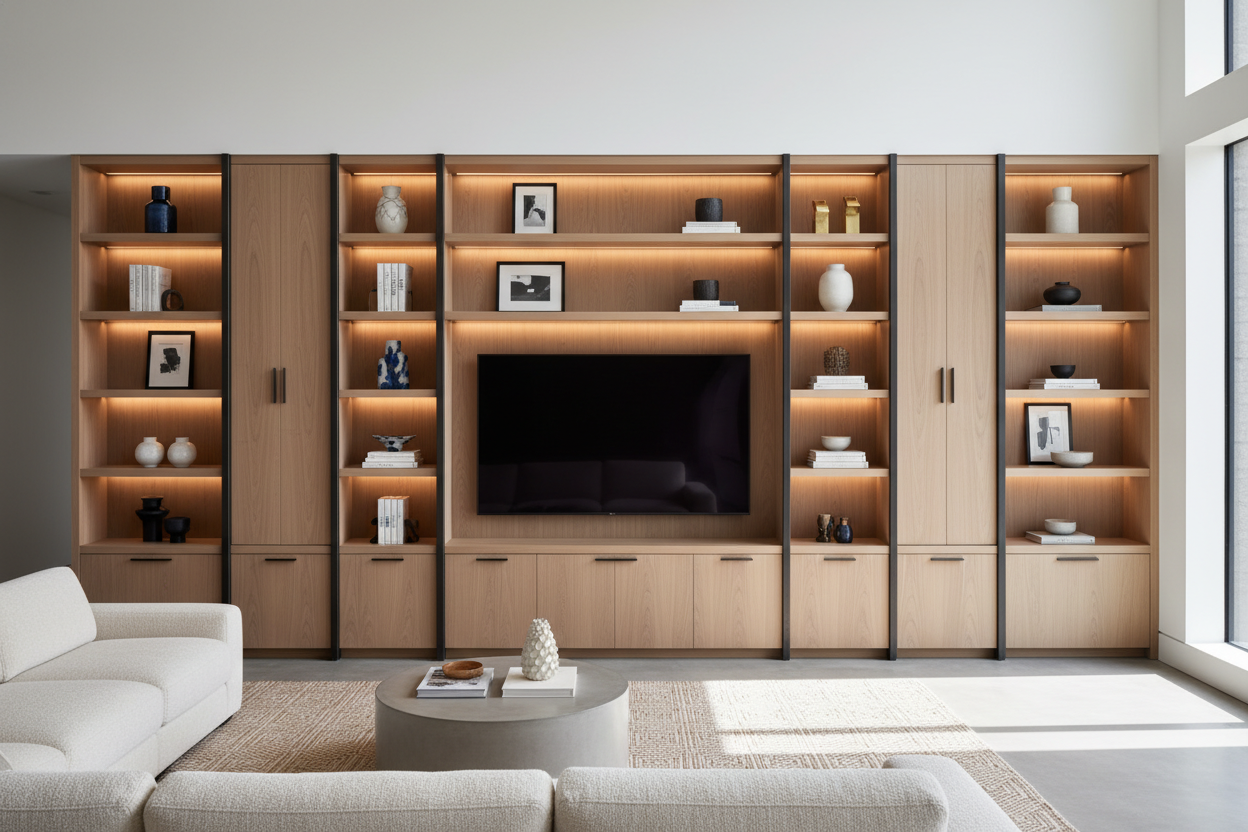
I spent three hours last Tuesday staring at a wall unit I bought in 2018, wondering why my living room felt like a waiting room at a mid-tier law firm. It’s that relatable 1 AM realization: you’ve spent thousands on a sofa and a rug, but your shelving entertainment center is still sucking the soul out of the room. We buy these massive pieces because they promise to solve our storage nightmares, but they often just become a giant, wooden anchor that keeps our decor stuck in 1997.
- Prioritize Closed Storage: At least 40% of your unit should have doors to hide the plastic junk.
- Scale Up Your Decor: If it is smaller than a grapefruit, it probably doesn't belong on a high shelf.
- Negative Space is a Choice: You don't have to fill every square inch of an entertainment system shelves setup.
- Cable Management is Non-Negotiable: Visible cords make even the most expensive unit look cheap.
The Mega-Unit Trap (And Why We Still Fall for It)
There is a specific kind of nostalgia attached to the massive media wall. We remember our parents' oak units that housed a 200-pound CRT television and a collection of VHS tapes. When we shop for a modern shelving entertainment center, we’re often subconsciously looking for that same sense of permanence. We want a piece that says, 'This is where the home happens.' But the reality of modern tech—thin OLED screens and invisible streaming boxes—means these giant units often end up looking like empty shells or, worse, cluttered graveyards for things we don't actually use.
I’ve seen so many people buy beautiful entertainment system shelves only to realize they have nothing to put on them except old Xbox games and a few dusty candles. The trap is thinking that more surface area equals better design. In reality, a massive wall unit requires a curated eye, or it just becomes a giant dust magnet that shrinks your floor plan. If you’re going big, you have to be intentional about the 'why' behind every shelf, or you’ll end up with a room that feels heavily anchored in the past rather than grounded in the present.
The 'Hide the Junk, Show the Art' Ratio
If your unit is 100% open shelving, you’ve already lost the battle. You need an entertainment center with shelves and cabinets to maintain your sanity. Why? Because life is messy. You have routers, tangled HDMI cables, PlayStation controllers, and that one weird remote that nobody knows what it does but everyone is afraid to throw away. These things are not decor. They are utility, and utility belongs behind a door.
When I’m hunting for a base, I look for something like a TV stand with adjustable center shelf. Having that flexibility in the bottom third of your unit is vital. It allows you to height-adjust for a chunky AV receiver or a stack of board games while keeping the visual 'weight' at the bottom. This creates a foundation that feels stable. Use the cabinets to camouflage the plastic chaos, and save the eye-level shelves for things that actually tell a story about who you are. A 60/40 split between open and closed storage is the sweet spot for a modern look.
Stop Filling Every Single Gap with Tiny Decor
This is the biggest mistake I see: the 'trinket creep.' People take an entertainment center with top shelf space and treat it like a display case for every souvenir they’ve ever bought. When you have dozens of small items, the eye doesn't know where to land. It just sees 'noise.' To modernize your unit, you need to embrace scale. Swap out five small tea lights for one massive, structural ceramic vase. Replace a stack of loose magazines with a singular, heavy piece of driftwood or a large-scale sculpture.
This is where adjustable shelf storage becomes your best friend. By removing a shelf or two, you create taller vertical gaps that force you to use larger items. These 'statement' pieces break up the horizontal monotony of a shelving entertainment center. Don’t be afraid of negative space, either. A shelf that is 70% empty with one beautiful object in the corner looks sophisticated and airy. A shelf packed to the brim looks like a thrift store clearance rack. Give your objects room to breathe, and they’ll actually start to look like art.
Treating It Like a Real Library
If you’re using an entertainment bookshelf unit, you have to treat the books with respect. Don't just shove them in wherever they fit. A modern library look is about rhythm. Try alternating your stacking methods: one cubby has books standing vertically, the next has a horizontal stack of three heavy coffee table books acting as a pedestal for a small bowl. This breaks up the 'grid' feel that makes wall units look so stiff.
I’m also a big fan of 'breathing room' in a book collection. If your shelves are bursting at the seams, the whole unit feels heavy and oppressive. Leave a few inches of space at the end of a row. Lean a small framed sketch against the books. By blending your media and your reading material, the TV becomes part of the room’s narrative rather than a black hole in the center of the wall. It’s about making the technology feel like an integrated guest in your library, not the guest of honor.
When a Massive Wall Unit Just Doesn't Work
I’ll be honest: sometimes the best shelving entertainment center is no shelving at all. If you’re working with a room smaller than 150 square feet, a full-wrap wall unit is going to swallow your space whole. I once tried to force a massive 90-inch wide unit into a cramped apartment living room, and I felt like I was living inside a shipping crate. If you’re tight on square footage, a low-profile console is almost always a better choice.
You also have to consider the focal point. For instance, a bookcase entertainment center with fireplace can be a stunning centerpiece in a large, high-ceilinged room, but in a standard 8-foot-ceiling suburban living room, it can feel like it’s screaming for attention. If your room already has a lot going on—busy wallpaper, a big sectional, or a lot of windows—adding a massive, feature-heavy unit might be a spatial mistake. Sometimes, high impact comes from a simpler, cleaner silhouette that lets the rest of your furniture do the talking.
FAQ
How do I hide my TV wires in an open shelf unit?
Use adhesive cable clips along the back of the vertical supports. If the unit is against the wall, you can also use a D-line cable raceway painted the same color as your wall to make the drop-down cords virtually disappear.
What is the best height for the TV in a wall unit?
Your eyes should be level with the bottom third of the screen when seated. Most people mount their TVs way too high. If you have to tilt your head back, it's too high. Keep the base unit around 20-24 inches tall.
Can I mix wood tones in my entertainment center?
Yes, but keep it intentional. If your unit is a dark walnut, use lighter oak or maple decor pieces to create contrast. Avoid mixing two very similar but slightly different wood grains, as it will look like an accidental mismatch rather than a design choice.


Dejar un comentario
Este sitio está protegido por hCaptcha y se aplican la Política de privacidad de hCaptcha y los Términos del servicio.