










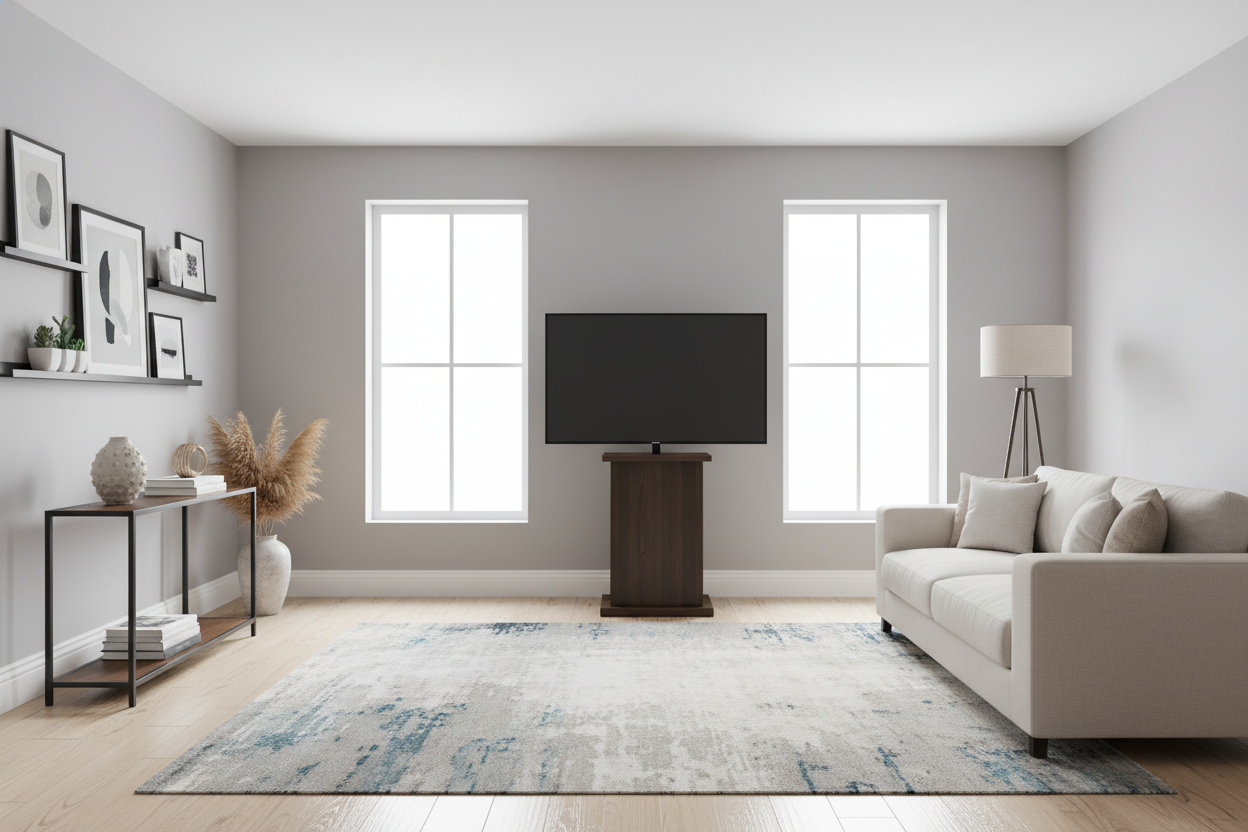
You know the feeling. You spent weeks picking out the right linen duvet cover and the perfect 'greige' paint, but your bedroom still feels like a cavernous hotel room that hasn't quite been finished. You look at the wall opposite your bed, and there it is: a sleek, 20-inch-high media console you bought because it looked great in a minimalist living room photo. But in your bedroom, it looks like a postage stamp stuck to the bottom of a billboard. It’s too short, it’s too small, and every time you lie back, you’re straining to see over your own feet.
In a large primary bedroom, scale is your best friend or your worst enemy. Most people default to living room furniture heights, but the bedroom is a different beast entirely. To fix the visual void and the literal pain in your neck, you need to stop looking at low-profile units and start looking for a tv stand 48 inches tall. This four-foot height is the secret weapon of interior designers who know how to handle big walls and high beds.
Quick Takeaways
- Vertical Balance: A 48-inch height fills the 'dead air' between your floor and 9-foot ceilings.
- Sightline Solutions: Higher stands ensure you can see the screen over thick duvets and high footboards.
- Storage Bonus: Taller units often provide dresser-style storage without the bulk of a full armoire.
- Room Proportion: A tall stand balances the massive visual weight of a King or Queen size bed.
The 'Floating Stamp' Problem in Big Bedrooms
The biggest mistake I see in primary suites isn't the color palette or the rug size—it's the vertical proportion of the furniture. When you have a massive 9-foot or 10-foot ceiling, a standard 18-to-24-inch media console completely vanishes. It leaves about seven feet of empty, echoing drywall above it. This creates what I call the 'Floating Stamp' effect. Your expensive 65-inch television looks like a tiny sticker floating awkwardly in the middle of a giant blank wall because the furniture underneath it has no architectural presence.
I’ve walked into rooms where the owner tried to fix this with a gallery wall around the TV. It almost never works. It just looks cluttered. The real issue is that the base—the furniture itself—isn't providing enough 'lift.' You need a piece of furniture that claims its territory. A 48-inch tall stand acts more like a built-in or a high-boy dresser. It anchors the wall, drawing the eye upward and making the entire room feel more intentional and furnished. It’s not just about holding a TV; it’s about correcting the architectural scale of a room that was designed with volume in mind.
Why the TV Stand 48 Inches Tall is the Goldilocks Dimension
Why exactly 48 inches? It’s the architectural middle ground. At four feet tall, the stand is roughly chest-high for the average adult. This is high enough to feel substantial and permanent, yet low enough that it doesn't feel like a heavy, room-dominating armoire from the 1990s. When you browse through a standard collection of TV stands, you'll see dozens of pieces designed for sofas. Sofas sit low; beds sit high. If you try to use a living room piece in a bedroom, you're fighting the room's natural geometry.
A 48-inch unit successfully fills that vertical visual space without closing the room in. It allows you to place decor on top—think a pair of substantial ceramic lamps or a few oversized art books—that reaches even higher, further bridging the gap to the ceiling. It’s the Goldilocks dimension because it provides the utility of a dresser while maintaining the specialized depth of a media console. Most of these units are 16 to 18 inches deep, whereas a dresser might be 22 inches deep. That extra four inches of floor space matters in a bedroom walkway.
Wait, does a tv stand 48 inches high ruin the viewing angle?
This is the first thing everyone asks: 'Won't I get a crick in my neck?' The short answer is no, because of the physics of a bedroom. Unlike a living room where you sit upright on a sofa with your eyes roughly 36 to 40 inches off the floor, in a bedroom, you are usually propped up against a headboard or lying flat. Your angle of incidence is much higher. You have to look over your own legs, your thick 12-inch mattress, and often a bulky footboard. If your TV is on a low console, you’re basically watching the bottom third of the screen through your toes.
Using a tv stand 48 inches high puts the center of the screen at a much more natural height for reclining. It mimics the placement of a TV in a luxury hotel room—high enough to be seen from anywhere in the suite. If you happen to have one of those ultra-plush, 18-inch thick pillow-top mattresses on a high frame, you might find that even 48 inches needs a little boost. In those specific cases, using a tall TV stand mount can help you tilt the screen slightly downward, giving you that perfect ergonomic 'sweet spot' without sacrificing the style of the furniture underneath.
How to Style a Four-Foot Console So It Doesn't Look Like a Dresser
The danger of a 48-inch tall stand is that it can start to look like you just shoved an old bedroom dresser under your TV. To avoid this, you need to look for specific design features. First, prioritize units with open shelving or glass-front doors. The 'visual air' provided by an open cubby for a soundbar or a cable box breaks up the solid mass of wood. If the piece is a solid bank of heavy wooden drawers from floor to top, it’s a dresser. If it has a mix of textures—perhaps some metal mesh doors or a stone top—it’s a media piece.
I personally love styling these taller units with asymmetrical decor. Put a tall, leafy plant (like a Fiddle Leaf Fig or a large Monstera) on one side of the TV to soften the height. On the other side, stack a few horizontal elements to balance the verticality. Also, pay attention to the legs. A 48-inch stand with 'tapered' or 'bracket' legs that lift it a few inches off the floor will feel much lighter and more modern than a unit that sits flush on the carpet. This 'reveal' of the floor underneath is a classic designer trick to make a large piece of furniture feel less imposing.
When NOT to Use a High-Boy TV Stand
As much as I love a tall stand for the bedroom, please do not put one in your main living room unless you have a very specific reason. Living room seating is designed for a lower center of gravity. If you place a 48-inch stand in front of a modern, low-slung sectional, you’ll feel like you’re sitting in the front row of a movie theater. Your neck will hate you within twenty minutes. In the living room, you want your eyes to hit the middle of the screen while sitting naturally.
For expansive living room walls where you need to fill space, don't go up—go out. You should skip the height and instead opt for an extra long barn door TV stand to anchor the horizontal space. This keeps the TV at a comfortable viewing height while still providing enough furniture 'mass' to keep the wall from looking empty. Save the 48-inch height for the sanctuary of the bedroom, where the rules of gravity and sightlines are fundamentally different.
My Personal Take: The 'Bookshelf' Mistake
A few years ago, I tried to hack this look using a standard 4-foot bookshelf I found at a flea market. I thought, 'Hey, it's the right height, it's solid wood, it'll work.' It was a disaster. Bookshelves are usually only 10 to 12 inches deep. My TV stand base was 13 inches. The TV literally overhung the front of the shelf, and because there were no cord management holes, I had a 'spaghetti mess' of black wires trailing down the side of the white unit. It looked cheap and dangerous. I eventually bit the bullet and bought a proper 48-inch media chest with a 17-inch depth and pre-drilled holes. The difference in 'finished' look was night and day. Don't hack it—buy the piece designed for the weight and the wires.
FAQ
How high is too high for a bedroom TV?
Generally, you don't want the center of the TV to be higher than 50-55 inches from the floor unless you are mounting it and tilting it down. A 48-inch stand usually puts the bottom of the TV at 4 feet, which is perfect for most bed heights.
Can I use a regular dresser as a TV stand?
You can, but dressers are often deeper than necessary (taking up floor space) and lack ventilation for electronics. If you use a dresser, you'll likely need to drill your own holes in the back panel for cords, which can ruin the piece's structural integrity.
What is the best width for a 48-inch tall stand?
Because the stand is tall, you want it to be wide enough to not look 'tippy.' Look for something at least 50 to 60 inches wide to maintain a stable, balanced silhouette against the wall.


Dejar un comentario
Este sitio está protegido por hCaptcha y se aplican la Política de privacidad de hCaptcha y los Términos del servicio.