










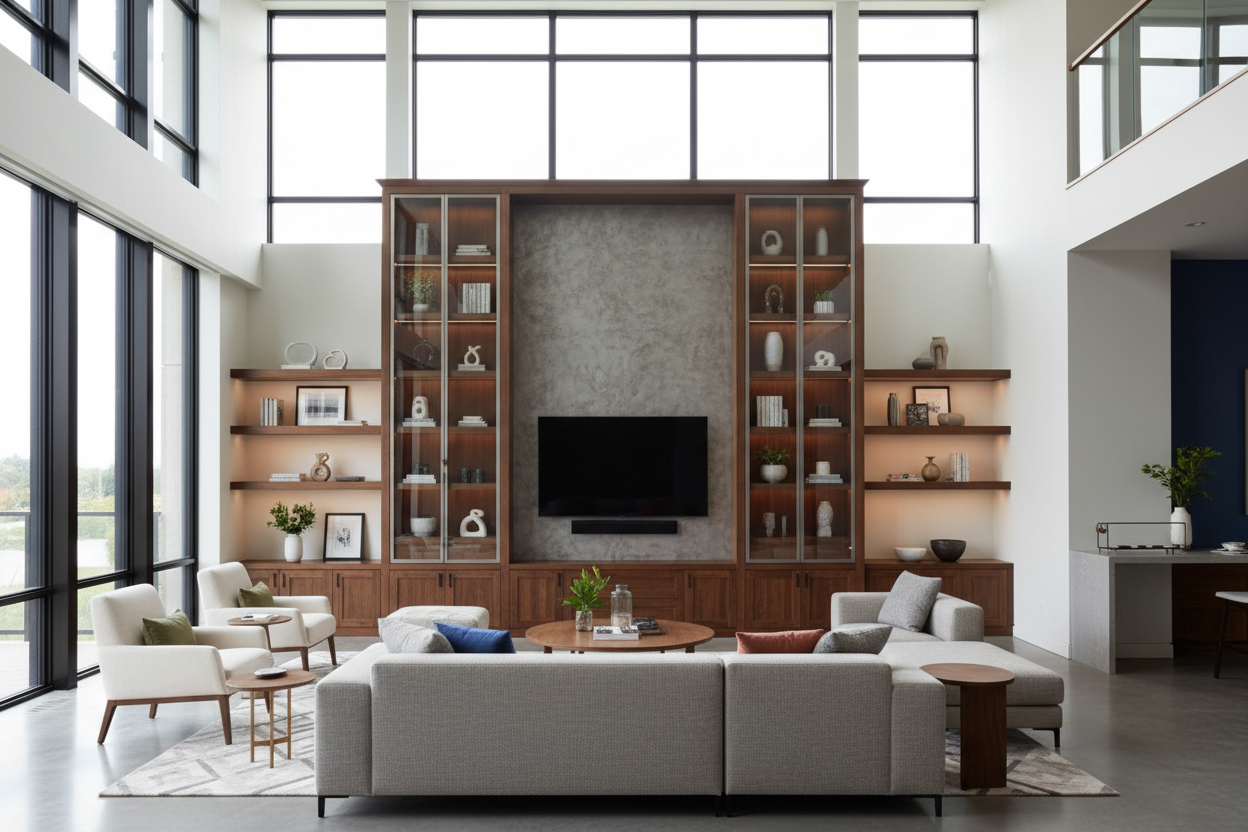
I remember sitting on my living room floor, staring at my brand new 75-inch TV. I’d spent a small fortune on the tech, but it was sitting on a mid-century console so low I felt like I was at a toddler's birthday party. The wall behind it stretched up ten feet—a vast, echoing desert of greige drywall that made my expensive screen look like a postage stamp stuck to a billboard. That was the moment I realized my mistake: I’d fallen for the minimalist trend in a room that desperately needed tall entertainment stands to claim the space.
- Scale is everything: A tiny console on a massive wall creates a visual imbalance that makes the whole room feel unfinished.
- Storage benefits: Vertical units don't just hold the TV; they hide the 'tech spaghetti' of routers, cables, and consoles.
- Architectural anchor: High units act like built-ins, giving a room a sense of permanence without the $5,000 contractor bill.
- Eye movement: Tall pieces draw the gaze upward, actually making use of the high ceilings you're paying for.
The 'Floating TV on a Giant Blank Wall' Epidemic
We’ve all seen it. You walk into a home with gorgeous 9 or 10-foot ceilings, and there’s a massive TV mounted five feet up the wall with a spindly, 18-inch high console sitting lonely on the floor beneath it. It creates this awkward 'dead zone' of empty drywall that feels cold and unintentionally cavernous. A high entertainment center isn't just furniture; it’s the architectural anchor that modern living rooms are missing. Without that verticality, your furniture feels like it’s drifting away from the walls, rather than belonging to them.
Most modern suburban homes lack crown molding or interesting millwork. When you introduce a tall entertainment cabinet, you are essentially adding a focal point that does the heavy lifting for the entire room. It frames the screen, provides a backdrop for your decor, and fills the visual void that makes a house feel like a temporary rental. You want your furniture to talk to the architecture, not look like it's afraid of it. Scale is the difference between a room that looks 'decorated' and a room that looks 'designed.'
Why I Finally Gave Up on the Low-Profile Console Trend
I tried to make the 'sleek and low' look work for two years. I bought the walnut stand that every interior design blog was pushing. In my old apartment with standard 8-foot ceilings, it was fine. But the second we moved into a space with real volume, that stand looked pathetic. It was like wearing a crop top to a black-tie wedding—just fundamentally wrong for the environment. The room felt echoey, and no matter how many oversized plants I threw into the corners, the wall behind the TV remained a giant, mocking blank space.
The realization hit when I visited a friend who had a massive, 80-inch tall unit. Suddenly, their room felt cozy, expensive, and grounded. I realized I was fighting the volume of my own home instead of embracing it. I stopped looking for 'minimalism' and started looking for 'presence.' Deciding on upgrading to a full entertainment center was the best design move I made that year. I traded that flimsy, low-slung unit for something with real vertical weight, and for the first time, the living room felt like it had a heartbeat. I stopped looking at the empty wall and started looking at a finished space.
The Magic Trick of a Tall Wood Entertainment Center
Wood brings a warmth that drywall simply cannot replicate. When you install a tall wood entertainment center, you’re essentially installing a massive piece of functional art. The vertical grain of the wood draws the eye up, emphasizing the height of the room while simultaneously grounding the floor space. It turns a cold, flat surface into a textured, intentional focal point. I personally went with a dark oak finish that had some real grain texture—none of that smooth, plastic-feeling laminate that chips if you bump it with a vacuum cleaner.
Before you pull the trigger, I highly recommend checking out an honest guide before you buy a tall wood cabinet. You need to ensure the scale is right for your specific TV size. If the unit is too narrow but very tall, it can look like a lonely skyscraper. You want the width to balance the height. The goal is to frame the TV so it looks like an integrated part of the furniture, not a black mirror stuck to a void. Solid timber or high-quality veneers are the way to go here; cheap particle board will bow under the weight of a unit this size, and that’s a disaster waiting to happen.
Overhead Cabinets Are Actually Your Friend
A lot of people are terrified of overhead storage because they have flashbacks to those bulky, dust-collecting oak monstrosities from the 1990s. But modern design has evolved. A tall tv entertainment center with a bridge or overhead cabinets creates a 'recessed' look for your TV, making the screen look built-in rather than just hung up. This modern 3 piece entertainment center with overhead cabinets is a prime example of how to get that height without the 'grandfather's library' vibe. It uses clean lines and mixed materials to provide verticality without feeling like it's closing in on you.
How to Style a Unit That Reaches for the Ceiling
When shopping for an entertainment cabinet tall enough to bridge the gap between your floor and your crown molding, the next challenge is styling it. The biggest mistake people make is filling every single shelf with small, cluttered knick-knacks. Don’t do it. The secret to styling these massive units is negative space and 'the rule of three.' Treat the upper shelves like a gallery. I like to put my heaviest art books on the lower shelves and save the top sections for a single, dramatic trailing plant or a large ceramic vase. If you clutter the top, the whole room feels top-heavy and anxious.
Use the lower, closed sections for the 'ugly' necessities. I’m talking about the mesh routers, the tangled web of HDMI cables, and the dusty controllers. It’s the designer secret to hidden storage that keeps your living room looking like a curated home rather than a tech showroom. Keep the visible shelves focused on items that have some height themselves—tall candlesticks, vertical frames, or sculptural pieces—to reinforce that upward movement. If you do it right, your giant blank wall won't just be 'filled'—it will be the best part of your house.
FAQ
How high should a tall entertainment center be?
For rooms with 9-foot ceilings, you want a unit that is at least 72 to 84 inches tall. If you go shorter, you'll still have that awkward 'floating' space above the unit that makes the wall look unfinished. Always aim to fill at least two-thirds of the wall's height.
Will a tall unit make my small living room feel cramped?
Actually, it’s usually the opposite. One large-scale, tall piece of furniture often makes a room feel more organized and spacious than four or five small, mismatched pieces. It simplifies the visual landscape and draws the eye up, making the room feel taller.
Is it difficult to assemble these larger units?
I won't lie—assembling a 3-piece tall unit is a two-person job. Because of the height, you’ll need someone to help steady the towers while you attach the bridge or overhead cabinets. Also, always, always anchor these units to the wall studs. Safety first when you're dealing with 80 inches of furniture.

Dejar un comentario
Este sitio está protegido por hCaptcha y se aplican la Política de privacidad de hCaptcha y los Términos del servicio.