










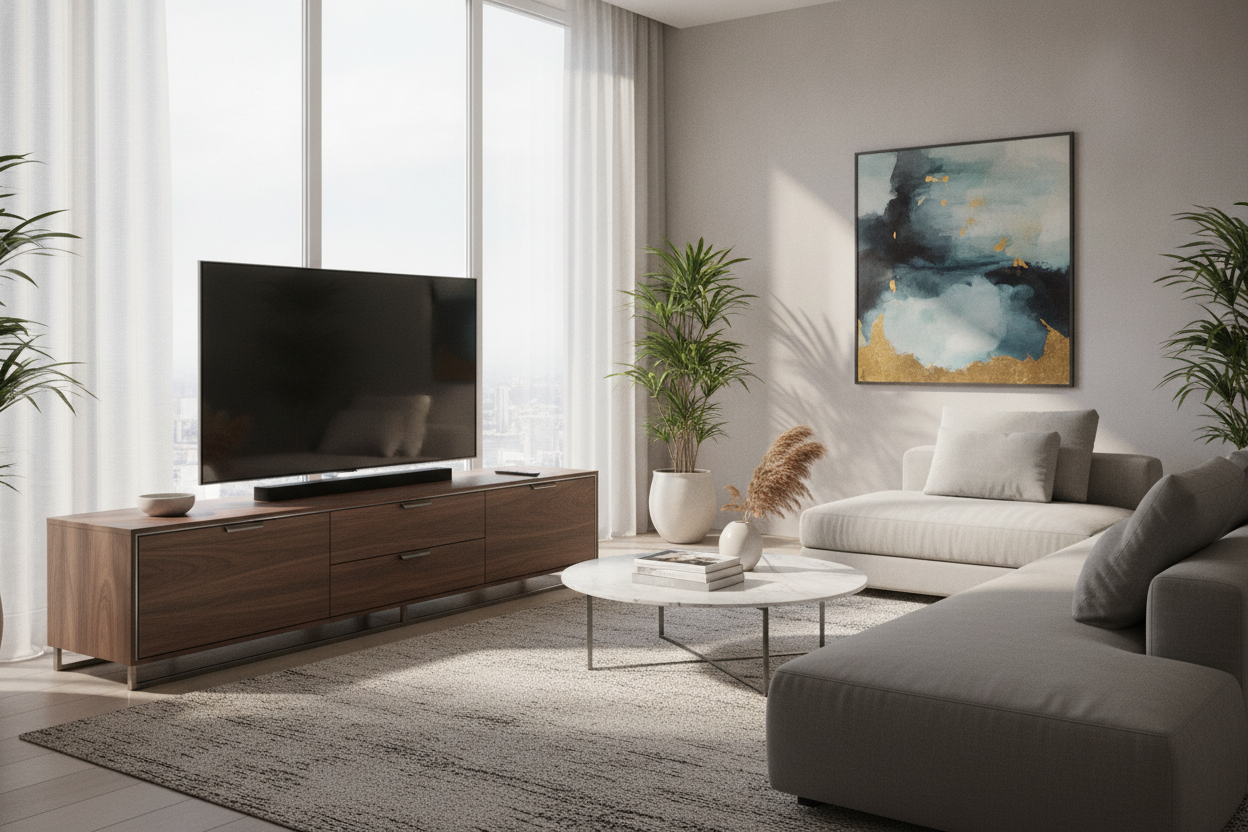
I spent three hours last night scrolling through photos of 'designer' living rooms, and I realized why so many of our homes feel just slightly off. It is usually not the rug or the paint color. It is that your TV looks like a massive mushroom growing out of a tiny pot. Staring at 47 browser tabs of furniture at 1 AM is a rite of passage, but the solution to a balanced room is actually quite simple: you probably need tv stands 60 inches wide.
We have all been there—you buy the stand that fits the TV legs, thinking that is enough. Then you set it up, and the whole wall feels cramped. I have personally assembled enough flat-pack furniture to know that the 'exact fit' is actually your worst enemy when it comes to scale.
Quick Takeaways
- The Golden Ratio: Your stand should be at least 10-20% wider than your screen.
- A 55-inch TV is physically about 48 inches wide, making a 60-inch stand the sweet spot.
- Center support legs are non-negotiable for any unit over 50 inches to prevent sagging.
- Extra width provides 'landing zones' for decor that softens the look of the big black screen.
The 'Mushroom Effect' (Why Your Current Setup Looks Top-Heavy)
The most common mistake I see in living room layouts is the 'Mushroom Effect.' This happens when you buy a console that is the exact same width as your television. Because the TV has more visual weight (it is a giant dark rectangle, after all), it makes the furniture underneath look like it is struggling to hold it up.
When the proportions are 1:1, the room feels top-heavy and visually cluttered. It actually makes your living room look smaller because the eye stops abruptly at the edge of the screen. You want the eye to travel past the TV and across the furniture to create a sense of width and airiness.
The Magic Math Behind TV Stands 60 Inches Wide
Here is the secret that most retailers do not explain clearly: TV sizes are measured diagonally, but furniture is measured horizontally. A standard 55-inch TV is actually only about 48 inches wide physically. If you put that on a 48-inch stand, it looks cramped. If you put it on tv stands 60 inches wide, you suddenly have six inches of breathing room on each side.
That six-inch margin is the difference between a 'dorm room' vibe and a 'custom home' look. It is the golden ratio of living room proportions. However, if you get this wrong, the whole wall can look like an afterthought. I have seen Why Most 60 Inch TV Stands Look Ridiculous (And How to Fix It) when people ignore the depth or height of the unit in relation to their seating.
How to Style the Edges of a TV Table 60 Setup
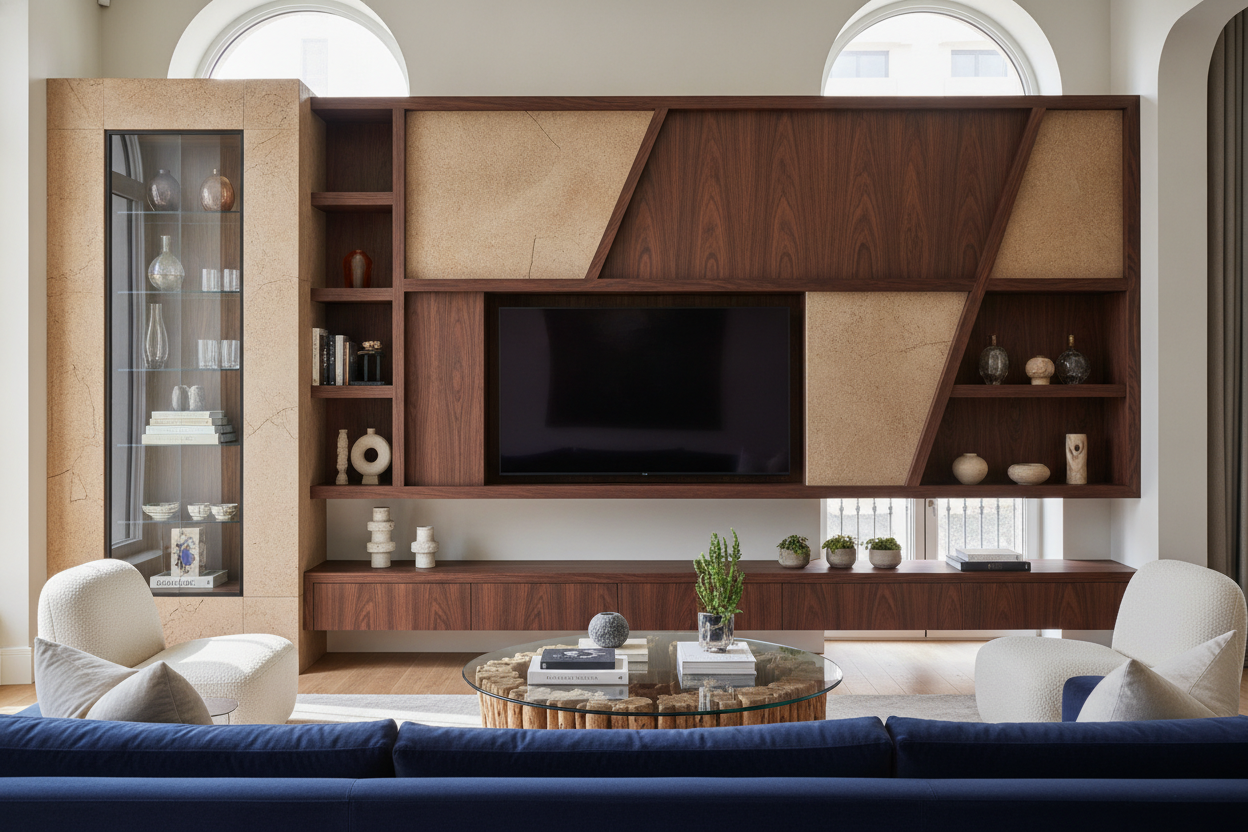
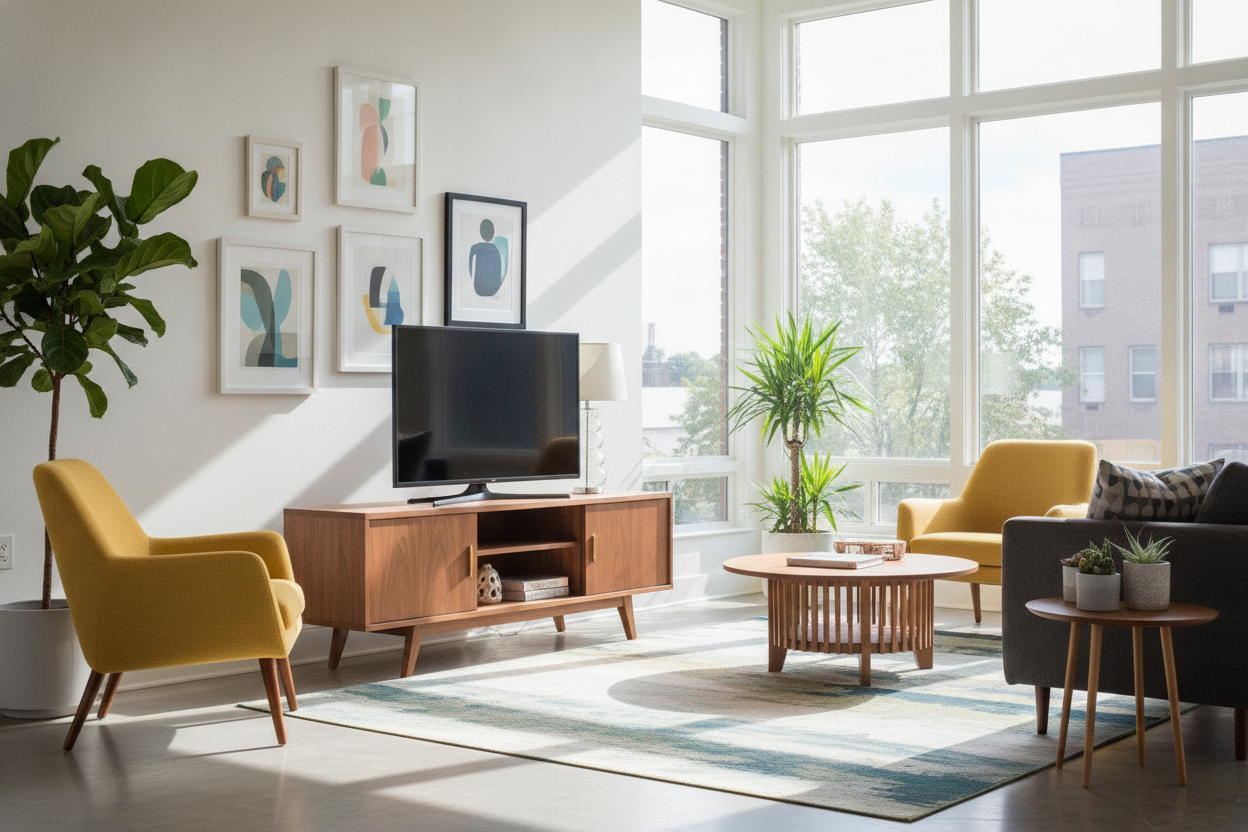
Once you have those extra inches on the ends of your tv table 60 inches long, do not leave them empty. This is your chance to ground that 'black box' of a screen so it does not dominate the room. I like to add a low-profile lamp on one side and a stack of linen-bound design books on the other.
Trailing plants like a Pothos or a Philodendron are also great for breaking up the hard lines of the tech. When you browse different styles of tv stands, look for options with a flat, continuous top surface. Avoid anything with raised edges or weird dividers that limit where you can place your decor. You want that surface area to be as versatile as possible.
What If You Actually Have a 60-Inch Screen?
Now, if your screen is actually 60 or 65 inches diagonally, the math changes. In this case, searching specifically for tv stands for 60 tv setups will lead you to units that are exactly 60 inches wide, which brings us back to the mushroom problem. For a screen that large, you actually need to size up again to a 70 or 72-inch console.
If you realize your screen is too massive for a standard 60-inch unit, do not try to squeeze it on. It is a safety hazard and a design fail. You are better off looking for a modern tv stand with cabinets and drawers for tvs up to 70 inches to keep those proportions in check. Trust me, the extra floor space it takes up is worth the visual balance.
The Structural Secret to Avoiding the 'Middle Sag'
I have a confession: my first 'real' apartment furniture was a cheap particle board unit that started to 'smile' (sag in the middle) after just three months. When you are looking for a tv stand up to 60 inch widths, you must check the underside. If there is no center support leg, walk away.
Even if the TV is light, the weight of the unit itself plus your consoles and books will cause bowing over time. Solid wood is great, but even high-quality MDF needs that fifth leg in the middle. I always point people toward The Only TV Stand for 60 Inch TV Walmart Carries That Won't Sag because it actually addresses this structural reality without costing a fortune.
Frequently Asked Questions
Can I put a 60-inch TV on a 60-inch stand?
Technically yes, if the legs fit, but it will look cramped. You generally want the stand to be about 10 inches wider than the TV for the best aesthetic. For a 60-inch screen, a 70-inch stand is better.
How high should my TV stand be?
Your TV should be at eye level when you are sitting on your sofa. For most standard couches, that means a stand height between 18 and 24 inches. Anything higher and you will be visiting a chiropractor.
Should I choose open or closed storage?
Closed storage is almost always better. Unless you are a master of cable management, open shelves just become a dusty nest of black wires. Cabinets hide the mess and keep the focus on your decor.

Dejar un comentario
Este sitio está protegido por hCaptcha y se aplican la Política de privacidad de hCaptcha y los Términos del servicio.