










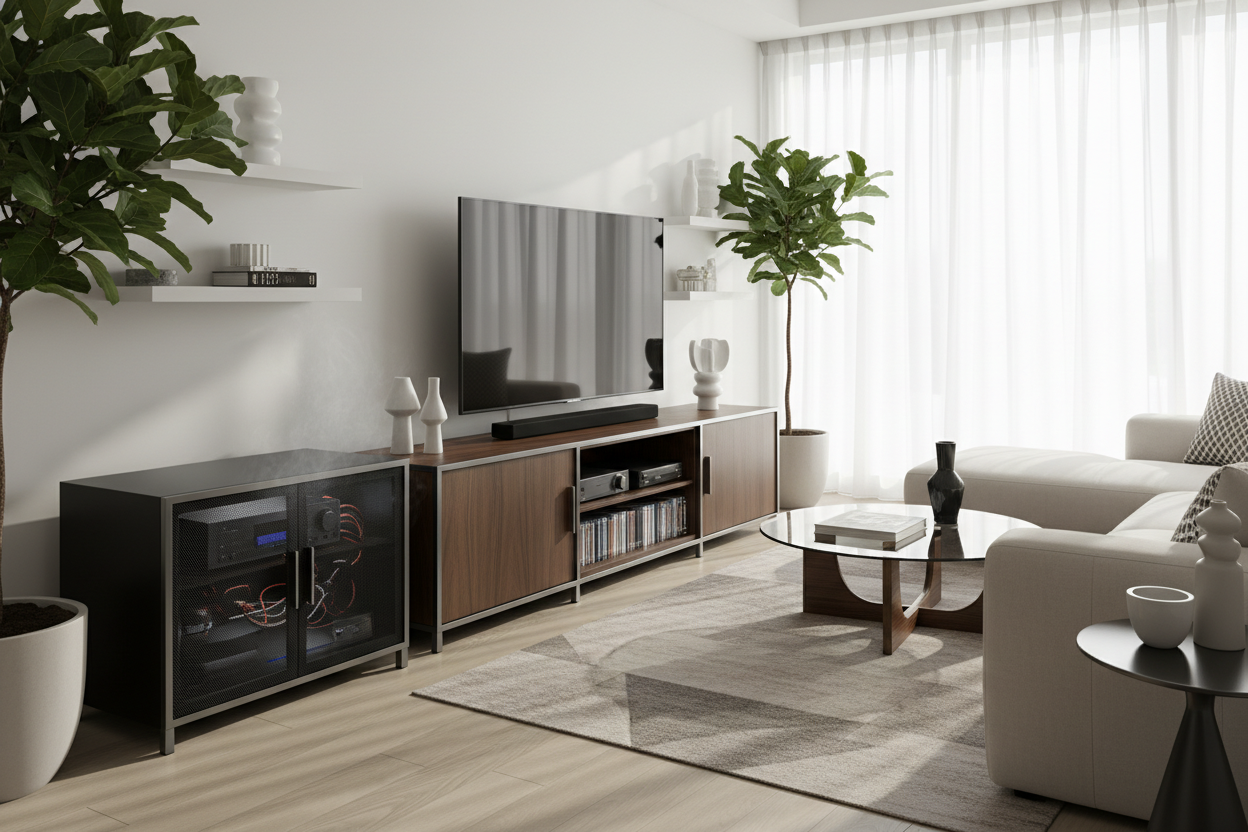
I still remember the smell of burning dust and hot electronics when I first set up my home theater. I'd just spent three weeks hunting for the 'perfect' mid-century sideboard, only to realize my Denon receiver was two inches deeper than the cabinet itself. I ended up hacking a jagged hole in the back panel with a steak knife just so I could plug in the HDMI cables. It was a disaster.
If you're tired of your gear hanging off the edge or overheating behind closed doors, you're likely searching for legitimate stereo and tv cabinets that actually respect the laws of physics. Most furniture is designed for looks first and equipment second, which is a recipe for fried circuit boards and tangled wires.
- Depth is King: Most receivers need at least 18-20 inches of clearance once you factor in the cable plugs.
- Passive Cooling: If your cabinet doesn't have vents or an open back, your amp is basically a slow-cooker.
- Weight Limits: A serious power amp can weigh 40 lbs; cheap MDF shelves will bow like a smile.
- Vibration Control: Turntables need a rock-solid surface to prevent skipping when you walk across the room.
The Moment I Realized Standard Consoles Hate Audio Gear
We've all been there: you find a sleek, low-profile media unit that looks amazing on Pinterest. But then you try to slide in your gear and realize the shelves are exactly 12 inches deep. Your receiver is 15 inches deep, and those banana plugs on the back add another two inches. Suddenly, your 'clean' setup has a giant black box protruding from the front like a sore thumb.
I've seen so many people make these common TV stand and cabinet mistakes because they prioritize a slim silhouette over functional depth. A proper tv stereo cabinet isn't just a box; it's a piece of furniture that accounts for the 'cable tax'—that extra space behind the unit where all the magic (and the mess) happens.
Depth, Heat, and Weight: The Holy Trinity of Audio Storage
When you move away from standard TV stands, you start noticing things like weight capacity. A high-end integrated amplifier isn't light. I once put a vintage Marantz on a cheap flat-pack shelf and watched it slowly sag over the course of a month. Dedicated tv and stereo stands use reinforced shelving or solid wood to handle the heft of transformers and heat sinks.
Then there's the heat. If you've ever touched the top of a receiver after a two-hour movie, you know they get hot. Most tv stereo stand designs include ventilated back panels or slatted doors. Without airflow, the internal temperature of your gear can climb high enough to shorten the lifespan of your capacitors. You aren't just buying a shelf; you're buying insurance for your electronics.
The Turntable Dilemma: Where Does the Record Player Go?
Turntables are the divas of the audio world. They need to be perfectly level and completely isolated from vibration. If your tv audio stand is flimsy, every footstep in the room becomes a 'thump' through your speakers. I personally prefer keeping the turntable on the top surface, but if you're tight on space, some tv and audio stands offer heavy-duty pull-out drawers designed specifically for top-loading gear.
Just remember: if you put your record player inside a cabinet, you need enough vertical clearance to actually open the dust cover. I learned that the hard way after buying a beautiful credenza that only gave me four inches of height—rendering my turntable a very expensive paperweight until I moved it to the top.
Ditching the 90s Look: Modernizing the Tech Rack
For a long time, 'audio furniture' meant those hideous black metal towers with glass shelves that looked like they belonged in a 1994 Best Buy. Thankfully, we've moved past that. Modern audio video stands now look like high-end furniture. You can find a modern TV console cabinet that uses acoustic fabric or louvered doors, allowing your remote signals (and sound) to pass through while hiding the blinking lights.
These tv and audio cabinets are designed to hide the clutter without sacrificing the performance of your gear. I've tested dozens of tv stereo stands cabinets over the years, and the ones that win are always the ones that treat a tv audio cabinet like a piece of art. No one wants to look at a 'cable waterfall' spilling out the back of their console.
3 Rules for Wiring Your New Setup Without Losing Your Mind
Setting up a stereo tv console is 20% lifting and 80% cable management. First rule: keep your power cables on one side and your signal cables (RCA, HDMI) on the other. This prevents that annoying 60Hz hum from leaking into your speakers. Second, always leave about six inches of slack. There is nothing worse than having to unplug everything just to swap one cable because the wire is too tight.
Third, prioritize accessibility. A tv stand audio rack with a removable back panel is a godsend. If you have to pull the entire 100-pound cabinet away from the wall every time you want to add a new component, you're going to hate your life. Look for 'open-back' designs or tv audio racks on hidden casters if you're the type of person who is constantly tweaking their system.
How deep should a TV and stereo cabinet be?
Aim for at least 18 to 22 inches. Most modern A/V receivers are 15-17 inches deep, and you need at least 3 inches of breathing room for the cables and connectors sticking out the back.
Can I put my receiver behind closed doors?
Only if the cabinet is ventilated. Look for slatted wood, mesh, or 'active' cooling (fans). If it's a solid wood door with no airflow, your receiver will likely overheat and shut down within an hour.
What's the best height for a TV stereo stand?
It depends on your eye level when seated, but usually 20 to 24 inches is the sweet spot. This keeps the TV at a comfortable height while leaving enough room for three or four tiers of audio gear below.



Dejar un comentario
Este sitio está protegido por hCaptcha y se aplican la Política de privacidad de hCaptcha y los Términos del servicio.