










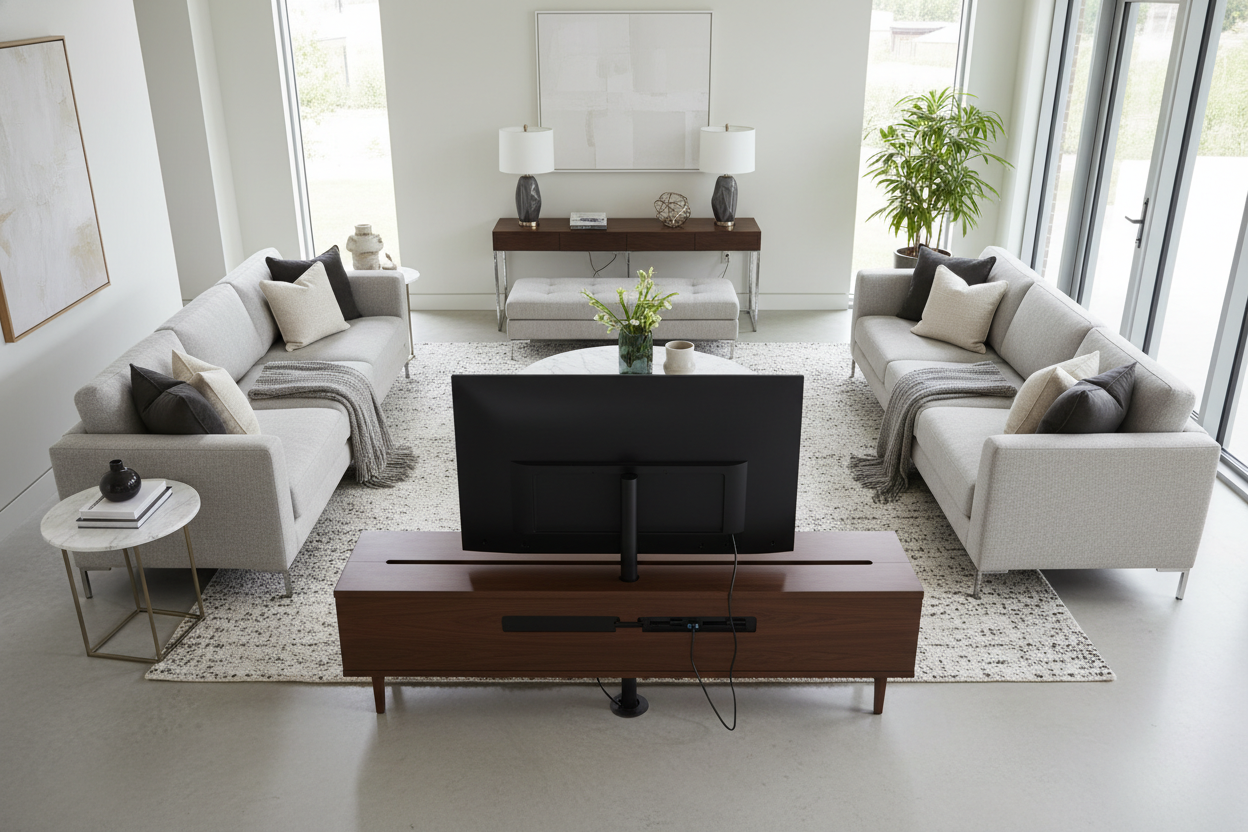
I spent three years living in what I called the 'bowling alley'—a long, narrow living room where every piece of furniture was shoved against the drywall like it was afraid of the rug. It felt static and cold. One Tuesday at 2 AM, I finally dragged my console three feet away from the wall to create a 'zone' and realized a middle of room tv stand wasn't just a design choice; it was a survival tactic for open floor plans.
- Cord Management: You need a plan for the wires before you move a single piece of furniture.
- Finished Backs: Only use furniture that is finished on all four sides.
- Traffic Flow: Maintain at least 30 inches of clearance for walking paths.
- Weight Matters: Heavier, solid-wood units are less likely to tip in high-traffic areas.
Why I Finally Stopped Pushing All My Furniture Against the Wall
Most of us follow this unwritten rule that says furniture must touch the perimeter. It is a trap that leaves a massive, awkward dead zone in the center of the room. By floating the media setup, I defined the seating area and actually made the room feel larger by creating a distinct 'room within a room.' This is why I finally tried a middle room TV stand—I needed to break the line of sight and stop staring at a vast expanse of empty hardwood.
When you pull the TV away from the wall, you create a natural hallway behind it. This stops people from walking between you and the screen while you're mid-binge. It feels more like a deliberate lounge and less like a waiting room. I realized that the 'bowling alley' effect was actually killing the coziness of my home.
The Biggest Problem With a TV Stand in the Middle of the Room
Let's be real: televisions are ugly from behind. They are plastic, vented, and usually covered in stickers you can't peel off. When you place a tv stand in the middle of the room, you're essentially inviting everyone to look at the 'engine room' of your entertainment system. My first attempt looked like a tech support closet had exploded in my living room.
Beyond the aesthetics, you have the stability issue. A console against a wall can be anchored for safety. A floating console relies entirely on its own footprint. I've tested flimsy particle board stands that wobbled every time the dog ran past. If you're going to do this, the piece needs to have some serious heft—think kiln-dried hardwoods or heavy steel frames.
Cord Management Is Non-Negotiable
If you have a stray HDMI cable snaking across the floor, someone is going to trip and your $1,200 OLED is going to meet the floor. I use heavy-duty cord protectors that tuck under the edge of an 8x10 area rug. If you own your home, installing a recessed floor outlet is the gold standard. For renters, look for flat power strips that can be taped down and hidden under furniture legs or thick rugs.
You Have to Make the Back Look Good
You can't just leave those ports exposed. A better move is choosing a console with a finished back panel rather than that cheap folded cardboard. If you want to go full stealth mode, a dresser with hidden TV lift is the ultimate move. The TV disappears entirely when you aren't watching, leaving a clean, sophisticated piece of furniture in the center of the space.
The Exact Math for Floating Your Media Setup
You need at least 30 inches of walking space behind the stand if it is acting as a room divider. Anything less and you will be shimmying past it like you are on a crowded subway. I also recommend an adjustable TV stand for living room layouts because it lets you tweak the width to perfectly align with your sofa's footprint. If the stand is wider than the couch, it looks bottom-heavy; if it's too narrow, the proportions feel 'off.'
Measure your 'walking lane' twice. I once set up a beautiful mid-century unit only to realize I couldn't fully open the balcony door behind it. Don't just eyeball it—use painter's tape on the floor to map out the footprint before you start plugging things in.
What Kind of Console Actually Works for This?
Avoid the $89 specials. They usually have unfinished backs that look hideous. You want something with weight—solid mango wood or powder-coated steel. Check out high-quality freestanding TV stands that offer 360-degree finishing. A heavy base is crucial; if the piece is top-heavy and sitting in a high-traffic area, one hip-bump from a guest could be a disaster.
Look for integrated wire management holes that lead into the cabinet. If the wires have to exit the back of the unit before they hit the floor, you've already lost the battle. The goal is to have one single, wrapped 'trunk' of cables that drops straight down to a rug or floor outlet.
Personal Experience: My 'Tipping Point'
I once tried to float a cheap MDF stand I bought on clearance. I didn't account for the weight of the cables pulling on the back. Every time I opened a drawer, the whole thing tipped forward half an inch. I ended up having to weight the bottom shelf with literal bricks hidden inside decorative baskets. It was a mess. Buy something solid from the start—your floors and your electronics will thank you.
FAQ
How do I hide the wires?
Use a cord hider that matches your flooring or run them under a large area rug. If you can, use a braided cable sleeve to group all wires into one neat 'rope' rather than a tangled mess.
Will it make my room look smaller?
Usually the opposite. By creating a dedicated zone for the TV, you define the space. It breaks up a large, cavernous room into functional areas, which often makes the layout feel more intentional and spacious.
Is it safe for kids?
Only if the console is heavy and the TV is bolted to the stand itself. Never float a light, wobbly setup in a house with toddlers or high-energy pets. Stability is the number one priority.

Leave a comment
This site is protected by hCaptcha and the hCaptcha Privacy Policy and Terms of Service apply.