










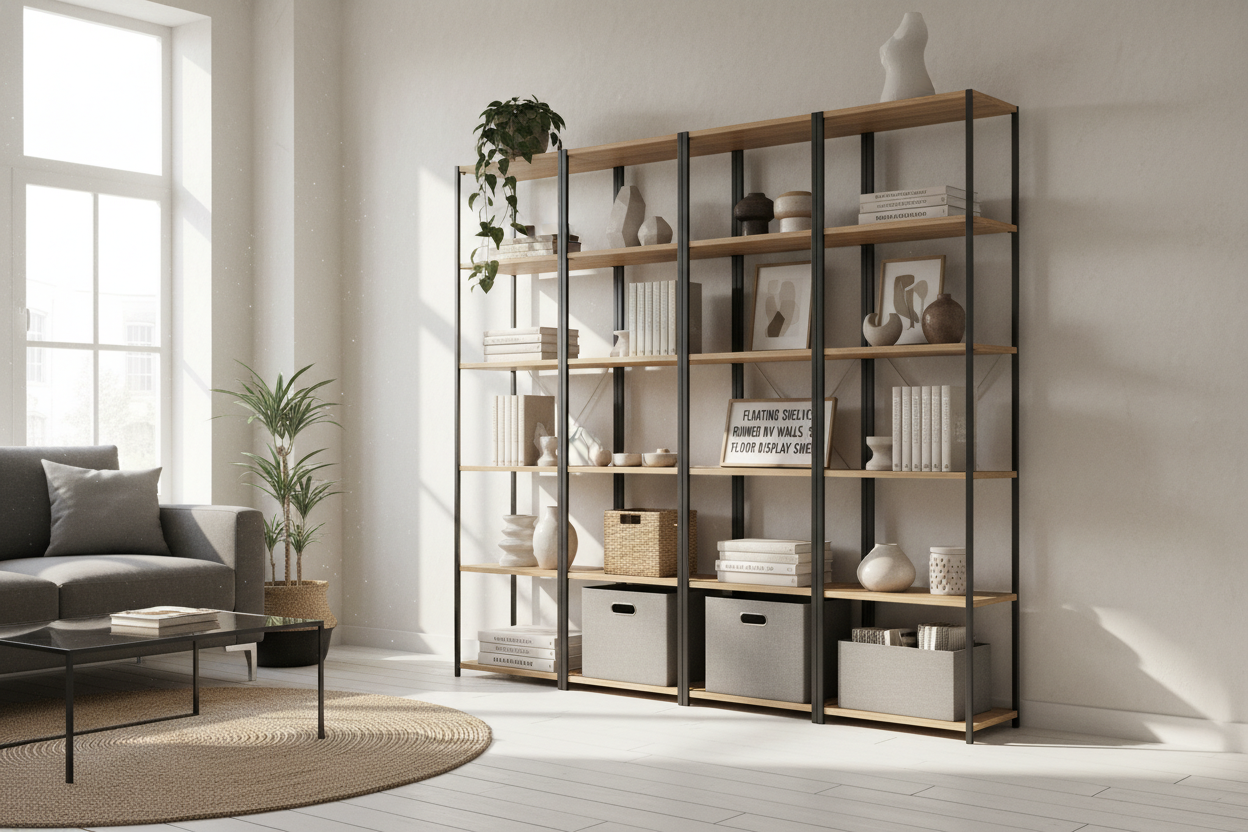
I spent four hours with a tub of spackle last July, sweating and crying over the half-inch craters left by my 'minimalist' floating ledges. The landlord still took $200 out of my security deposit. That was the day I swore off drilling massive toggle bolts into crumbly apartment drywall and finally bought a floor display shelf.
We have all been there: staring at a wall, wondering if that 18-inch stud is actually where the sensor says it is, only to have the drill bit sink into nothingness. After three apartments and twelve patched holes, I realized I was trying too hard to make a trend work for a space I didn't even own.
- Zero Wall Damage: No anchors, no drills, no spackle-induced breakdowns.
- Higher Weight Capacity: Real wood and steel frames beat tension-held brackets every time.
- Portability: When you move, it goes in the truck, not the trash.
- Instant Architecture: A tall unit creates a focal point in a boxy, characterless room.
The Floating Shelf Fantasy (And The Drywall Reality)
The dream is a clean, gravity-defying line of books. The reality is a sagging piece of MDF that slowly pulls away from the wall until your $40 Diptyque candle is tilted at a precarious 10-degree angle. Floating shelves are notoriously fickle. If you aren't hitting a stud—and in most cheap rentals, the studs are never where you need them—you're relying on plastic anchors that eventually fail under the weight of anything heavier than a single air plant.
I spent years fighting this battle before asking myself if a floor-based unit was actually better than floating shelves. The answer was a resounding yes. A floor display shelf takes the structural load off your walls and puts it on the floor, where it belongs. You get the same vertical storage without the constant anxiety that your entire collection of hardcovers is going to come crashing down at 3 AM.
Why I Finally Caved and Bought a Floor Display Shelf
The pivot to freestanding furniture wasn't just about my security deposit; it was about physics. A solid floor display shelf with a 16-gauge steel frame can hold hundreds of pounds. My current unit houses a record player, a vintage receiver, and about fifty vinyl LPs. If I tried that with floating shelves, the drywall would have literally peeled off the studs.
There is also the 'take it with you' factor. I’ve left behind at least four sets of expensive wall-mounted ledges because they were too much of a pain to uninstall and patch. Now, my display moves with me. It’s a piece of furniture, not a permanent modification. Plus, you can change your room layout on a whim. Try moving a floating shelf six inches to the left on a Tuesday afternoon—it’s a weekend project. Moving a floor unit? That’s a five-minute job.
How to Keep Tall Floor Display Shelves from Tipping (Without Pissing Off Your Landlord)
I know what you're thinking: 'But what about safety?' If you have kids, pets, or live in earthquake country, a 72-inch tower is a liability. But you don't need giant lag bolts to secure it. Most anti-tip kits use a small nylon strap and a single screw that is no bigger than a picture hanger nail. It’s a tiny hole that takes two seconds to fill with a dab of toothpaste-sized spackle.
If you are strictly 'no-drill,' use the bottom-weighting trick. Keep your heavy art books and stone bookends on the bottom two shelves. This lowers the center of gravity significantly. I also swear by 'museum wax' on the feet if you have hardwood floors; it adds just enough grip to prevent the unit from sliding or shifting if someone bumps into it.
How to Style It So It Doesn't Look Like a Sad Dorm Bookcase
The biggest fear with floor display shelves is that they can look like a cheap 'back-to-school' special. To avoid this, you need to play with scale. Don't just line up books like a library. You need negative space. I like to group books by color or size, then leave a gap for a sculptural ceramic piece or a trailing Pothos. If you're struggling with the layout, here is a guide on how to display them properly.
Height is your best friend here. If every item on the shelf is the same height, the eye gets bored. I look for adjustable shelf storage so I can create a double-height 'gallery' section in the middle for a tall vase or a piece of framed art. It breaks up the grid and makes the unit look like a custom installation rather than a flat-pack purchase.
The 'Fake Built-In' Trick for Awkward Layouts
If you have a long, empty wall or a weird corner that feels useless, don't just buy one unit. Buy two or three and line them up. Pushing two identical floor display shelves together creates the illusion of custom cabinetry for a fraction of the price. It anchors the room and makes the ceiling feel higher than it actually is.
For those nightmare living rooms with weird 45-degree angles, I suggest using a large corner shelf storage organizer to bridge the gap. It wraps the corner and makes the transition look intentional. I did this in my last place—a cramped 1920s studio—and it turned a 'dead' corner into the most commented-on part of the apartment. No carpentry required.
Personal Experience: The MDF Disaster
I once bought a $40 particle board shelf that bowed in the middle after exactly three weeks. The shelves looked like a sad smile. Now, I only buy units with at least a 3/4-inch shelf thickness or reinforced metal supports. If you can see the shelf flexing when you press down with your hand, walk away. Your decor deserves better than a sagging foundation.
FAQ
Do floor display shelves work in small apartments?
Absolutely. In fact, they work better than small cabinets because open-frame shelves don't block the line of sight, making the room feel larger while providing vertical storage.
Are metal or wood shelves better?
Metal frames are usually more stable and thinner, which looks modern. Solid wood is beautiful but heavy. Avoid cheap MDF (medium-density fiberboard) if you plan on holding heavy books, as it will sag over time.
How do I stop my shelf from wobbling on carpet?
Most modern units come with 'leveling feet'—small screw-in pads on the bottom. If yours doesn't, a simple wooden shim tucked under the front edge does wonders for stability on thick pile carpet.

Leave a comment
This site is protected by hCaptcha and the hCaptcha Privacy Policy and Terms of Service apply.