










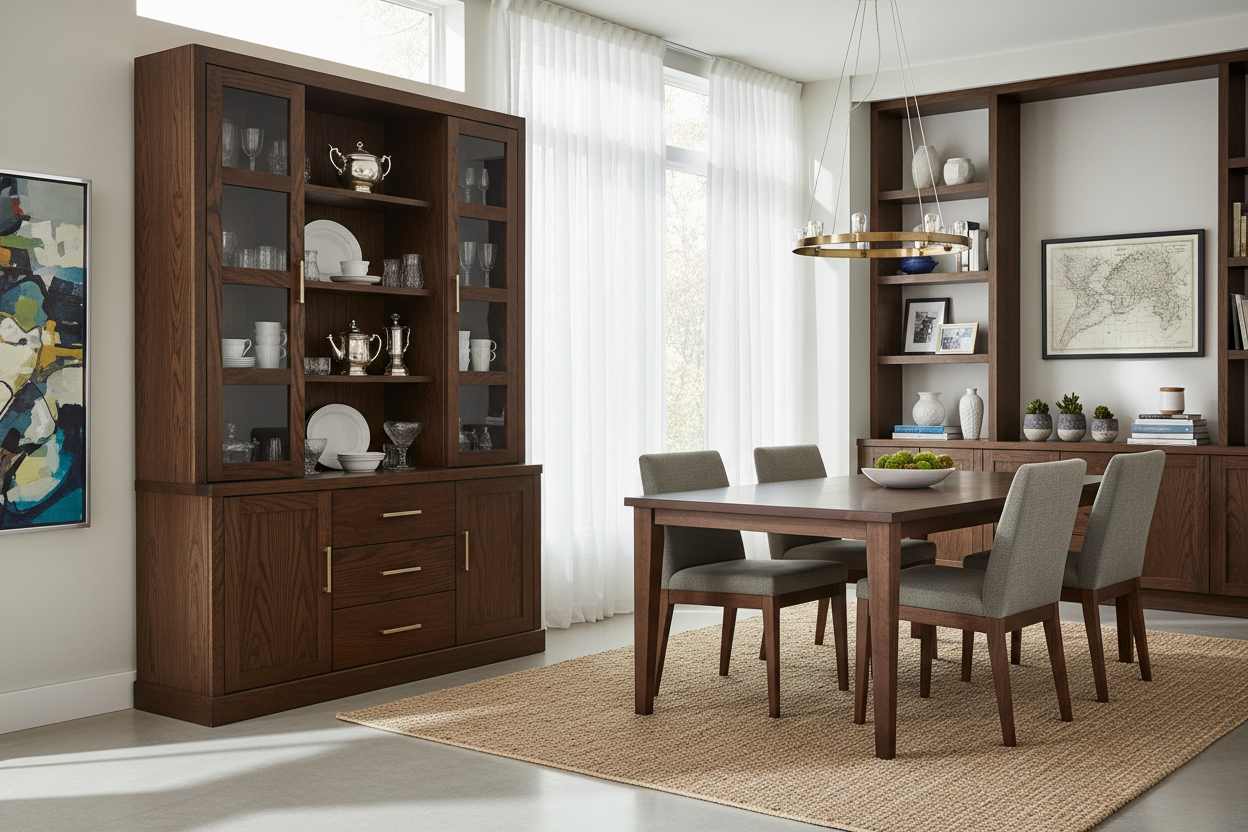
I remember walking into a client's dining room last year—they'd just moved into a 1920s colonial in Boston. They had this beautiful china cabinet wood piece they'd inherited, but it felt heavy and dark against their light gray walls. The wood type wasn't working with their space, and it made the whole room feel off. That's when I realized most people don't think about their china cabinet's wood until it's already in the room.
After furnishing over 200 homes across North America, I've seen how the right wood choice can make a china cabinet feel like it was built for the room, while the wrong one creates constant visual friction. Let's talk about how to choose wisely.
Quick Takeaways
- Solid wood cabinets last generations but require more maintenance than veneers
- Dark wood hutches need at least 18 inches of clearance from walls to avoid feeling oppressive
- Oak has prominent grain (great for traditional), maple is smoother (ideal for modern)
- Always check for kiln-dried construction to prevent warping in dry climates
- Your existing flooring material should influence your cabinet wood choice
Why Your China Cabinet's Wood Matters More Than You Think
When you're shopping for a china cabinet, you're probably thinking about size first—will it fit in that corner by the window? But the wood type affects everything from how long it lasts to how it changes color over time. I worked with a family in Chicago who bought a beautiful pine china cabinet, not realizing how soft the wood was. Within a year, their kids had dented the doors with toys.
Different woods have different hardness ratings on the Janka scale. Oak sits around 1,290 lbf, while pine is only 380 lbf. That difference determines whether your cabinet survives toddler years or shows every bump. The wood also affects how the piece integrates with your room. A cherry cabinet will warm up to reddish tones over time, while maple stays relatively neutral.
For more on wood selection fundamentals, I've written a detailed Wood China Cabinet — The Designer's Guide that covers what most stores don't tell you.
Solid Wood China Cabinets: The Timeless Investment
When clients ask me about solid wood, I tell them it's like buying a wool coat versus a polyester blend. Both keep you warm, but one lasts decades with proper care. Solid wood china cabinets are constructed from planks of actual wood—not veneers over particle board. This means they can be refinished multiple times over their lifespan.
I specify kiln-dried hardwood frames for all my solid wood recommendations. Kiln drying removes moisture at controlled temperatures, preventing the wood from warping when your heating system runs all winter. The difference is noticeable—I've seen solid wood cabinets shift less than 1/8 inch over five years, while cheaper constructions can warp up to half an inch.
Maintenance is straightforward but non-negotiable. You'll need to dust with a microfiber cloth weekly and use a quality wood conditioner every six months. Avoid placing them near heat vents or in direct sunlight, which can cause uneven fading. For a great example of solid wood construction, check out this Modern Rustic Wood China Cabinet with its mortise-and-tenon joinery.
Here's my honest take: solid wood costs 40-60% more upfront than veneer options. But I've had clients pass down solid wood cabinets to their grandchildren, while veneer cabinets typically need replacement after 10-15 years. The value retention is real—a well-maintained solid wood piece often appreciates.
Dark Wood China Hutches: Making Bold Statements Work
Dark wood china cabinets can feel intimidating. I had a client in Seattle who loved the look of walnut but worried it would make her 10x12 dining room feel like a cave. The secret is balance and placement.
First, measure your space. A dark wood hutch needs breathing room. I recommend at least 24 inches of clearance on either side if it's freestanding, or 18 inches if against a wall. In smaller rooms, consider a cabinet that's no more than 60 inches wide—anything larger starts to dominate visually.
Lighting is crucial. Install LED strip lighting inside the cabinet (3500K temperature works best) to create glow rather than shadow. Place a floor lamp with a warm white bulb opposite the cabinet to bounce light back. For the walls, choose paint with LRV (Light Reflectance Value) above 50. Benjamin Moore's White Dove (LRV 85) makes dark wood pop without feeling heavy.
Style with contrast. Display white porcelain or cream-colored dishes against the dark wood. Add brass hardware to warm up the look. For more specific techniques, I share my favorite approaches in Dark Wood Display Cabinet Styling Tips.
My personal favorite dark wood is quarter-sawn oak. It has beautiful ray fleck patterns that catch the light, preventing that flat, heavy look some dark woods can have.
Wood Type Comparison: From Oak to Walnut and Beyond
Let's compare the most common woods I specify for china cabinets. Each has distinct characteristics that suit different homes and lifestyles.
Red Oak: Janka hardness 1,290 lbf. Prominent grain pattern with cathedral figures. Takes stain unevenly (which can be charming). Best for traditional homes. Naturally light amber color that darkens slightly with age.
Maple: Janka hardness 1,450 lbf. Closed, subtle grain. Takes paint and stain evenly. My go-to for modern interiors. Starts pale white and develops a honey patina over 5-10 years.
Cherry: Janka hardness 995 lbf. Smooth grain with occasional pin knots. The color change is dramatic—starts pinkish-brown and deepens to rich red-brown with sun exposure. Needs placement consideration to avoid uneven coloring.
Walnut: Janka hardness 1,010 lbf. Straight grain with occasional curls and burls. The only naturally dark domestic wood (chocolate brown). Expensive but stunning. Works in both traditional and modern settings.
For a sense of how different woods work in dining furniture, this Elegant Solid Wood Modern Sideboard shows maple's clean lines beautifully.
Practical Considerations: Maintenance, Placement, and Integration
Once you've chosen your wood type, proper care ensures it lasts. Here's what I tell every client during installation.
Maintenance Schedule: Weekly dusting with microfiber (never feather dusters—they scratch). Every 3 months, use a damp cloth followed immediately by a dry one. Every 6 months, apply a paste wax or oil finish, depending on the original finish. For oil-finished woods (common with walnut), use boiled linseed oil. For lacquered woods, use paste wax.
Placement Rules: Keep at least 36 inches between your china cabinet and dining table for comfortable movement. Never place against exterior walls in cold climates—the temperature differential can cause condensation inside. If you have radiant floor heating, use felt pads at least 1/2 inch thick to create an air buffer.
Integration Tips: Match undertones, not exact colors. If your flooring has red undertones (like many oak floors), cherry or mahogany cabinets will harmonize. For gray-toned floors, maple or ash works better. Don't match your dining table wood exactly to your cabinet—choose complementary woods instead.
If you're considering alternatives to traditional china cabinets, our Black Cabinet With Glass Doors Collection offers modern display options that work with various wood types elsewhere in the room.
Frequently Asked Questions
Can I mix wood types in my dining room? Absolutely. I do this in 80% of projects. The key is varying the tones and grains. Pair a dark walnut cabinet with a medium-toned oak table and light maple chairs. Keep the undertones consistent—all warm or all cool.
How do I protect my wood cabinet from humidity changes? Use a humidifier in winter if your home drops below 30% humidity. In summer, run a dehumidifier if above 55%. Solid wood moves with humidity—this is normal. Veneer over particle board can delaminate with extreme swings.
What's the biggest mistake you see with china cabinet placement? Putting it in direct sunlight. UV exposure fades all woods unevenly and can damage finishes. If you must place near a window, use UV-filtering window film.
Is solid wood always better than veneer? Not always. For budget-conscious projects or humid environments (like Florida), quality veneer over plywood can be more stable. Look for veneers at least 1/28 inch thick—anything thinner won't withstand refinishing.

Leave a comment
This site is protected by hCaptcha and the hCaptcha Privacy Policy and Terms of Service apply.