










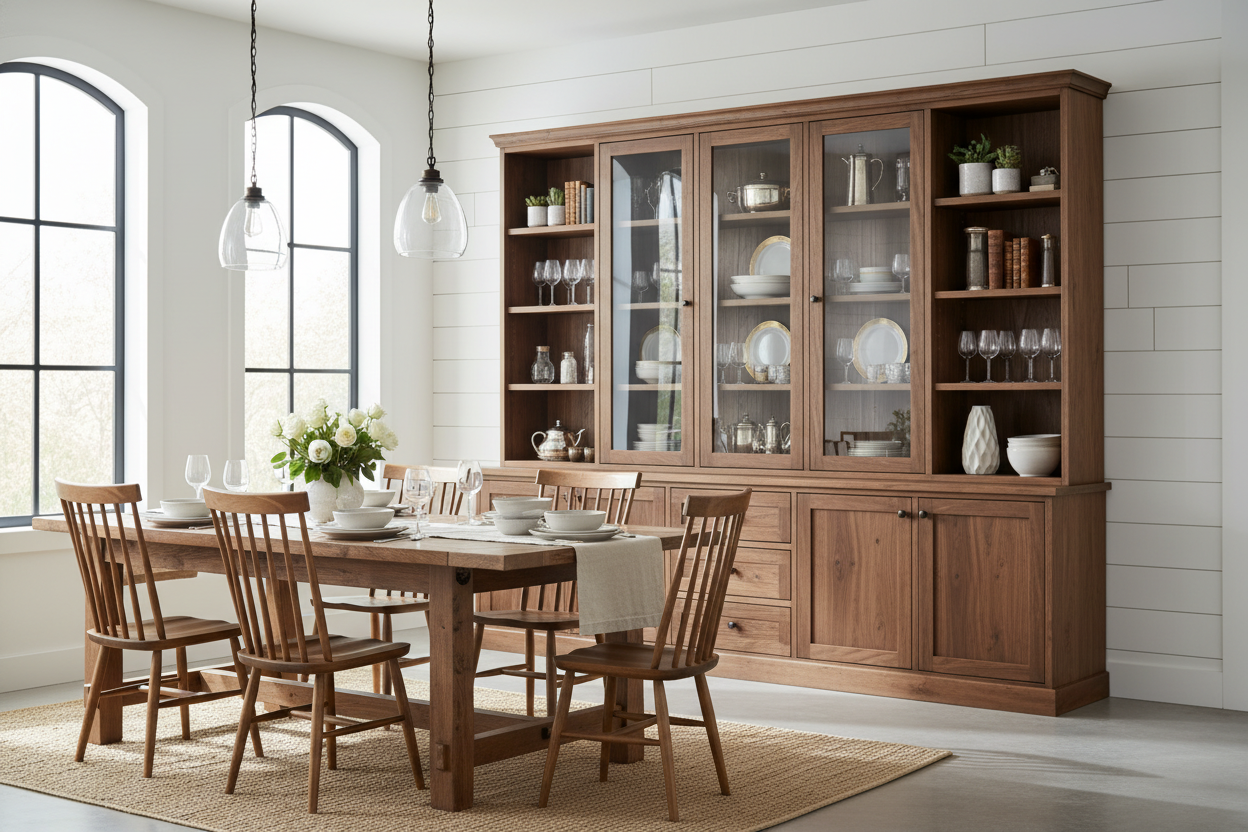
I remember walking into a client's dining room last year—they'd just moved in, and the space felt like a collection of random pieces. The table was too big, the chairs didn't match, and their beautiful wedding china was stacked in cardboard boxes in the corner. They told me, 'We just need something to put our dishes in.' What they actually needed was an anchor. That's when we brought in a wood china cabinet. Within a week, that dining room transformed from a storage problem into their favorite gathering spot.
Quick Takeaways
- A solid wood china cabinet isn't just storage—it's a design anchor that organizes your space visually and functionally.
- Measure twice: For standard dining rooms, allow 18-24 inches of clearance around the cabinet for comfortable movement.
- Glass doors (single-pane tempered) protect your items while letting you curate a display that reflects your style.
- Regular maintenance with a microfiber cloth and wood-specific cleaner preserves the finish for decades.
Why a Wood China Cabinet is Your Dining Room's Secret Weapon
After furnishing over 200 homes, I've seen the same pattern: dining rooms often become catch-alls. The sideboard holds mail, the table collects projects, and the good dishes stay hidden. A wood china cabinet solves three problems at once. First, it gives you dedicated, organized storage—no more stacking plates precariously. Second, it becomes a focal point. In a 12x14 dining room, a 60-inch wide hutch provides visual weight without overwhelming the space. Third, it's an investment. Unlike fast furniture, a real wood china cabinet made with kiln-dried hardwoods like oak or maple can last generations. I always remind clients that what designers actually think about solid wood storage comes down to longevity. It might cost more upfront than particleboard, but you won't be replacing it in five years when the veneer peels.
Choosing Your Perfect Wood China Cabinet: The Designer's Checklist
Let's get practical. When you're shopping, start with construction. Solid wood means the structural pieces are hardwood throughout—not just a veneer over plywood. For a china hutch, I recommend at least 3/4-inch thick shelves to support heavy dishware without sagging. Size matters: for small dining rooms under 10x10 feet, look for a small wood china cabinet around 48 inches wide. It still provides display space without blocking pathways. Glass doors are non-negotiable for me—they keep dust off your china while letting you enjoy it. Tempered glass is safer and clearer than standard options. For finishes, dark wood china cabinets like espresso or walnut add drama and hide fingerprints well, while natural wood finishes show off the grain and brighten a room. One of my go-to recommendations is a piece like the modern rustic wood china cabinet with sliding glass doors—it combines function with clean lines.
Styling Your Wood China Hutch Like a Designer
This is where personality shines. Don't just line up plates. Create layers. Start with your tallest items at the back—maybe a large serving platter leaned against the back panel. Place everyday dishes at eye level, and use the lower shelves for heavier bowls or less-frequently used pieces. Leave breathing room; overcrowding looks cluttered. I like to mix in decorative objects: a ceramic vase, a few hardcover books laid flat, or even a small piece of art. Lighting is key. If your hutch doesn't have built-in lights, add battery-operated LED strip lights along the top interior edge—they're inexpensive and make everything sparkle. For compact spaces, remember that a small wood cabinet with glass doors storage upgrade can be styled just as effectively by focusing on a few statement pieces rather than filling every inch.
Integrating Your Cabinet into Your Dining Room Design
Placement affects flow. Ideally, position your china cabinet on the longest wall, centered if possible. Leave at least 36 inches between it and the dining table for chair pull-out and walking space. If your dining room is open to the living area, use the cabinet to define the space—its height creates a visual boundary. Coordinate finishes without matching exactly. If your table is a light oak, try a dark wood china cabinet for contrast. Or, if you have upholstered chairs in a navy fabric, a natural wood finish complements without competing. Your china hutch should work with other storage pieces, not duplicate them. For example, pairing it with an elegant solid wood modern sideboard with adjustable shelves gives you closed storage for linens and serving pieces below, while the hutch displays your favorites above.
Maintaining Your Real Wood China Cabinet for Generations
Solid wood furniture is durable, but it needs care. Dust weekly with a soft, dry microfiber cloth—never use feather dusters that can scratch. For cleaning, use a product specifically made for wood finishes; spray it on the cloth, not directly on the cabinet, to avoid streaks or buildup on the wood. Glass doors should be cleaned with a vinegar-water solution or a streak-free glass cleaner, again applied to the cloth first. Check the hardware annually. Tighten any loose knobs or hinges to prevent strain on the wood. Avoid placing your cabinet in direct sunlight, which can fade the finish over time, and keep it away from heating vents to prevent drying and cracking.
FAQ
What's the difference between a china cabinet and a hutch?
A china cabinet typically refers to a taller piece with both closed storage (often at the bottom) and glass-fronted display shelves above. A hutch usually describes the upper glass-door section alone, but the terms are often used interchangeably.
Can a wood china cabinet work in a modern home?
Absolutely. Look for clean lines, minimal ornamentation, and finishes like matte black or light oak. The warmth of wood actually softens modern spaces beautifully.
How much weight can the shelves hold?
This varies by construction. In a solid wood cabinet with proper supports, shelves can typically hold 30-50 pounds evenly distributed. For heavy collections, consider adding center supports or using thicker shelving.
Is it worth refinishing an old wood china cabinet?
Often, yes. If the structure is sound (no major cracks or rot), refinishing can restore a family heirloom. I recommend consulting a professional for veneered pieces, as DIY sanding can go through the thin wood layer.

Leave a comment
This site is protected by hCaptcha and the hCaptcha Privacy Policy and Terms of Service apply.