










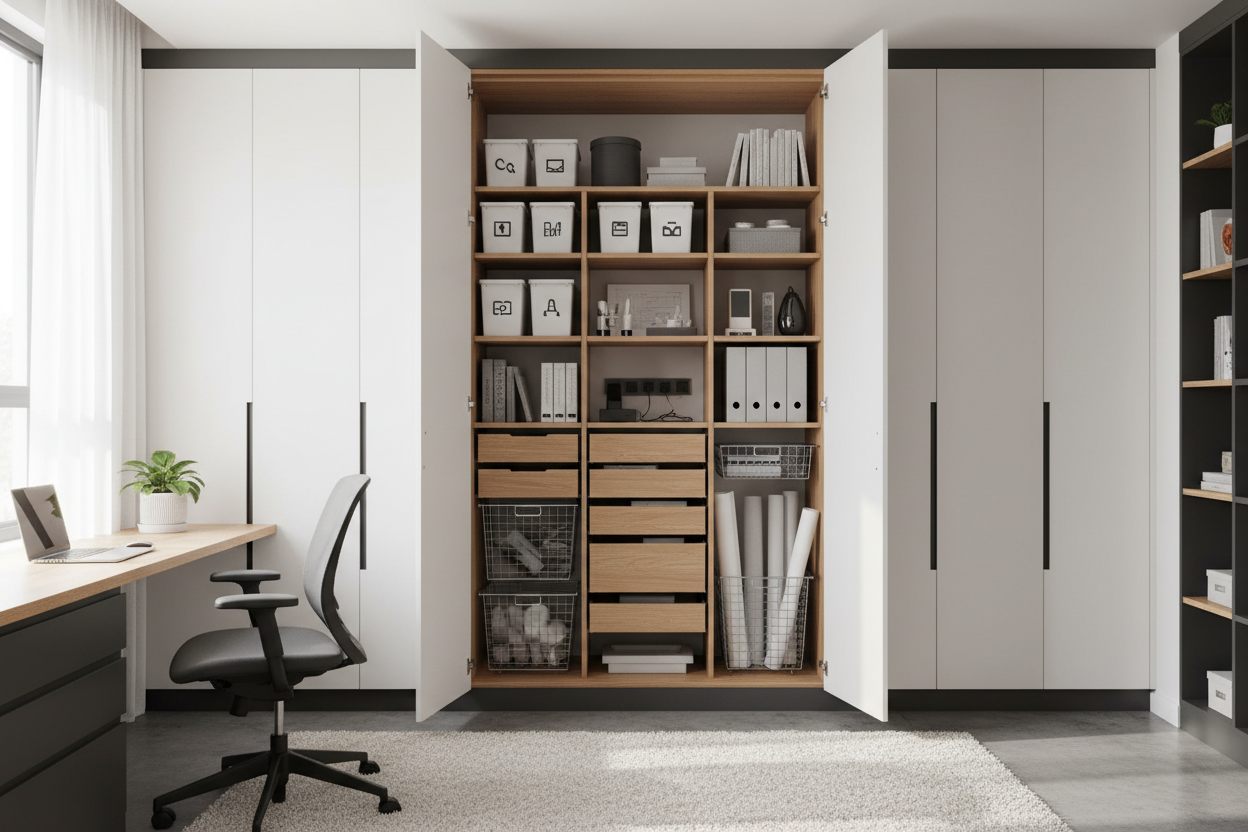
There is nothing quite as distracting as visual clutter when you are trying to meet a deadline. We often focus heavily on the desk and the ergonomic chair, but the backbone of a functional workspace is how you handle the overflow—the files, the tech gear, and the supplies. A well-designed closet for office use isn't just a box with doors; it is a strategic tool for maintaining mental clarity and workflow efficiency.
Key Considerations for Office Storage
- Accessibility: High-use items must be within arm's reach (15-28 inches high), while archival storage belongs up high.
- Depth Requirements: Standard wardrobe depth (24 inches) is often too deep for books and papers, leading to lost items. Aim for 12-15 inches for shelving.
- Cable Management: Integrated grommets and ventilated back panels are essential if you plan to house printers or servers inside.
- Lighting: Ambient room lighting rarely reaches the back of a closet; specify integrated LED ribbon lights.
- Material Durability: Horizontal surfaces need scratch-resistant thermal fused laminate (TFL) or stone, rather than soft veneers.
Analyzing Your Workflow and Storage Needs
Before we look at finishes or hardware, we need to audit what you actually possess. In my years designing workspaces, I have found that most homeowners overestimate their need for hanging space and underestimate their need for drawer banks in their office closets. Are you storing sensitive client files? You will need locking lateral file drawers. Are you a designer with sample books? You need reinforced, heavy-duty shelving.
The goal is to categorize your inventory into 'active' and 'passive' storage. Active items belong in open closet office shelving or glass-front cabinets to keep them visible and accessible, while passive items (taxes from three years ago) should be concealed behind solid doors to reduce visual noise.
Selecting the Right Closet Office Systems
When choosing between custom millwork and modular closet office systems, consider the permanence of your office. Built-in millwork increases property value and offers a seamless, architectural look that blends with your home’s trim. However, high-end modular systems offer flexibility; if your workflow changes, you can swap a hanging rod for shelving in minutes.
The Material Debate: Wood vs. Laminate
For a luxury aesthetic, many clients gravitate toward solid wood. However, for a high-traffic storage closet office, I often steer them toward high-quality textured melamine or TFL. Modern laminates are indistinguishable from real wood grain but are impervious to the heat generated by electronics and the inevitable coffee ring. If you do choose wood veneer, ensure it has a commercial-grade polyurethane finish to prevent premature wear.
Optimizing Layout and Visual Balance
A massive wall of cabinetry can feel imposing in a small home office. To mitigate this heavy look, we use a technique called 'breaking the plane.' This involves mixing depths—perhaps the center section bumps out slightly to accommodate a printer, while the flanking closet office shelving remains shallower. Incorporating open niches for decorative objects or books creates negative space, preventing the room from feeling like a corporate file room.
My Personal Take on Closet for Office Design
I learned a hard lesson early in my career regarding depth. I designed a stunning floor-to-ceiling unit for a client using standard 24-inch deep cabinetry because they wanted to hide a large laser printer. It looked sleek until they actually tried to use it.
We hadn't accounted for the extra three inches needed for the power cord and USB cable protruding from the back of the machine. The doors wouldn't close flush. We had to hire a carpenter to cut a ventilation and cable relief hole in the back panel onsite—a messy, dusty job that ruined the 'white glove' install experience. Now, I always measure the device plus the cables, and I usually insist on pull-out trays for heavy equipment. Also, a word of advice: avoid push-to-open latches on lower cabinets if you have pets. My own dog discovered he could open my supply cabinet with his nose, and I came home to a shredded ream of paper.
Conclusion
Investing in a tailored storage solution transforms your office from a chaotic drop-zone into a sanctuary of productivity. By prioritizing correct depths, durable materials, and integrated lighting, you create a space that supports your work rather than hindering it. It is time to close the door on clutter.
Frequently Asked Questions
What is the ideal depth for office shelves?
For standard binders and books, a depth of 12 to 14 inches is ideal. Anything deeper usually results in items getting pushed back and lost. However, if you are storing equipment like printers, you will need at least 18 to 24 inches.
How do I light a dark storage closet office?
Avoid battery-puck lights; they dim quickly and are frustrating to maintain. The best solution is a vertical LED tape light channel routed into the side panels (gables) of the cabinet. This illuminates every shelf evenly from top to bottom.
Can I use a standard bedroom closet system for my office?
Technically yes, but bedroom systems prioritize hanging space and often lack the weight capacity for heavy paper files. Office-specific systems include reinforced shelves and specialized hardware for hanging file folders.



Leave a comment
This site is protected by hCaptcha and the hCaptcha Privacy Policy and Terms of Service apply.