










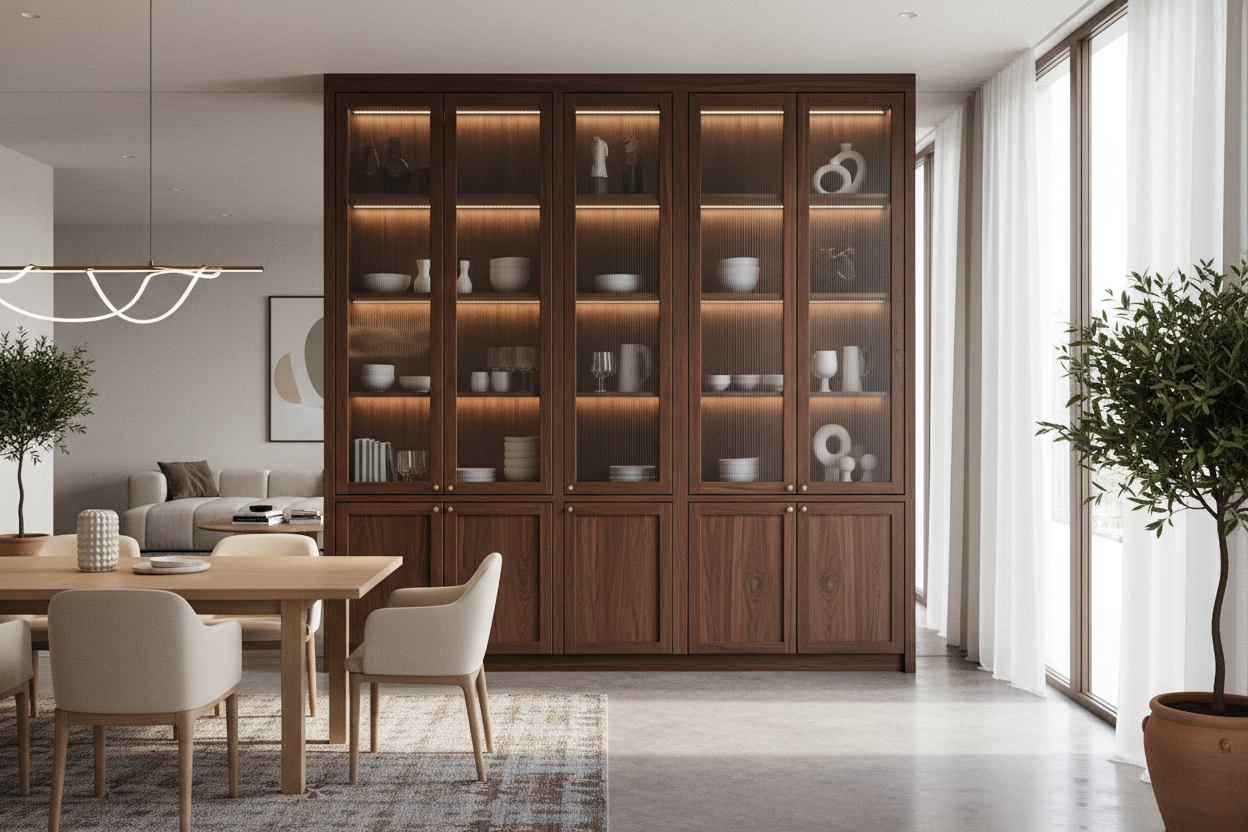
Many homeowners face the same frustrating dining room dilemma: a beautiful table sits in the center, but the perimeter of the room feels either painfully empty or cluttered with overflow dishes. If you are tired of stacking serving bowls on your sideboard, a dining cabinet tall in stature and smart in design might be exactly the piece you are missing. In this guide, I will walk you through how to choose a cabinet that balances visual weight with everyday practicality, based on my 15 years of designing residential dining spaces.
Quick Decision Guide
- Measure your platters first: Standard cabinets are 15 to 18 inches deep, but large turkey platters and chargers often require at least 16 inches of interior clearance.
- Respect the ceiling gap: Leave a minimum of 12 to 18 inches between the top of the cabinet and your ceiling so the room retains a sense of negative space.
- Anchor it: Any tall cabinet must be secured to the wall studs, especially in homes with children, pets, or uneven hardwood floors.
- Mix, don't match: Avoid buying a cabinet from the exact same collection as your dining table. Mixing wood tones or introducing a painted finish creates a layered, collected aesthetic.
Space Planning: Nailing the Proportions
When sourcing a tall cabinet for dining room layouts, proportion is everything. You want a piece that commands attention without swallowing the room whole.
The Ceiling Height Rule
Most standard North American dining rooms have 8- or 9-foot ceilings. A tall dining room cabinet usually ranges from 72 to 84 inches high. If you have standard 8-foot (96-inch) ceilings, an 84-inch cabinet will feel too imposing and make the room feel cramped. Stick to a maximum height of 76 inches to let the piece breathe. If you have vaulted ceilings, you can afford to go taller or place art above the unit to draw the eye upward.
Clearance and Walkways
Do not forget about the swing of the doors. You need a minimum of 36 inches of clearance between the edge of your dining table and the front of the cabinet. If you choose a dining room tall cabinet with swinging doors, make sure a seated guest will not get hit when someone opens the cabinet to grab an extra wine glass.
Balancing Display and Hidden Storage
The silhouette of your furniture dictates how heavy it feels in the room, but the doors dictate how you actually live with it.
Glass Fronts vs. Solid Doors
If your primary goal is showing off heirloom ceramics or neatly stacked glassware, a tall dish cabinet with glass upper doors makes sense. Glass naturally reflects light and reduces the visual weight of a large piece. However, if you need a tall storage cabinet for dining room overflow—like board games, holiday linens, and mismatched Tupperware—solid doors are your best friend. A great compromise is a transitional piece with glass on the top half and solid wood drawers or doors on the bottom.
Material Realities and Build Quality
When shopping for dining room tall storage cabinets, you will encounter a massive price gap between big-box retailers and high-end showrooms. The difference usually comes down to materials and joinery.
Engineered Wood vs. Solid Wood
Solid wood (like oak, walnut, or maple) will last generations, but it responds to humidity. In regions with harsh winters and dry indoor heating, solid wood doors can warp slightly if not properly constructed. Engineered wood with a high-quality wood veneer is incredibly stable and often a smarter choice for large, flat cabinet doors. However, check the hardware. Even the best veneer will feel cheap if the hinges are flimsy. Look for soft-close, adjustable European hinges that can handle the weight of a heavy door.
Lessons from My Own Projects
I learned the hard way that depth matters just as much as height. A few years ago, I specified a stunning, matte black oak tall dining room storage cabinet for a client's modern farmhouse project. It looked incredible on the floor plan.
On installation day, my client tried to put her favorite oversized serving platters inside. The cabinet was 14 inches deep, but the interior shelves were only 12.5 inches deep because of the inset doors. The platters hung over the edge, and the doors would not close. We had to hire a local carpenter to route out custom grooves in the back of the shelves so the plates could stand vertically. I also learned that matte black oak shows every single fingerprint and speck of dust. If you use the cabinet daily, a mid-tone wood or a painted finish with a slight sheen is much more forgiving.
Frequently Asked Questions
How deep should a tall dining room storage cabinet be?
Look for a depth between 16 and 20 inches. Anything shallower than 15 inches will struggle to hold large dinner plates, serving bowls, or chargers. Anything deeper than 22 inches starts to feel like a bulky kitchen pantry rather than an elegant dining piece.
Can I use a tall cabinet in a small dining room?
Yes, utilizing vertical space is actually a smart strategy for small rooms. Instead of a wide, low sideboard that eats up floor space, opt for a narrow, tall cabinet. Just ensure the piece has legs rather than a solid plinth base; seeing the floor underneath the furniture tricks the eye into perceiving more space.
How do I style the top of a tall cabinet?
If the cabinet is over 72 inches tall, it is usually best to leave the top completely bare. Stacking baskets or faux plants on top of an already tall piece creates visual clutter and draws attention to the ceiling in an awkward way. Let the cabinet stand on its own.

Leave a comment
This site is protected by hCaptcha and the hCaptcha Privacy Policy and Terms of Service apply.