










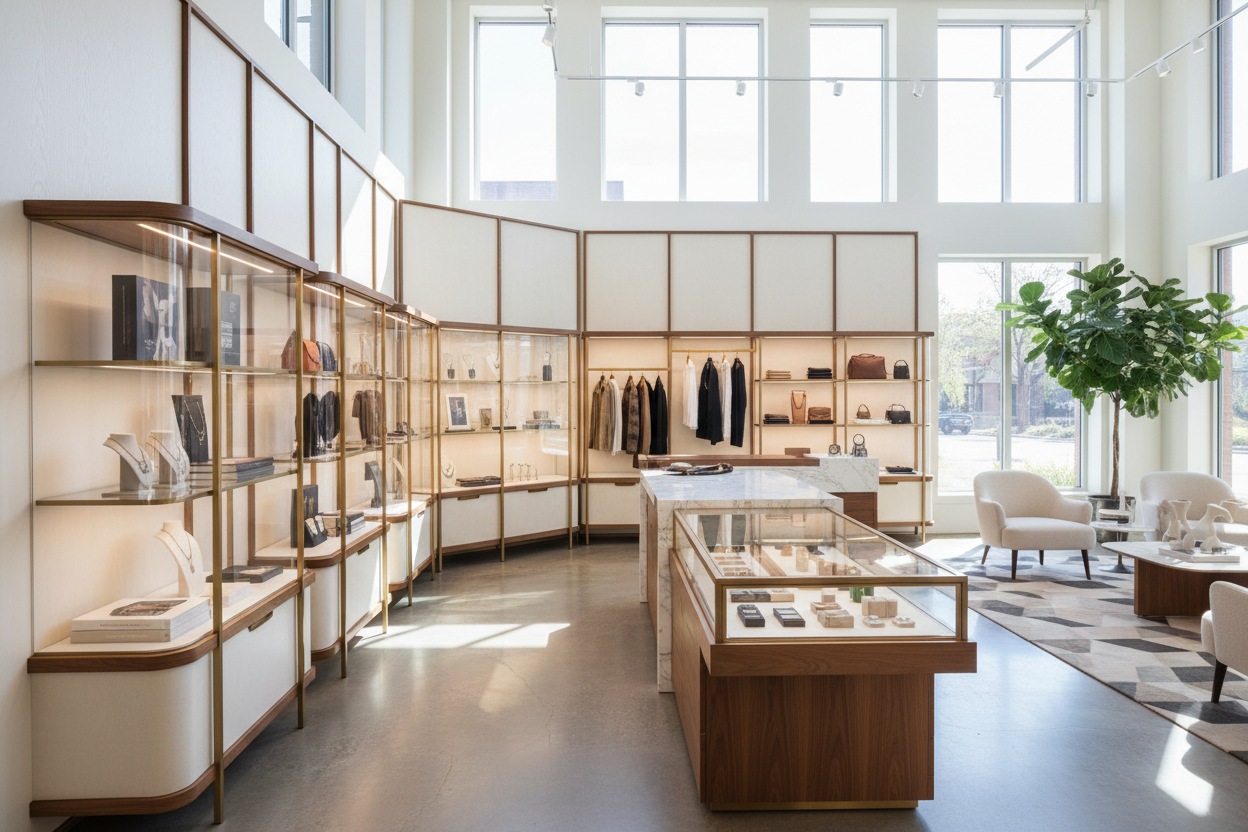
I remember walking into a client's boutique jewelry store for the first time. The owner had spent a fortune on beautiful pieces, but they were hidden in dark, scratched cases that made everything look dull. Customers would glance and walk right by. That's when I realized a display case for retail isn't just furniture—it's the stage for your products. After furnishing over 200 retail spaces, I've seen how the right case can triple engagement and how the wrong one can kill sales before a customer even touches the door.
Quick Takeaways
- Your display case is a silent salesperson—it creates the first impression and tells your brand story before you say a word.
- Never compromise on four features: security locks, high-clarity glass, durable framing (like powder-coated steel or solid hardwood), and adjustable interior components.
- Match the case to your merchandise. A 24-inch deep clothing display cabinet needs different shelving than a 12-inch deep jewelry glass display cabinet.
- Budget realistically. A custom glass counter for store might cost $3,000+ with a 6-week lead time, while a quality used retail showcase counter could be $800 installed next week.
- The most common mistake? Choosing aesthetics over function. That gorgeous antique-style locking retail display cabinet might look perfect but could have poor sightlines if the glass isn't low-iron for maximum clarity.
Why Your Display Case Is Your Silent Salesperson
Think about the last time you walked into a store. Before a salesperson greeted you, what did you see? The displays. In retail, you have about 3 seconds to capture attention. A well-designed retail cabinet display does more than hold items—it creates a micro-experience. I've tracked customer flow in stores, and products in a properly lit glass floor display case get 40% more dwell time than items on open shelves. The psychology is simple: enclosure suggests value and importance. It tells the customer, "This is special." But if the case is poorly designed—with fingerprints on the glass, dim lighting, or cluttered interiors—it whispers, "This is an afterthought." For deeper industry insights that sales reps might not emphasize, I always recommend reading about Display Cabinet For Store Design What Reps Wont Tell You.
The 4 Non-Negotiables Every Retailer Should Demand
When clients ask me what to look for, I tell them to start with these four essentials. First, security. For any retail display case counter with valuables, you need a reliable locking mechanism. I prefer integrated locks with recessed cylinders—they're harder to tamper with than surface-mounted ones. Second, visibility. This means two things: glass quality and lighting. Opt for tempered glass with low-iron content (often called "ultra-clear") to eliminate that greenish tint. For lighting, LED strips are my go-to. They run cool, last 50,000 hours, and provide even illumination without hotspots. A product like the 78 7 Wide Glass Door Display Case Curio Cabinet With Led Lights demonstrates this well with its integrated, energy-efficient lighting. Third, durability. In a commercial setting, your case will get bumped, leaned on, and cleaned daily. Look for frames made of 16-gauge steel or kiln-dried hardwood. Avoid MDF or particle board in high-traffic areas—they swell with moisture. Fourth, flexibility. Adjustable glass shelves (at least 3/8-inch thick) and removable interior components let you reconfigure for seasonal merchandise without buying new fixtures.
Matching Your Case to Your Merchandise (Not the Other Way Around)
I once saw a boutique try to display delicate silk scarves in a deep, multi-shelf retail glass showcase designed for handbags. The scarves looked lost. Your merchandise should dictate the case, not vice versa. For jewelry, you need shallow-depth cases (typically 12-18 inches) with velvet-lined trays and focused pin lighting to make stones sparkle. For clothing, like in a glass clothing display case, you need depth (24-30 inches) for hanging garments, plus sturdy bars rated for weight. For general retail, modular shop display cabinets that can be rearranged offer the most versatility. Don't forget about your space constraints either. For awkward corners, a Corner Display Case can turn dead space into a premium display area. Always measure your merchandise first, then add 4-6 inches of clearance inside the case for easy access and visual breathing room.
The Budget Reality: New vs. Used vs. Custom
Let's talk numbers, because this is where dreams meet reality. New retail showcases for sale from a reputable display case company offer warranties (look for at least 5 years on structural components) and the latest features, like touch-latch doors or programmable LED colors. Expect to pay $1,500 to $5,000 per unit. Used or store closing display cases for sale can be a steal—I've found quality glass checkout counters for 70% off retail. The catch? You inherit any wear, like scratched glass or worn locks, and delivery/installation is on you. Always inspect in person. Custom-built solutions are for when standard sizes won't fit. I had a client with a curved store front who needed a bespoke curved glass display case. It was stunning, but cost $8,000 and took 10 weeks. For most retailers, I recommend mixing: invest in one or two key new custom pieces for your focal points, and fill in with quality used or standard new units for the rest.
Where Most Retailers Go Wrong (And How to Avoid It)
The biggest mistake I see is prioritizing how a case looks over how it functions. That ornate, antique-style boutique display case might fit your aesthetic, but if the glass doors don't open past 90 degrees, your staff will struggle to arrange products. Another common error: underestimating maintenance. Glass doors on a commercial glass cabinet need daily cleaning with the right solution (ammonia-free to protect seals) to stay crystal clear. Ignoring customer flow is another pitfall. Placing a large store counter display case right inside the entrance creates a bottleneck. Leave a minimum 42-inch walkway around displays. Finally, scale. A massive 8-foot tall showroom display cabinet in a small boutique overwhelms the space. The principles of good display are universal, whether for home or business. For a refresher on the fundamentals, The Art Of Display Choosing The Perfect Glass Door Cabinet For Your Home offers great foundational insights.
Your Next Steps: From Research to Installation
Ready to choose? Start with a tape measure. Document your space's exact dimensions, including ceiling height, electrical outlet locations, and door widths for delivery. Create a realistic budget that includes the cases, delivery, installation (often $150-$300 per unit), and a 10% contingency. When identifying suppliers, ask for references and visit a showroom if possible. Check the warranty details—what exactly is covered and for how long? For installation, plan for it to take longer than you think. Installing and leveling a series of retail wall display cases in an existing store often takes a full day with a professional crew. A product like the 62 2 H Tall China Curio Cabinet White Display Case With Glass Doors is a good example of a versatile, well-proportioned unit that meets many of the criteria we've discussed. From order to grand re-opening, give yourself a 4-6 week timeline to do it right.
FAQ
Where is the best place to buy a glass display case? It depends. For new, standard sizes, specialized store fixture suppliers or reputable online display case companies offer the widest selection. For used, check local restaurant/retail auction houses or business liquidation sales. For custom, work with a local commercial cabinetmaker or a national fixture manufacturer that offers custom design services.
How much should I spend on a retail display counter? As a rule of thumb, allocate 10-15% of your total store build-out or renovation budget to all your display fixtures, including cases. A single quality glass display case counter can range from $800 for a basic 4-foot unit to over $3,000 for a large, feature-rich model with integrated lighting and security.
What's the ideal height for a showcase counter? For a standing customer interface, the counter surface should be between 42 and 45 inches high. This allows comfortable viewing without stooping. The interior display area itself often starts a few inches above that. For a seated sales interaction, like in many jewelry stores, the counter height is typically lower, around 36 inches.
Can I use residential display cabinets in my store? I don't recommend it. Residential cabinets aren't built for commercial durability—their finishes scratch easily, their hinges aren't rated for hundreds of openings per week, and they often lack proper security features. The cost difference is worth it for the longevity and professional function of a true commercial display cabinet.

Leave a comment
This site is protected by hCaptcha and the hCaptcha Privacy Policy and Terms of Service apply.