










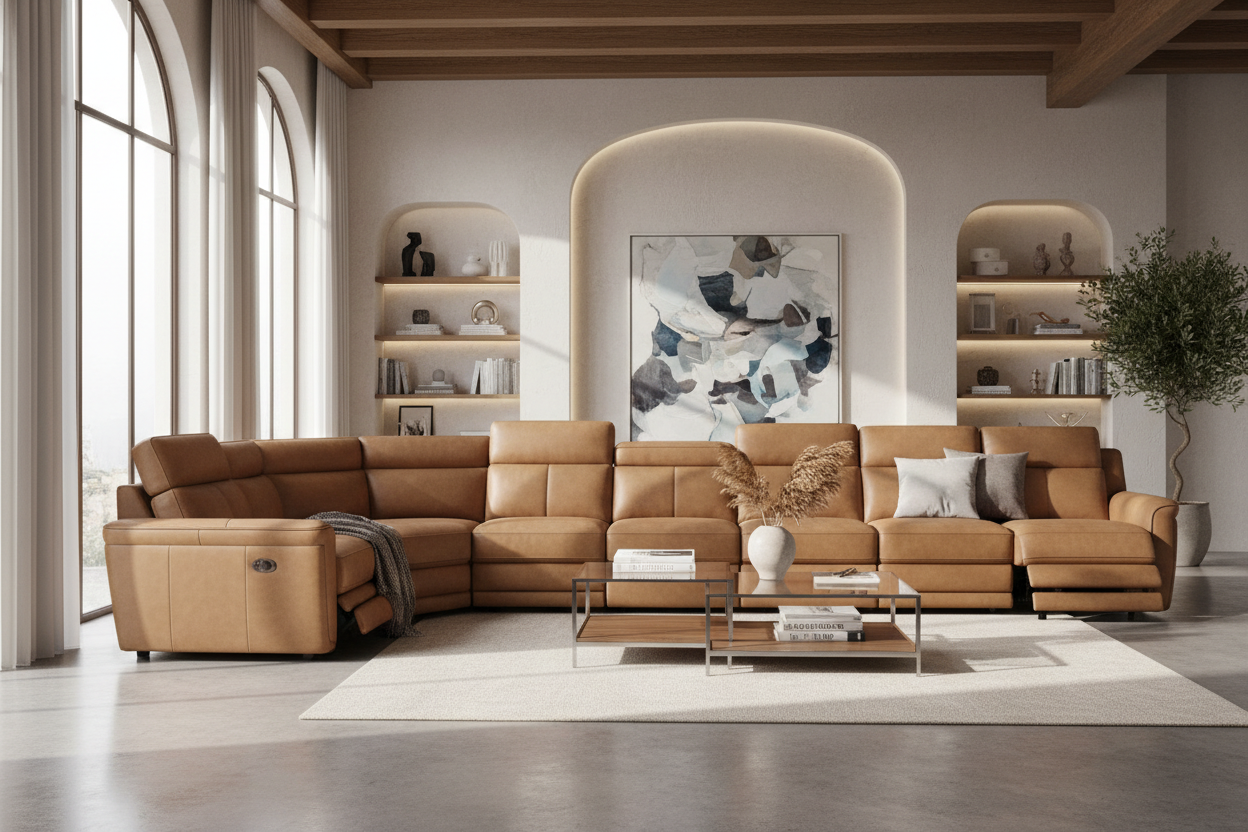
There is a specific tension I see in almost every living room consultation. One partner wants the sleek, architectural lines of a modern tuxedo sofa, while the other wants the cloud-like embrace of a recliner. For years, designers treated these as mutually exclusive. However, the modern leather reclining sectionals with chaise has bridged this gap, offering a compromise that doesn't sacrifice visual weight for comfort. But be warned: this is one of the most difficult pieces of furniture to buy correctly. Get the scale or the leather grade wrong, and your sophisticated living area can quickly start looking like a bulky basement cinema.
Key Features to Look For
- Leather Grade: Prioritize Top-Grain or Full-Grain for longevity; avoid "Bonded" leather which peels over time.
- Reclining Mechanism: Look for "Wall-hugger" designs if space is tight, allowing the sofa to be placed inches from a wall.
- Suspension System: Sinuous springs or 8-way hand-tied coils offer superior support compared to webbing.
- Chaise Orientation: Determine if you need a Left-Arm Facing (LAF) or Right-Arm Facing (RAF) chaise based on your room's traffic flow.
- Cushion Density: High-resiliency foam wrapped in down provides the best balance of structure and softness.
Decoding the Leather: Grain vs. Bonded
When shopping for a leather sectional recliner sofa set, the terminology can be intentionally misleading. As a specialist, I advise clients to ignore the price tag initially and look at the swatch. A cheap leather reclining sectional often uses "bonded leather"—a pulp made of shredded leather scraps glued together with polyurethane. It looks pristine in the showroom but will crack within two years of daily use.
For that buttery, luxurious feel, you want a soft leather sectional with recliner functionality made from aniline or semi-aniline top-grain hides. These materials breathe, adapt to your body temperature, and develop a rich patina over time rather than wearing out.
Mastering the Layout and Scale
The most common error homeowners make with a leather sectional couch with chaise and recliner is underestimating its footprint. A static sofa has fixed dimensions; a leather motion sectional sofa is a shapeshifter. You must measure the piece not just in its upright position, but fully extended.
The "Wrap Around" Effect
If you are considering a massive leather wrap around couch with recliners, ensure you have at least 36 inches of walking clearance around the perimeter. These pieces have substantial visual mass. To counteract this, I recommend choosing a model with legs that lift the frame off the floor. Seeing the floor underneath the sofa tricks the eye into perceiving the room as larger.
Integrating the Chaise
The chaise portion is usually static (non-reclining). Place the chaise side on the side of the room with the least traffic, or use it to define the boundary between the living area and the dining space. This creates a natural "wall" without blocking sightlines.
Ergonomics and The "Sit Test"
A soft leather reclining sectional should support your lumbar region without pushing your head forward. When testing these pieces, pay attention to the break between the seat and the footrest. In lower-quality designs, a gap appears here that can leave your legs unsupported. Look for a "chaise-style" footrest (continuous upholstery) for maximum comfort and a cleaner look.
Lessons from My Own Projects
I learned a hard lesson early in my career regarding a leather reclining sectional with chaise. I specified a gorgeous, Italian-tanned power recliner for a client's downtown loft. We measured the room perfectly, but we forgot one crucial detail: the power source.
We floated the sectional in the middle of the room, and suddenly, we had ugly black power cords snaking across a beautiful wool rug to the nearest wall outlet. We ended up having to install a floor outlet, which involved cutting into concrete—a costly mistake. Now, I always specify battery-pack upgrades for floating layouts. Furthermore, I've noticed that on lower-end models, the leather makes a distinct "rubbing" noise against itself when the recliner moves. It’s a small auditory detail, but in a quiet evening setting, it drives some clients crazy. Always listen to the furniture before you buy it.
Conclusion
Investing in a sectional that combines a chaise lounge with reclining capabilities is a commitment to comfort. By focusing on top-grain leather, accurate scale, and hidden power sources, you can secure a piece that anchors your home with elegance rather than bulk. Choose wisely, and you’ll have the best seat in the house for decades.
Frequently Asked Questions
Can I find a durable but cheap leather reclining sectional?
True leather is expensive due to the tanning process. If a price seems too good to be true, it is likely vinyl or bonded leather. If budget is a constraint, look for "leather match" options where the seating areas are real leather, and the back/sides are high-quality vinyl.
How do I style a leather wrap around couch with recliners?
Because these sofas are heavy and masculine, balance them with softer textures. Use a high-pile Moroccan rug, linen throw pillows, and round coffee tables to break up the rectangular lines and soften the leather's sheen.
What is the difference between a motion sofa and a standard recliner?
A leather motion sectional sofa usually features a more streamlined look where the reclining mechanism is hidden internally, often with power headrests, whereas traditional recliners may have visible levers and bulkier silhouettes.



Leave a comment
This site is protected by hCaptcha and the hCaptcha Privacy Policy and Terms of Service apply.