










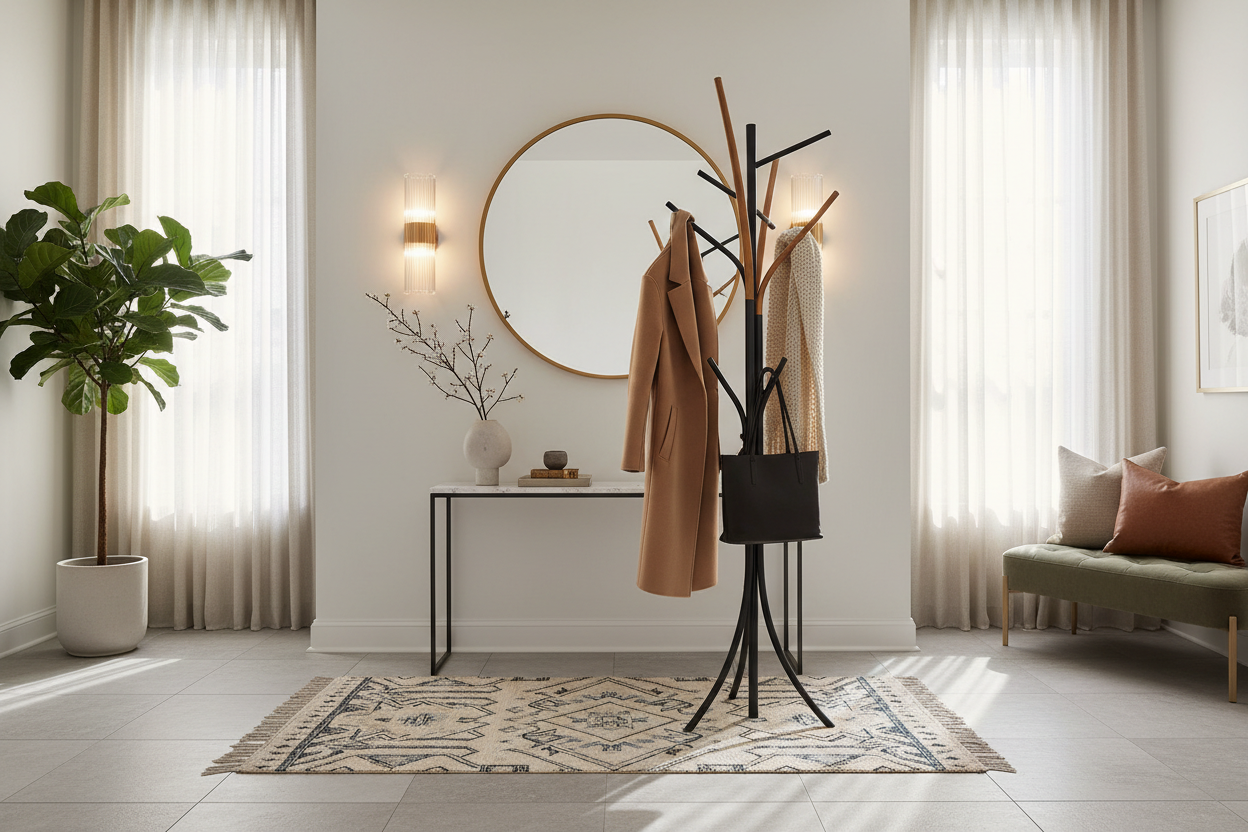
The foyer is the handshake of the home; it sets the tone before a guest even steps into the living room. Yet, it is often the most neglected space, cluttered with shoes and jackets. As a designer, I see clients struggle to balance the utility of a "drop zone" with the aesthetics of a curated entrance. The solution often lies in selecting the correct coat hanger for entryway organization—a piece that must be as sculptural as it is functional.
Key Features to Look For
- Scale and Proportion: Ensure the piece doesn't obstruct the traffic flow; aim for at least 36 inches of clearance in a hallway.
- Base Stability: For freestanding units, a weighted base is non-negotiable to prevent tipping under the weight of heavy winter coats.
- Material Integrity: Solid wood (oak, walnut) or powder-coated steel offers longevity over particle board or hollow aluminum.
- Hook Ergonomics: Look for wide or rounded hooks to prevent permanent creases or structural damage to garment shoulders.
- Integrated Storage: Evaluate if you need a simple rail or a multi-functional unit with shelving and shoe cubbies.
Defining the Spatial Layout
Before falling in love with a specific design, we must address the architecture of your space. A coat rack in entryway layouts serves as a visual anchor, but its form must follow the room's footprint.
The Narrow Hallway Dilemma
In urban apartments or older homes, you are often dealing with a narrow entryway coat rack requirement. Here, floor space is premium currency. Avoid bulky coat trees for entryway use that protrude into the walking path. Instead, opt for an entryway wall mounted coat rack with storage. By elevating the storage, you keep the floor clear, creating an illusion of width. A sleek hallway wall coat rack with retractable hooks is a favorite specification of mine for tight corridors; when not in use, it becomes a piece of wall art rather than an obstruction.
The Grand Foyer
If you have the luxury of space, a freestanding coat stand for hallway use can act as a centerpiece. A substantial hall coat stand made of turned wood or brass commands attention and fills vertical voids. In these scenarios, I often pair a coat rack stand with a separate umbrella holder or a small console table to create a complete vignette.
Materiality and Visual Weight
The material of your entryway clothes hanger dictates the mood. For a Scandi-Japandi fusion, a light oak or ash wood entryway coat rack brings warmth without visual heaviness. If your home leans industrial or modern, a matte black metal entryway garment rack offers clean lines and durability.
Be wary of cheap veneers. High-traffic areas like the front door coat rack zone take a beating. Damp raincoats, heavy wool, and metal zippers will scratch inferior finishes quickly. Solid materials develop a patina; veneers just peel.
Maximizing Function: Storage Hybrids
The modern home demands multitasking furniture. An entryway coat rack with shelf is essential for households that need a landing pad for keys and mail. For families, I almost exclusively recommend an entryway coat rack with storage benches. This allows for a "sit and remove" workflow for shoes, keeping the entry hall coat rack area pristine.
If you lack a mudroom, an entryway coat cabinet or a comprehensive hall coat rack with storage system can simulate that utility. Look for units that combine a hat rack, lower shoe shelves, and mid-height hooks to accommodate various garment lengths.
My Personal Take on coat hanger for entryway
I learned a hard lesson early in my career regarding coat trees for entryway styling. I specified a stunning, sculptural mid-century modern coat stand for a client in a windy city. It looked architectural and beautiful when empty. However, I failed to account for the "dinner party test."
During their first gathering, guests piled heavy wool trench coats onto one side of the rack. The center of gravity shifted, and the whole thing toppled over, chipping the floor tile. Since then, I physically test the "wobble factor" of every hallway coat stand I buy. If I can't hang a heavy bag on a single hook without the base lifting, I won't put it in a client's home. Furthermore, I now prioritize entryway wall coat hanger installations for families with young children—it eliminates the tipping hazard entirely and keeps the floor clear for the inevitable pile of backpacks.
Conclusion
Whether you choose a minimalist coat rack by front door or a robust hallway storage and coat rack system, remember that this piece is the gatekeeper of your home's organization. Invest in stability, choose materials that age gracefully, and ensure the scale respects your architecture. A well-chosen rack doesn't just hold coats; it holds the design of your entrance together.
Frequently Asked Questions
How high should a wall-mounted coat rack be installed?
Standard ergonomic height is roughly 60 inches (5 feet) from the floor. This accommodates long coats without them touching the ground while remaining accessible for most adults. If designing for children, consider a secondary row of hooks at 36-48 inches.
Can a freestanding coat rack work in a small foyer?
It can, provided you choose a vertical design with a heavy but compact base. Look for a "pencil" style coat stand hallway unit that utilizes vertical height rather than horizontal spread. However, if the width is under 4 feet, wall-mounted is usually superior.
What is the best material for a humid climate?
If you live in a rainy area, avoid untreated woods or MDF, which can swell with moisture exposure. Powder-coated steel, brass, or sealed teak are excellent choices for a front entrance coat rack facing the elements.


Leave a comment
This site is protected by hCaptcha and the hCaptcha Privacy Policy and Terms of Service apply.