










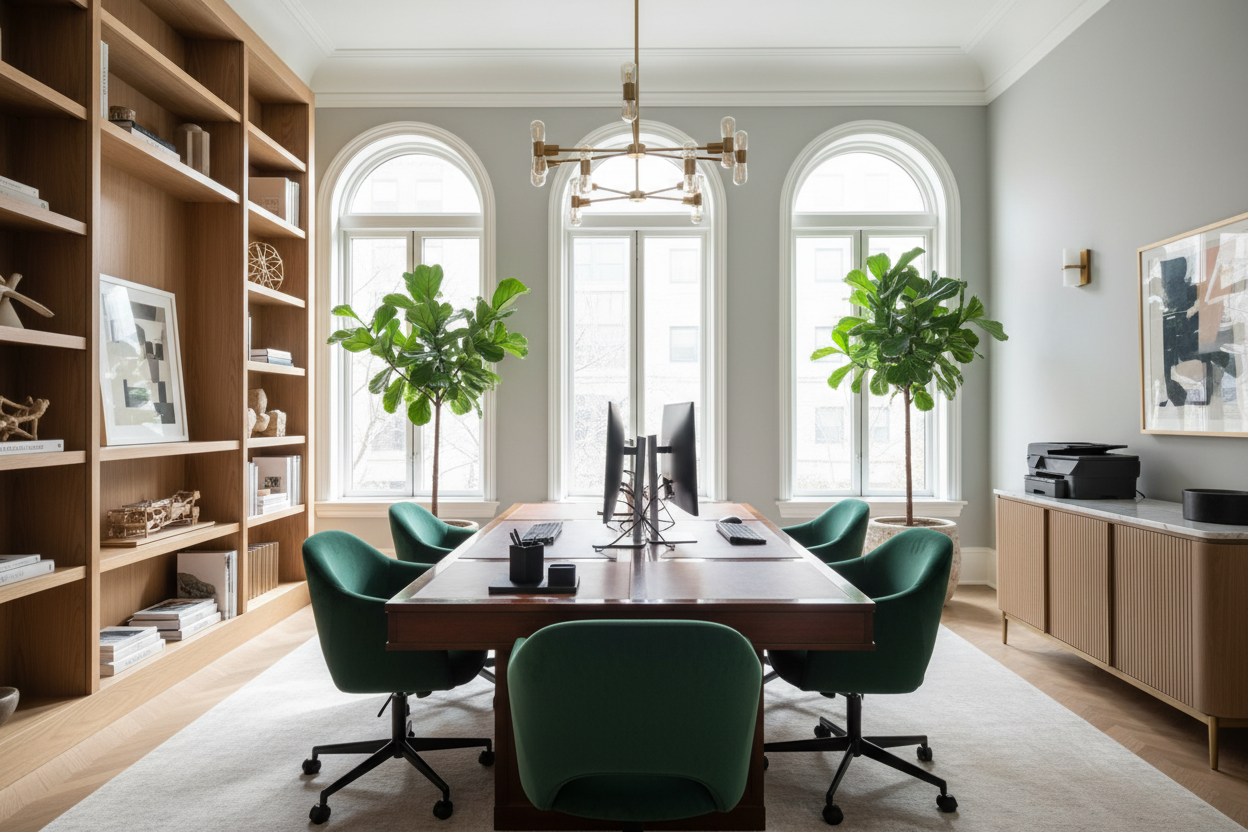
For decades, the standard North American floor plan dictated a dedicated space for hosting holiday dinners, leaving us to squeeze our daily workstations into cramped guest bedrooms. If you are staring at a massive mahogany table that only collects mail and laundry, it is time to rethink your square footage. Executing a formal dining room into office conversion is one of the most practical layout shifts you can make, but doing it right requires more than just swapping a dining table for a desk.
In this guide, we will cover the spatial planning, lighting adjustments, and acoustic tricks required to make this transition feel intentional, rather than like a temporary pandemic-era setup.
Quick Decision Guide: The WFH Conversion
- Assess the sightlines: If your space is visible from the front door, prioritize closed storage to hide cable clutter and paperwork.
- Address the acoustics: Dining rooms are notorious for hard surfaces; you will need heavy drapery and plush rugs to absorb conference call echoes.
- Rethink the lighting: That low-hanging chandelier needs to be swapped for a semi-flush mount or layered with dedicated task lighting.
- Define the boundary: Use visual weight—like a large area rug or an open bookcase—to separate the workspace from adjacent living areas.
Navigating the Open-Concept Dilemma
How to convert open dining room to office
Many modern suburban homes feature dining areas that bleed directly into the living room or kitchen. When you want to convert open dining room to office spaces, the biggest hurdle is establishing a psychological boundary. You do not want to feel like you are working in the middle of a hallway.
Start by grounding the new workspace with a substantial area rug. Leave at least 36 inches of clearance between the edge of your desk and any high-traffic walkways. To create a physical barrier without blocking natural light, consider flanking the desk with open-backed étagères or a low console table. This adds necessary storage while maintaining the airy proportion of the original room.
Making It Look Intentional, Not Temporary
Choosing the Right Furniture Silhouette
The fastest way to ruin your home's aesthetic is by dropping a sterile, commercial-grade cubicle desk into a residential living space. When turning your dining room into an office, focus on furniture that bridges the gap between residential warmth and ergonomic utility.
Opt for a desk with a warm wood veneer or a solid walnut finish rather than cold metal and melamine. If you need a secondary work surface, a credenza designed for dining rooms can easily double as a stylish printer stand and file cabinet. Pair your desk with an upholstered office chair that complements your living room seating—think performance velvet or supple leather in a tone that ties the two spaces together.
Designer's Honest Take: Lessons from My Own Projects
Over the last few years, I have seen every variation of a formal dining room turned into office space. In my own 1920s Craftsman, I made the switch because the dining room had the best natural light in the house. Visually, it was stunning. Practically, it was an acoustic disaster.
I learned the hard way that a beautiful, minimalist room with hardwood floors and plaster walls will amplify every keystroke and video call until it rings through the entire house. I ended up having to retroactively add thick, lined linen drapery and a heavy wool rug just to dampen the sound. Also, be warned: if your office is the first thing guests see when they walk in, you will be forced to keep your desk impeccably clean. A messy pile of tax documents quickly becomes the focal point of your entire home.
Frequently Asked Questions
How to convert dining room into office without losing resale value?
Do not make permanent structural changes like walling off an open-concept space or removing a chandelier junction box. Keep the modifications cosmetic—use freestanding bookshelves, temporary wallpaper, and modular desks so the next buyer can easily visualize it as a dining room again.
What should I do with the dining room chandelier?
Dining room fixtures are typically hung 30 to 36 inches above a table, which is too low for an open office layout and will likely obstruct your view or hit your head. Swap it out for a stylish semi-flush mount, or if you keep the desk directly under it, ensure the fixture is raised to at least seven feet above the floor.
How do I hide my computer monitors in an open space?
If you hate the look of dual monitors looming in your living area, position the desk so the monitors face a wall rather than the center of the room. Alternatively, invest in a secretary desk or an armoire-style workstation that allows you to literally close the doors on your workday when evening hits.

Leave a comment
This site is protected by hCaptcha and the hCaptcha Privacy Policy and Terms of Service apply.