










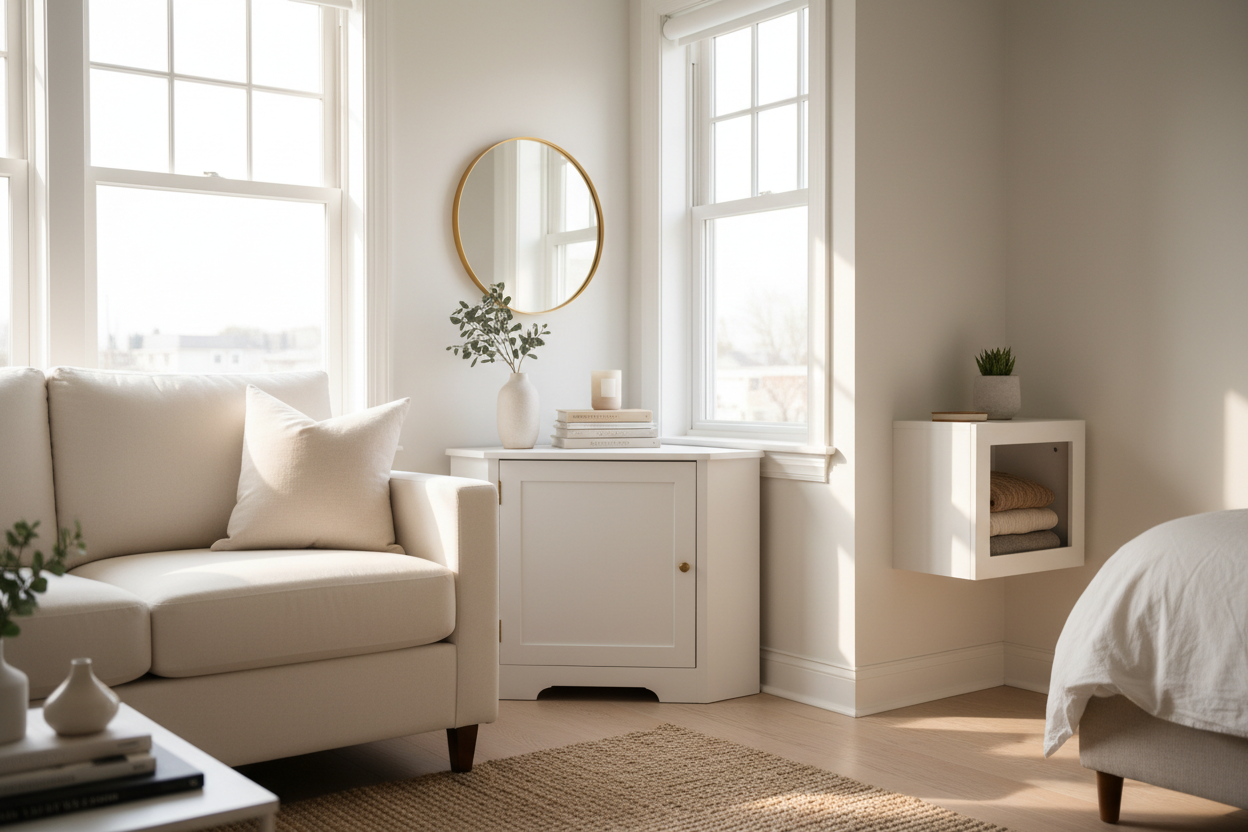
I spent three years dodging the sharp corner of a massive, espresso-stained media console that felt like a dark hole in my 400-square-foot studio. It was 'high quality' solid oak, but it swallowed every bit of natural light from my one window. Eventually, I realized that a small white cabinet for living room corners wasn't just a storage choice—it was a survival tactic for my sanity.
- Dark, bulky furniture absorbs light; white reflects it to make rooms feel larger.
- Standard cabinet depth is often overkill—12 to 15 inches is the sweet spot for narrow walkways.
- Closed storage is always superior to open shelving for hiding visual clutter.
- Versatile pieces can transition from the entryway to the bedroom as your needs change.
The 'Heavy Furniture' Trap in Small Spaces
We have all been there. You find a 'statement piece' at a flea market or a big-box store and think, 'This is the one.' But in a 12x14 room, that heavy mahogany sideboard acts like a black hole. It physically and visually crowds the floor, making you feel like you are living in a storage unit rather than a home.
The mistake is thinking that more 'substantial' furniture equals better quality. In reality, oversized furniture in a small space just creates friction. You end up shimmying past your coffee table or bruising your hip on a console that has no business being that deep. It shrinks your square footage before you even put a single book on the shelf.
Why a small white cabinet for living room use is the ultimate fix
Switching to a lighter palette changes the vibe instantly. A white finish acts like a mirror for whatever sunlight you actually get, bouncing it back into the room rather than soaking it up. When I started looking for the perfect small cabinet for your living room, I prioritized footprint over raw volume.
You do not need a 60-inch beast to hold a router, some extra candles, and your board game collection. A compact cabinet forces you to ruthlessly edit your belongings. If it does not fit in the designated 30 inches of width, do you really need it in your primary living space? Probably not. I found that by shrinking my storage, I actually stopped hoarding mail and random tech cables I haven't used since 2018.
I personally tested a cheap particle board unit first and regretted it within a month. The 'white' was more of a dingy grey and the doors never hung straight. If you are going small, go for something with a bit of weight—kiln-dried wood or high-grade MDF with a solid lacquer finish. It makes the 'small' choice feel like a design decision, not a budget compromise.
From Sofa to Sleep: Moving a small white cabinet for bedroom use
The beauty of these pieces is their second life. If I move to a place with a massive living room next year, this cabinet does not become trash. It easily transitions into a small white cabinet for bedroom storage. The height is usually much better than a standard nightstand for modern, thick mattresses.
Specifically, a boho white storage cabinet with 2 drawers works wonders next to a bed. It provides enough surface area for a proper lamp and a carafe of water, while the drawers hide the 'ugly' stuff like sleep masks and charging cables. Most nightstands are too low and have zero storage; a small cabinet fixes both problems in one go.
How to style it so it feels intentional, not temporary
To keep a white cabinet from looking like a dorm room leftover, you have to lean into textures. Skip the flat, shiny laminate. Look for fluted doors, cane inserts, or even just swapping out the generic silver knobs for some heavy unlacquered brass hardware. It is a ten-dollar upgrade that makes a hundred-dollar cabinet look like a custom build.
I am a huge fan of using a 2 door accent cabinet storage solution because it gives you a clean exterior to play with. On top, I usually stack two oversized art books and place a small ceramic lamp on top of them to add height. This draws the eye upward, making your ceilings feel taller while the white base of the cabinet disappears into the wall.
The verdict: Less square footage, more breathing room
At the end of the day, your home should breathe. Swapping out one 'big' piece for a smaller, brighter alternative changed how I felt the moment I walked through the door. It is about editing your life down to what actually fits your current reality, not what you wish you had space for.
Don't be afraid to go small. When you stop fighting the dimensions of your room and start working with them, the whole space opens up. You get your floor space back, you get your light back, and most importantly, you get your peace of mind back.
Is white furniture a nightmare to keep clean?
Not if you choose the right finish. Avoid porous, matte paints that soak up oils. A semi-gloss or a lacquered surface wipes down in seconds with a damp microfiber cloth. Keep a magic eraser handy for those weird scuffs that happen during vacuuming.
What is the ideal depth for a small living room cabinet?
Aim for 12 to 14 inches. Most 'standard' sideboards are 18 inches deep, which might not sound like a big difference, but those extra 4 inches are the difference between a clear walkway and a cramped obstacle course.
Can I put a TV on top of a small accent cabinet?
Check the weight rating first. Most of these smaller units are rated for 40-60 lbs. If you have a modern 50-inch LED, it usually weighs under 30 lbs, so you are fine. Just make sure the base of the TV stand doesn't overhang the edges of the cabinet.


Leave a comment
This site is protected by hCaptcha and the hCaptcha Privacy Policy and Terms of Service apply.