










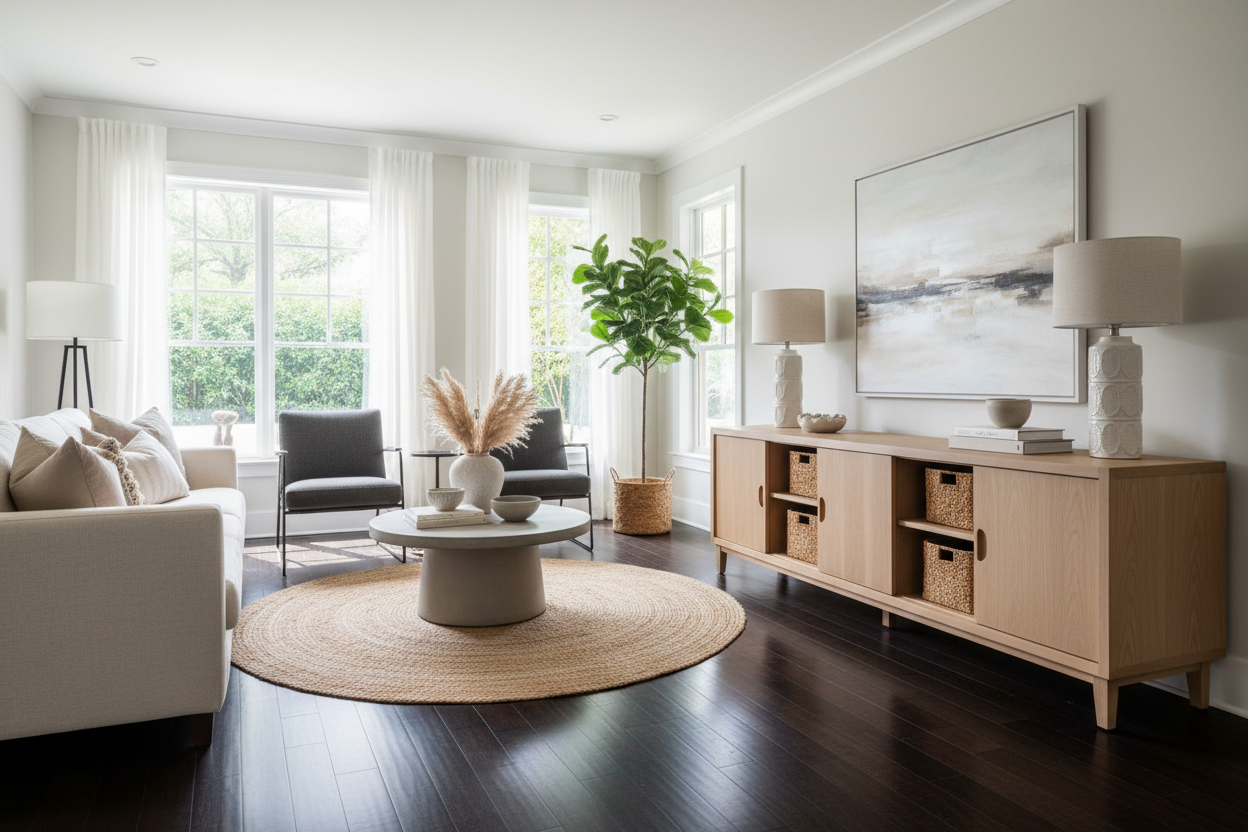
I remember staring at my living room at 1 AM, surrounded by 47 open tabs of furniture I couldn't commit to. My floors are a deep, moody espresso—beautiful, but they eat light for breakfast. I desperately wanted a light wood storage cabinet to break up the gloom, but I was terrified it would look like a random piece of driftwood washed up on a dark beach.
- Contrast is a design tool, not a mistake.
- Use textiles like jute or wool to bridge the color gap.
- Match your hardware to other dark elements in the room.
- Place light pieces near natural light sources to maximize the airy feel.
The 'Floating Island' Problem (And How to Fix It)
The biggest fear people have is that a pale piece of furniture will look like it was dropped into the room by accident. If you have dark floors and you plop a light oak cabinet right in the middle of a wall, it can look unanchored. It lacks a visual 'why.'
To choose the perfect wood storage cabinet, you have to think about anchoring. You aren't just buying a box for your stuff; you're creating a focal point. If the piece feels like it's floating, it’s usually because the scale is off or there’s no transition between the light wood and the dark floor. A heavy piece with a solid base feels more grounded than something on thin, spindly legs when the contrast is this high.
Embrace the Contrast, Don't Fight It
Trying to match wood tones perfectly is a losing game. I’ve seen people spend weeks trying to find a 'medium' wood that sits somewhere between their light walls and dark floors, and it almost always ends up looking muddy. Instead, lean into the drama. A pale ash or white oak piece acts as a much-needed breath of fresh air against dark walnut floors or navy walls.
I recently saw a light wood finish dresser used in a bedroom with charcoal floors. The modern linear design and the bright finish actually made the room feel larger. It stops the 'black hole' effect that happens when every piece of furniture is as dark as the flooring. You want that pop of brightness to catch the eye.
Bridging the Gap With Textiles
If the jump from dark floor to light wood still feels too jarring, textiles are your best friend. A simple cream-colored jute rug or a light gray runner can act as a buffer. It provides a middle ground for the eye to rest on before it hits the cabinet.
I’m a big fan of using woven baskets on the bottom shelf of a cabinet if it has an open base. A seagrass or rattan basket pulls some of those lighter tones down to the floor level. It makes the transition feel intentional rather than accidental. It’s about creating a gradient of color rather than a hard line.
Hardware is the Secret Handshake
Hardware is the easiest way to make a piece of furniture feel like it belongs in the family. If your light wood cabinet has silver or gold pulls, but your door handles and light fixtures are matte black, the cabinet will feel like an outsider. Swapping the hardware to matte black immediately ties it to the darker elements in the room.
Think about the rest of the space. Maybe you have black cabinets with glass doors in the kitchen or a dark metal bookshelf in the corner. By using black hardware on your light wood piece, you’re creating a 'secret handshake' between the items. It tells the viewer that these pieces were chosen to work together, even if their wood species are different.
Where to Place It So It Makes Sense
Placement is everything. If you tuck a light cabinet into a dark, windowless corner, it’s going to look like a ghost. Put it where the light actually hits. Near a window, the grain of the light wood really shines, and the contrast with the dark floor feels natural—like sunlight hitting a forest floor.
I often suggest a modern solid wood sideboard for dining rooms with heavy, dark tables. By keeping the sideboard light and airy, you prevent the room from feeling like a Victorian library. Flank it with a couple of tall green plants. The green against the light wood and dark floor creates a balanced, organic palette that feels cohesive.
My Design Mistake
I once bought a 72-inch white oak sideboard for my dining room, which has dark espresso hardwood. I didn't use a rug. For two weeks, it looked like a giant tooth sitting in the middle of the room. I hated it. I almost returned it, but then I layered a textured, off-white wool rug underneath. Suddenly, the oak didn't look 'bright'—it looked 'warm.' The rug was the missing link that made the contrast look like a choice rather than a mistake.
FAQ
Can I mix more than two wood tones?
Yes, but keep a 'hero' tone. Usually, your floor is the hero. You can have your dark floors, your light cabinet, and maybe one medium-toned accent like a leather chair or a picture frame. Any more than three and the room starts to feel like a lumber yard.
Should the wood grain match?
Not necessarily. In fact, if the grains are too similar but the colors are different, it can look 'almost right,' which is worse than being totally different. I prefer a tight grain on the light wood if the dark floor has a lot of movement.
Do I need a rug under the cabinet?
You don't need one, but it's the easiest way to make high-contrast furniture work. If you skip the rug, make sure you have other light elements in the room—like light curtains or art—to balance the weight.

Leave a comment
This site is protected by hCaptcha and the hCaptcha Privacy Policy and Terms of Service apply.