










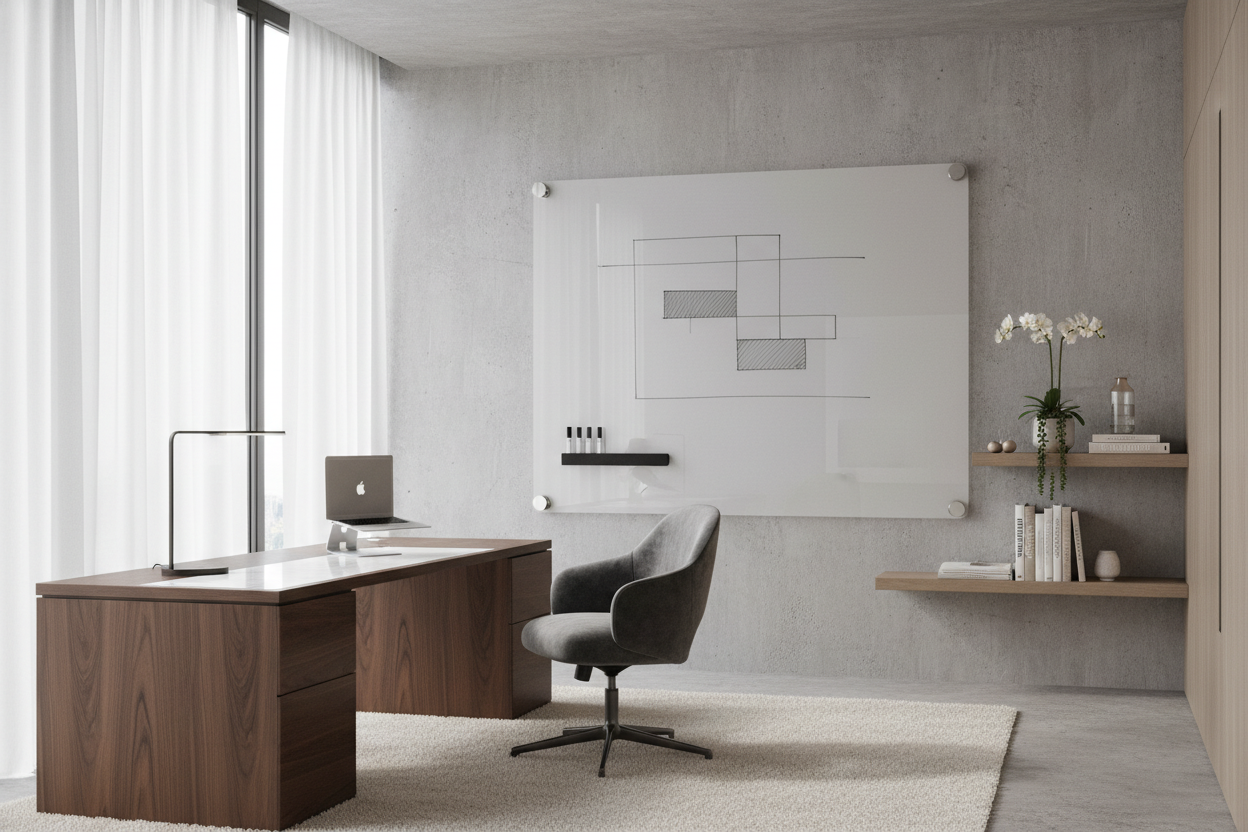
We often face a rigid dichotomy in design: the functional versus the beautiful. Nowhere is this more apparent than when trying to integrate productivity tools into a curated living space. You need a space to brainstorm, but you certainly don't want your study to feel like a sterile corporate cubicle. The solution lies in selecting the right modern home office whiteboard—a piece that serves as a canvas for your ideas while complementing your interior architecture rather than disrupting it.
Key Features to Look For
- Surface Material: Opt for tempered glass over melamine to eliminate "ghosting" and elevate the aesthetic.
- Mounting Hardware: Look for brushed metal stand-offs or invisible floating mounts for a clean, architectural silhouette.
- Opacity & Color: Consider frosted or back-painted glass to match your wall color, reducing visual clutter.
- Magnetic Capability: Ensure the board is backed with steel if you plan to pin documents (requires rare-earth magnets).
Elevating Materiality: Beyond Basic Melamine
As a designer, I advise clients to treat a whiteboard not as stationery, but as a fixture—similar to how you would treat a light fitting or hardware. The standard melamine boards found in supply closets yellow over time and stain easily. For a truly modern office whiteboard aesthetic, tempered glass is the industry standard for luxury interiors.
Glass offers a non-porous surface that cleans perfectly every time, maintaining a pristine look even after heavy use. From a visual standpoint, the translucency of glass (or the gloss of back-painted glass) interacts with ambient light, making the object feel lighter and less imposing than a solid white plastic rectangle.
Space Planning and Visual Weight
The Rule of Proportions
A common error is undersizing the board, which makes it look like an afterthought. If you have a large expanse of wall, a small board floats awkwardly in the negative space. Aim for a board that aligns with the width of your desk or creates a deliberate vertical column. If the room allows, a floor-to-ceiling installation can act as a stunning architectural feature rather than just a tool.
Lighting Considerations
Placement is critical regarding lighting. A glossy surface reflects light. Avoid placing your board directly opposite a south-facing window or directly under a harsh downlight. Instead, position it where it receives soft, diffuse side lighting. This ensures your writing is legible without the blinding glare that causes eye strain during long work sessions.
Integrating with Your Color Palette
The stark white of a traditional board can be jarring in a moody, dark-toned office or a warm, wood-heavy library. Modern manufacturing allows for customizable options. A black glass board using neon or chalk markers can look incredibly chic in a masculine, industrial space. Alternatively, a 'greige' or soft taupe back-painted board can blend seamlessly into a neutral wall, effectively disappearing when not in use.
My Personal Take on Modern Home Office Whiteboards
I learned a hard lesson about glass whiteboards during a project for a tech executive's loft in Tribeca. We specified a massive, beautiful floating glass board. It looked stunning—until we tried to use it.
Here is the unpolished truth that product descriptions rarely tell you: standard refrigerator magnets do not work on glass magnetic boards. The glass thickness creates too much distance between the magnet and the steel backing. We had a presentation ready, and the papers slid right to the floor. I had to rush order "rare earth" (neodymium) magnets immediately. Furthermore, regarding installation: if your drywall isn't perfectly plumb (and it rarely is), invisible mounts can be a nightmare to align. I now always recommend using stainless steel stand-offs; they are forgiving of uneven walls and add a nice industrial jewelry touch to the piece.
Conclusion
Your workspace should inspire you, not remind you of a classroom. By choosing high-quality materials, considering the scale, and integrating the piece into your existing lighting scheme, a whiteboard becomes more than a utility—it becomes an asset to your design. Treat your workspace with the same curatorial eye you apply to your living room.
Frequently Asked Questions
What is the best way to clean a glass whiteboard to prevent streaks?
Unlike porous melamine, glass doesn't hold ink. However, to keep that high-gloss shine, skip standard board sprays. A simple solution of water and vinegar, or a high-quality glass cleaner used with a microfiber cloth, will leave the surface streak-free and dust-resistant.
Can I install a heavy glass whiteboard on drywall?
Yes, but you cannot rely on drywall anchors alone for larger sizes. Because glass is significantly heavier than acrylic or wood, you must anchor at least two of the mounting points into wall studs. If stud placement doesn't align, use toggle bolts rated for heavy loads, but proceed with caution.
How high should I mount my whiteboard?
Ergonomics dictate that the center of the board should be at eye level when you are in your primary working position. If you stand to brainstorm, mount it higher (center at roughly 60-65 inches from the floor). If you usually write while seated, lower it so the top third is at eye level.

Leave a comment
This site is protected by hCaptcha and the hCaptcha Privacy Policy and Terms of Service apply.