










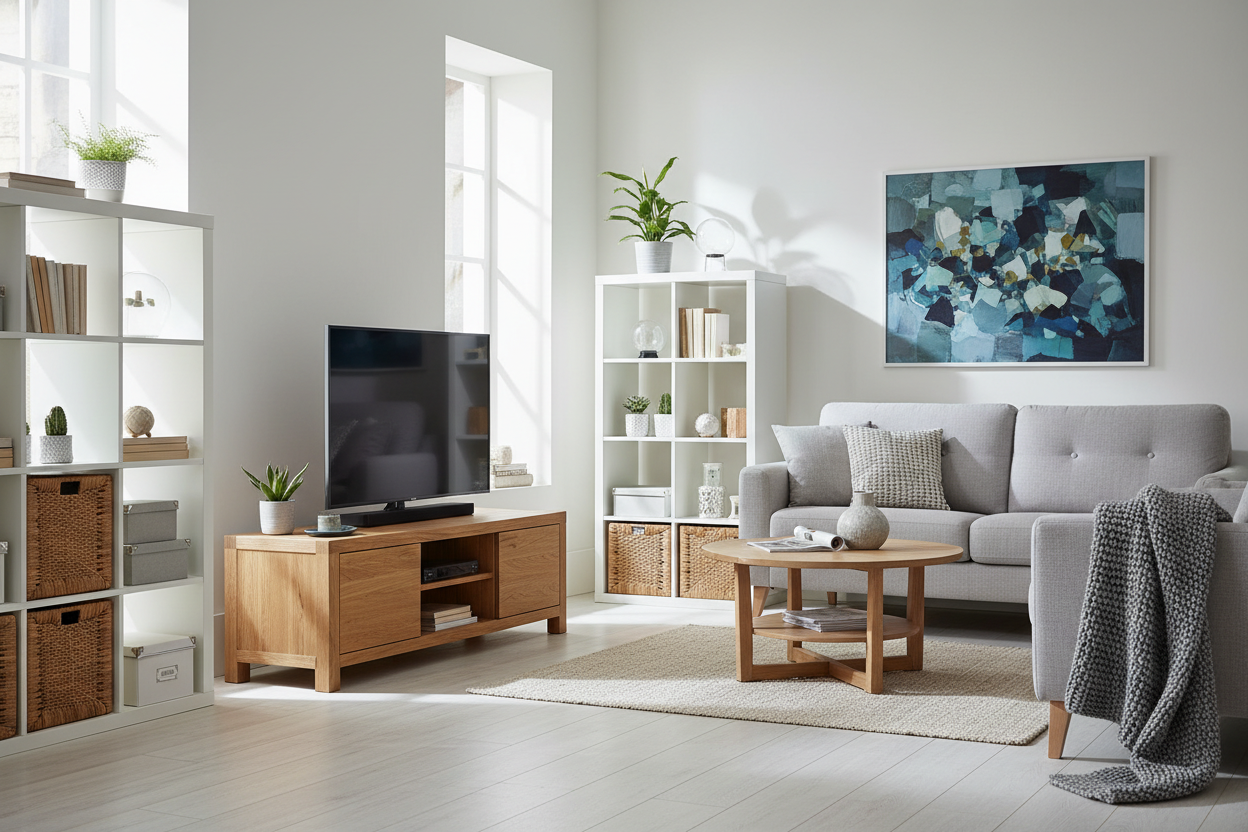
I remember staring at my living room three years ago. It was a sea of white laminate and hex-key-tightened screws. It looked fine, I guess, but it felt like a dorm room for someone with a 401(k). I finally bit the bullet and bought a solid wood television stand, and the vibe shift was instant. It was the first piece of furniture I owned that didn't feel like it would dissolve if I spilled a glass of water.
- One 'anchor' piece of real timber can make your cheap flat-pack furniture look like a deliberate design choice.
- Solid wood handles the weight of modern 65-inch-plus TVs without the dreaded 'particle board sag.'
- Never try to match faux-wood laminate to real wood; go for high contrast instead.
- A heavy media unit provides enough visual gravity to ground a room full of spindly, lightweight pieces.
The 'Anchor Piece' Theory for Budget Living Rooms
You do not need to replace every piece of furniture you own just because you graduated from your twenties. The secret to a 'grown-up' apartment is the anchor piece. This is one heavy, high-quality focal point that signals you actually care about your space. When you have a solid wood tv bench sitting in the center of the room, people stop noticing that the bookshelves next to it cost forty dollars.
Instead of trying to buy a massive, matching modern 3 piece entertainment center that might overwhelm a small rental, I stuck with one standalone unit. It creates a 'moment' in the room. The natural imperfections in the grain draw the eye, acting as a distraction from the perfectly smooth, somewhat soulless surfaces of the surrounding laminate. It’s about balance, not a total overhaul.
Why the TV Wall is the Best Place to Splurge
If you are going to spend money on one thing, make it the media center. Why? Because your electronics are heavy and expensive. I have seen too many friends place a heavy OLED on a flimsy shelf and watch it slowly bow in the middle like a sad smile. When you shop for tv stands, you are shopping for a foundation. Solid wood media consoles don't just look better; they are structurally superior.
A hardwood tv console or a set of solid wood tv consoles can handle the heat from a gaming console and the weight of a soundbar without vibration. I once had a cheap wood tv console table that rattled every time the bass kicked in during a movie. Switching to a real hardwood tv stand silenced that immediately. It feels permanent. It feels safe. It doesn't wobble when the cat decides to use it as a launching pad.
How to Make Real Timber Look Natural Next to Laminate
The biggest fear people have is that a real wood entertainment stand will make their IKEA stuff look even cheaper. It can, but only if you do it wrong. The goal is to make the mix look intentional. You want your wood media centers to feel like an heirloom that just happens to be hanging out with some modern utility pieces. Use textures to bridge the gap—a ceramic vase or a stack of linen-bound books can soften the transition between real wood and manufactured surfaces.
Please, Do Not Try to Color-Match
This is the golden rule. If you have 'oak effect' laminate shelves, do not buy solid wood tv cabinets in a similar oak finish. You will fail. The 'wood-look' print usually has a weird grey or pink undertone that looks sickly next to the warm, vibrating tones of real timber. Instead, go for high contrast. If your furniture is white, get a dark walnut entertainment unit solid wood. If your furniture is black, go for a light, honey-colored tv units solid wood. Contrast looks like a choice; 'almost matching' looks like a mistake.
Balance the Visual Weight
Solid wood is visually 'heavy.' If you put a massive, chunky real wood entertainment stand next to a spindly metal chair, the room will feel lopsided. You need to distribute that weight. I used a thick, high-pile rug and a large potted fiddle-leaf fig to balance out the density of my new console. In a previous apartment, I swapped my solid console for a wood tv cabinet with glass doors just to see if the transparency helped with the 'bulk' in a tiny room. It did, but I eventually went back to the solid doors because I'm too messy to keep my cables organized.
The Verdict: Was the Dreaded Moving Day Worth It?
Let’s be real: moving a solid wood television cabinet is a workout. When mine arrived, the delivery guy and I both questioned our life choices as we lugged it up three flights of stairs. It weighed 140 pounds, whereas my old flat-pack unit weighed about as much as a medium-sized pizza. My back hurt for two days. I had a minor existential crisis about whether I was 'too old' for heavy furniture.
But then I sat down, turned on the TV, and looked at it. The way the light hit the grain made the whole room feel warmer. It didn't feel like a temporary apartment anymore; it felt like a home. The durability alone makes it worth the sweat. I know this piece will still be in one piece ten years from now, which is more than I can say for the hex-key bookshelves. If you're on the fence, buy the heavy stuff. Your future self (and your living room's ego) will thank you.
FAQ
Is solid wood better than MDF for a TV stand?
Yes, absolutely. MDF (medium-density fiberboard) is fine for light use, but it sags over time under the weight of a large TV. Solid wood handles the load without warping and can be sanded and refinished if it gets scratched.
How do I know if a TV stand is actually solid wood?
Check the weight and the underside. Real wood will be significantly heavier. Look for end grain on the edges; if the grain pattern wraps perfectly around a 90-degree corner without a break, it is likely a veneer or a print, not a solid plank.
Does solid wood require a lot of maintenance?
Not really. Just keep it out of direct, scorching sunlight to prevent cracking and give it a wipe with a damp cloth. Avoid harsh chemical sprays; a simple wood-safe cleaner or a bit of beeswax once a year is plenty to keep it looking fresh.


Leave a comment
This site is protected by hCaptcha and the hCaptcha Privacy Policy and Terms of Service apply.