










I spent six months staring at a pair of 'mid-century modern' end tables that had legs thinner than my morning espresso. They looked great in the catalog, but in my actual living room, they were basically just expensive coasters for a growing pile of mail, three half-dead remotes, and a tangle of USB-C cables. Every time I looked at them, my blood pressure spiked. My sofa-side situation was a disaster zone, and no amount of 'curated' coffee table books could hide the mess.
I finally hit a breaking point when I knocked a full glass of water over because the spindly table wobbled when my dog walked past. That was the day I realized I didn't need a table; I needed a side cabinet with drawers. I needed a piece of furniture with enough gravity to stay put and enough storage to swallow my digital life whole when I was done working from the couch.
Quick Takeaways
- Standard end tables are just horizontal surfaces for clutter to accumulate.
- Drawers are non-negotiable if you use your living room as a part-time office.
- A heavier cabinet provides visual grounding that spindly tables lack.
- Measurement is everything: aim for a height that is 1-2 inches below your sofa arm.
The 'Aesthetic' End Table Trap (And Why I Fell For It)
We’ve all been there. You see a photo of a minimalist living room with a single, elegant pedestal table holding nothing but a ceramic vase and a sprig of eucalyptus. It looks peaceful. It looks like a life without 16-inch MacBooks and half-eaten bags of pretzels. I fell for it hard. I bought two 'Scandi-chic' tables that were essentially just circles of MDF on toothpicks. They were beautiful for about twenty minutes.
The reality of living with minimalist furniture when you aren't a minimalist is that the furniture becomes a pedestal for your junk. Within a week, my beautiful tables were buried under charging bricks, a collection of pens that didn't work, and a stack of magazines I was never going to read. Because there was no 'away,' everything stayed 'out.' The visual noise was exhausting. Minimalist furniture assumes you have a hidden closet nearby for all the things you actually use. I don't. I have an 800-square-foot apartment where every square inch has to work for its rent.
These tables were also top-heavy. If I put a heavy lamp on one side, it felt like it was going to tip. If I accidentally bumped it with my knee, the whole thing shuddered. It felt temporary, like dorm furniture for adults. I realized that 'light and airy' is often just code for 'flimsy and impractical' when it comes to high-traffic seating areas.
Enter the Side Cabinet: Form, Meet Serious Function
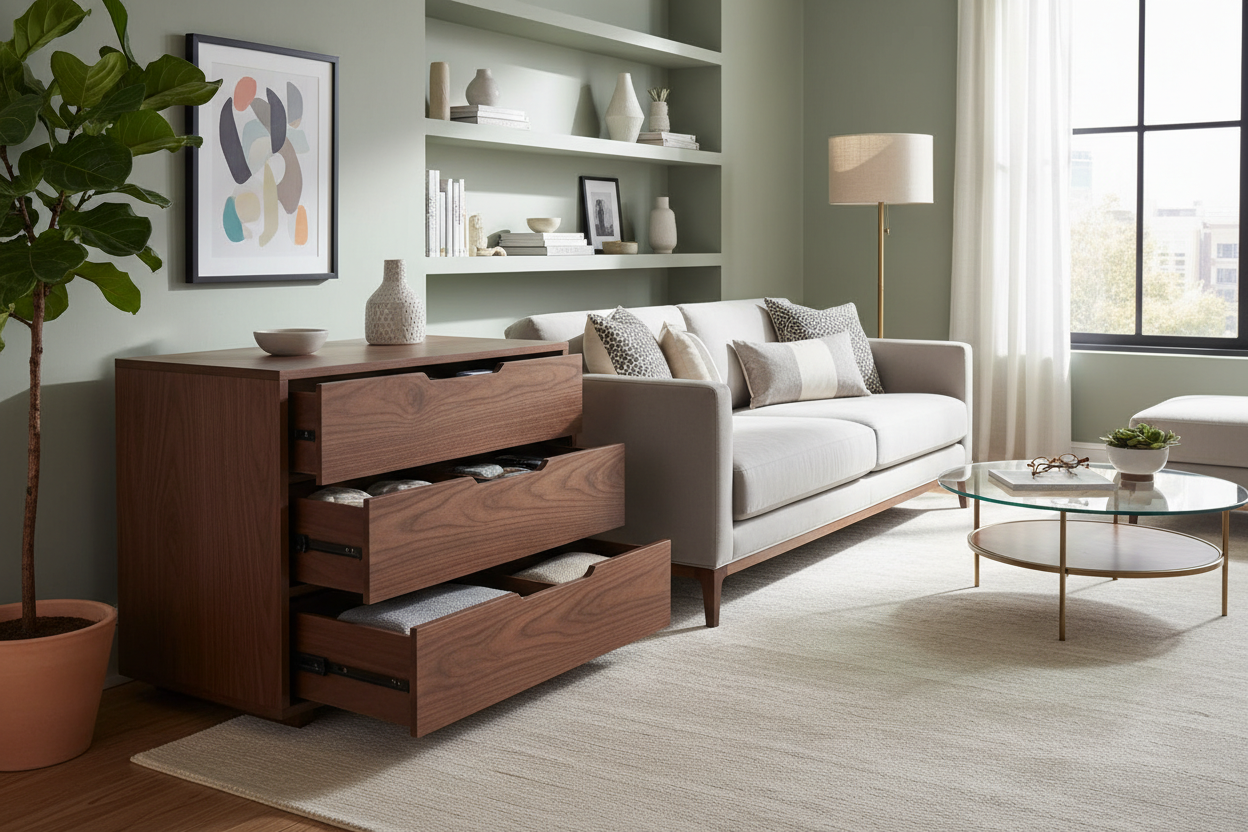
The moment I swapped the flimsy table for a substantial cabinet, the energy of the room shifted. It felt anchored. Instead of a floating circle of mess, I had a solid piece of furniture that looked like it belonged there. I stopped looking for something that just held a drink and started looking for something that solved a problem. I eventually landed on a black double file cabinet with side drawers that completely changed my workflow. It sounds industrial, but in a matte finish next to a charcoal sofa, it looks incredibly sharp.
Having actual concealed compartments meant I could finally categorize my chaos. The top surface stayed clear for my coffee and a lamp, while the interior held the things I actually need within arm's reach. It’s about the mental relief of closing a drawer. When 5:00 PM hits, my laptop goes into the cabinet, the drawer shuts, and my 'office' disappears. You can't do that with a tripod table.
The weight of a cabinet also matters for the 'feel' of a room. In design, we talk about visual weight. If everything in your room has thin legs—your sofa, your chairs, your tables—the room starts to look like it’s floating away. A solid side cabinet provides a base. It makes the seating area feel like a destination rather than a collection of sticks. I opted for a piece with a mix of drawer sizes, which is key for organizing everything from tiny SD cards to bulky planners.
How Side Cabinet Drawers Finally Hid My Cord Chaos
Let's talk about the 'cord nest.' You know the one—that tangled pile of white and black cables that lives behind your sofa and collects dust bunnies like it's getting paid for it. When I had open end tables, that nest was on full display. It was the first thing I saw when I walked into the room. It made a $2,000 sofa look like a bargain-bin find.
The beauty of side cabinet drawers is that they act as a staging area for power. I actually ran a small power strip into the back of my cabinet (a little DIY drilling goes a long way). Now, my phone and tablet charge inside the drawer. No cables trailing across the floor, no 'laptop brick' taking up space on the rug. It’s a literal sanity saver. I use the shallow top drawer for frequently used items like my Kindle and glasses, and the deeper bottom drawers for the heavy-duty tech stuff. The room feels five times cleaner just because the wires are gone.
How to Style a Bulkier Piece Next to Your Sofa
The biggest fear people have with cabinets is that they’ll look too 'heavy' or 'office-y' next to a plush sofa. The trick is all in the styling and the finish. You want to avoid the 'filing cabinet in a cubicle' look by choosing pieces with interesting textures or hardware. When you choose the perfect cabinet with drawers, look for wood grains that complement your flooring or matte metal finishes that match your floor lamps.
To keep the cabinet from feeling like a giant block of wood, use the 'rule of three' on top. A tall lamp provides height, a small tray corrals your daily items (keys, watch), and a plant or a stack of two books adds a soft edge. The tray is important—it defines a specific 'landing zone' so the rest of the surface stays open. If you have a dark cabinet, go with a lighter-colored lamp to create contrast.
Also, don't be afraid to leave some breathing room. You don't need to shove the cabinet flush against the sofa arm. Leaving two or three inches of space makes the arrangement feel intentional rather than cramped. If the cabinet has feet (even short ones), it will feel lighter than a piece that sits directly on the floor. That small gap of light underneath is a classic designer trick to make heavy furniture feel less imposing.
Finding the Right Proportions for Seating Areas
Scale is where most people trip up. I’ve seen people put massive, 30-inch tall nightstands next to a low-slung Italian sofa, and it looks like the furniture is trying to eat the person sitting there. Your cabinet should be roughly level with the arm of your sofa. If your sofa is a low-profile model with a 24-inch arm, try a short cabinet with drawers instead of a standard chest. If it’s too high, you’ll be reaching 'up' for your drink, which is a recipe for spills.
Depth is the other killer. Most standard sofas are 35 to 40 inches deep. If you buy a cabinet that is only 12 inches deep, it’s going to look dinky and lost. Aim for something in the 18 to 24-inch depth range. This ensures the cabinet has enough presence to hold its own against the bulk of the sofa. I measured my sofa arm length before I bought my cabinet, and it made a world of difference in how the room flows.
Finally, consider the 'swing' or 'pull' of the drawers. If you have a coffee table close by, make sure you actually have room to stand and pull the drawers out fully. There’s nothing more annoying than a drawer that hits the edge of your rug or hits your coffee table every time you try to grab a charger.
FAQ
Is a side cabinet too heavy for a small living room?
Actually, one solid cabinet often looks better than three small, spindly pieces. It reduces visual 'clutter' by providing one clean silhouette instead of a forest of table legs. Just make sure it has some sort of feet to let light pass underneath.
What material is best for high-use cabinets?
If you're putting drinks on it, go for a sealed wood or a powder-coated metal. Avoid cheap laminate that bubbles the second a drop of water touches it. I always use a coaster, but a durable finish is your best insurance policy.
How many drawers do I really need?
Two is the minimum—one for 'active' stuff (remotes, phone) and one for 'deep storage' (cords, manuals). Three is the sweet spot if you plan on using it to store your laptop or work supplies.

Leave a comment
This site is protected by hCaptcha and the hCaptcha Privacy Policy and Terms of Service apply.