










I remember walking into a client's new open-concept home last year. They'd just moved from a traditional house with a formal dining room to a loft-style space. In the middle of their living area sat a beautiful, inherited living room china cabinet, looking completely lost. 'It feels like a dining room misfit,' they told me. I've seen this exact scenario play out in dozens of homes I've furnished. That piece you love—whether it's an heirloom or something you found—doesn't have to feel awkward in your living room. With the right approach, it can become the most intentional, functional element in your space.
Quick Takeaways
- Think of your china cabinet as versatile storage, not just for fine china—books, media, barware, and collectibles all work beautifully.
- Scale is everything: measure your room and leave at least 36 inches of walkway clearance around the piece.
- Placement can define spaces: use it as a room divider in open plans or to anchor a seating area.
- Styling should feel personal and curated, not like a museum display—mix everyday items with special pieces.
Why a China Cabinet in the Living Room? (It's Not as Weird as You Think)
When I started designing homes fifteen years ago, most clients had separate dining rooms where china cabinets lived. Today, with open-plan living dominating North American homes, that formal dining space often disappears. But people still own beautiful dishes, glassware, and collections they want to display. That's where the living room comes in.
I encourage clients to rethink what a china hutch in living room spaces can hold. One of my favorite projects involved using a cabinet to store board games, art books, and a cocktail station—complete with glassware and a small bar cart tucked inside. The key is intentionality. When you approach styling living room storage cabinets with purpose, they become functional art rather than awkward furniture.
From personal experience: I once tried to force a massive 84-inch traditional hutch into a 12x14 living room. It overwhelmed the space completely. The lesson? Just because you have the piece doesn't mean it belongs in that particular room. Sometimes the best solution is choosing a smaller cabinet specifically for your living area's proportions.
Choosing the Right Cabinet: Scale, Style, and Sight Lines
Let's talk practicalities. When selecting a cabinet, I always start with measurements. For a standard 12x16 living room, I'd recommend something no wider than 60 inches and no taller than 72 inches—this maintains good sight lines and doesn't block natural light from windows. Leave at least 18 inches between the top of the cabinet and your ceiling to prevent a cramped feeling.
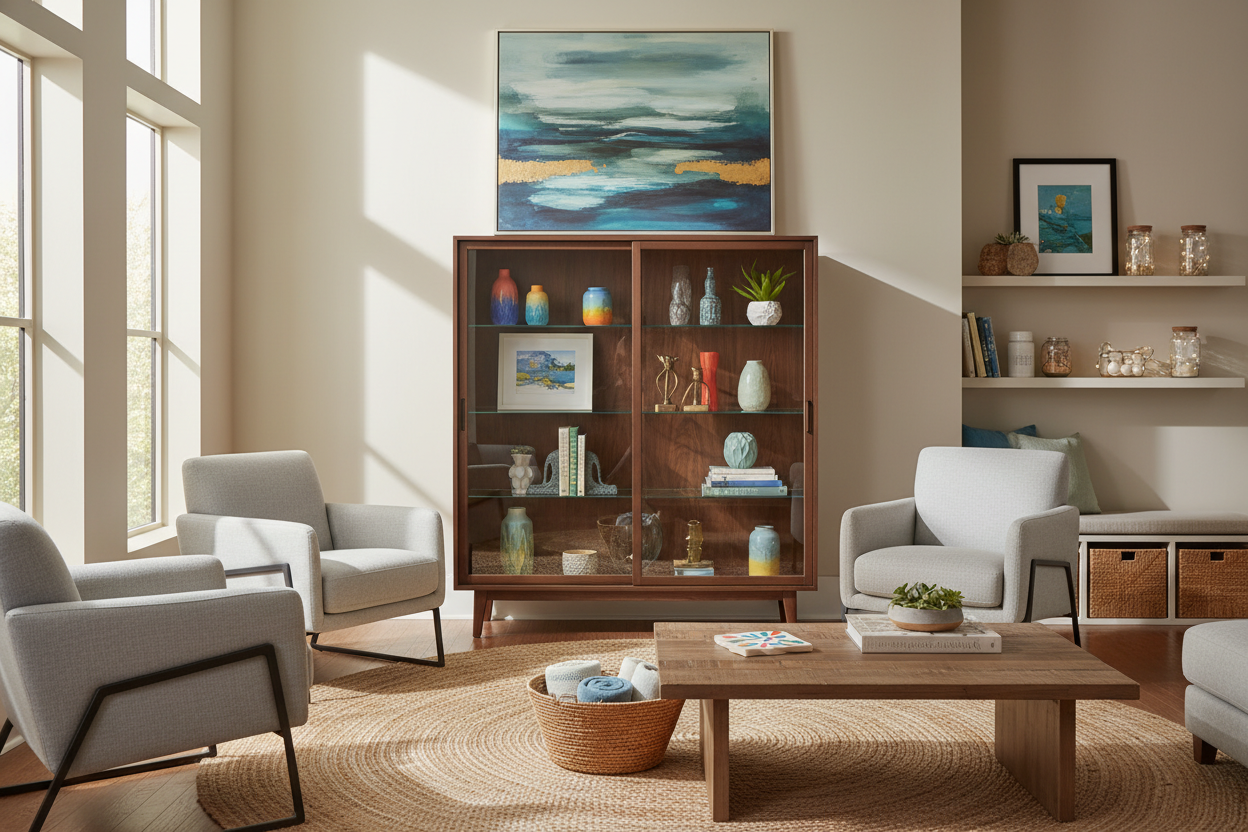
Material matters too. Solid wood cabinets with kiln-dried frames (like oak or maple) offer durability but can feel heavy visually. For a more airy look, consider a glass-door display cabinet that lets you see through to the wall behind. I recently used one in a client's mid-century modern living room, and it became the perfect spot for their vintage pottery collection without feeling imposing.
If your space is compact, don't force a large piece. I've had great success with choosing small cabinets around 36 inches wide for apartments and smaller homes. The trick is to go taller rather than wider—a narrow, vertical cabinet can provide ample storage without eating up floor space.
The Perfect Placement: Beyond the Dining Room Wall
Where you put your cabinet changes everything. In open-plan spaces, I often use them as subtle room dividers. Position one perpendicular to a sofa to create separation between living and dining areas without building a wall. Just make sure to leave that crucial 36-inch walkway on at least one side.
Another favorite placement: flanking a fireplace. Two matching cabinets on either side of a mantel create symmetry and balance. In a recent project with a stone fireplace, we used two 48-inch cabinets with glass doors to display the client's blue glass collection. The reflection from the firelight made the entire wall come alive at night.
For blank walls, consider creating a focal point by centering the cabinet and adding artwork above it. I typically hang art so the bottom of the frame sits 6-8 inches above the cabinet top—this creates visual connection without crowding.
Styling Your Hutch: From Heirlooms to Everyday Life
This is where personality shines. Start by emptying the cabinet completely. Then layer from back to front: place taller items (books, vases) toward the back, medium items in the middle, and smaller pieces up front. I recommend varying heights by at least 3 inches between adjacent items to create visual interest.
Mix materials intentionally. Combine glassware with ceramic pieces, add some wood elements, and include a few metallic accents. For lighting, LED strip lights installed inside the cabinet create beautiful ambiance, especially for evening entertaining. If internal lighting isn't possible, a small table lamp placed on top works wonderfully.
Remember that not everything needs to be displayed. Use the lower enclosed sections for less-attractive items. A versatile solid wood sideboard with drawers can handle board games, extra blankets, or media equipment while the upper glass shelves showcase your favorite pieces.
Making It Work: Real Solutions for Common Hangups
What if you inherited a formal piece that feels too stuffy? I faced this with my grandmother's Victorian china cabinet. The solution was surprisingly simple: I painted the interior a deep navy blue, replaced the ornate hardware with simple brass pulls, and filled it with a mix of modern ceramics and a few of her original pieces. The contrast made it feel fresh rather than dated.
For balancing with modern furniture, focus on clean lines. If your cabinet has curved details, pair it with a sofa that has straight, simple lines. The contrast actually makes both pieces more interesting. To avoid clutter, follow the 'one-third empty' rule: leave about one-third of each shelf visually open. This gives items room to breathe.
Light flow concerns are real. If your cabinet blocks a window, consider one with glass doors and sides. Or position it so it's perpendicular to the window rather than directly in front. Sometimes simply moving a piece 18 inches to the left can completely change how light moves through a room.
FAQ
Can a china cabinet work in a small living room?
Absolutely. Choose a narrow, vertical cabinet (around 24-30 inches wide) and place it against the longest wall. Use mirrors on adjacent walls to reflect light and create the illusion of more space.
How do I style inherited china that doesn't match my decor?
Group by color rather than pattern. Mix your grandmother's floral plates with solid-colored modern dishes in coordinating hues. The color connection creates harmony even when styles differ.
What if my cabinet feels too tall for the room?
Remove the top molding if possible, or paint the upper portion the same color as your ceiling. This visually 'shortens' the piece. Adding a substantial item on top (like a large basket or sculpture) can also break up the vertical line.
How often should I change the display?
Seasonally works well for most people. Rotate pieces with the seasons—lighter colors and glass in spring/summer, richer tones and ceramics in fall/winter. It keeps the display feeling fresh without being a constant chore.
Remember, the goal isn't perfection—it's creating a space that feels authentically yours. Your living room with china cabinet should tell your story, not someone else's. For more ideas that might work in your home, browse our living room collection to see how different pieces can come together.

Leave a comment
This site is protected by hCaptcha and the hCaptcha Privacy Policy and Terms of Service apply.